The Ultimate Guide to Answer Engine Optimization and Selecting the Right AEO Checker for Your Brand

The digital landscape is undergoing a fundamental transformation as traditional search engine result pages (SERPs) are increasingly supplanted by AI-driven responses. As users migrate toward ChatGPT, Perplexity, and Google’s AI Overviews (AIO) to receive synthesized, conversational answers, the conventional model of "clicking a link" is rapidly fading. This shift necessitates a new strategic framework known as Answer Engine Optimization (AEO). AEO focuses on ensuring that a brand is not only visible but also explicitly cited or mentioned within the text of an AI-generated response, effectively securing "zero-click" authority.
The Evolution of Search: From Blue Links to AI Synthesis
For two decades, Search Engine Optimization (SEO) was defined by the pursuit of top-ten rankings on Google. The objective was clear: secure a high-ranking position, capture the click, and drive traffic to a landing page. However, the launch of Google’s AI Overviews in May 2024 served as a watershed moment in digital history. By placing summarized AI content above traditional organic links, Google signaled that the intent of the searcher was shifting from discovery to resolution.
![AEO checker tools that measure answer engine visibility [2026]](https://53.fs1.hubspotusercontent-na1.net/hubfs/53/aeo-checker-1-20260903-3858273.webp)
This transition follows a clear timeline of development. In 2023, the emergence of Large Language Models (LLMs) like OpenAI’s ChatGPT and Perplexity began changing how users query information. Instead of browsing a list of websites, users began asking nuanced, complex questions. By mid-2024, the mainstream integration of these features into major search engines rendered the traditional "ten blue links" format secondary. Today, if a brand does not exist within the context of an AI-synthesized answer, it is effectively invisible to a growing demographic of high-intent searchers.
The Core Components of Answer Engine Optimization
AEO operates on the premise that AI models are not just "crawling" the web; they are digesting it to build a knowledge base. Consequently, optimization is no longer just about keywords and backlinks—it is about "entity clarity" and "citation authority."
An AEO strategy requires a technical foundation. AI engines prioritize content that is:
![AEO checker tools that measure answer engine visibility [2026]](https://no-cache.hubspot.com/cta/default/53/9dd5e54b-fbef-4dd0-bc44-1689feb1ea18.png)
- Structurally Parsable: Using clear H2/H3 headers, schema markup, and bulleted lists that allow AI to extract information cleanly.
- Factually Authoritative: Providing verifiable primary sources that the AI can treat as "ground truth."
- Directly Responsive: Answering the "who, what, where, and why" of a user’s query within the first 100 words of a document.
While SEO provides the crawlability and domain authority signals that build the baseline for trust, AEO focuses on the specific "answer snippets" that AI models select to satisfy a user’s query.
Why Manual Checking Is No Longer Sustainable
In the early days of generative AI, marketing teams could manually test queries by opening an incognito browser window and recording the results. However, modern AI engines are highly dynamic. Results vary based on geography, user history, and the underlying model update cycle.
A single manual check provides only a fleeting snapshot. To gain a comprehensive understanding of a brand’s digital footprint, teams must move toward continuous monitoring. Automated AEO checkers offer this by logging visibility across thousands of keywords, identifying "citation gaps"—instances where a competitor is cited for a query that the brand is well-positioned to answer.
![AEO checker tools that measure answer engine visibility [2026]](https://53.fs1.hubspotusercontent-na1.net/hubfs/53/aeo-checker-2-20260903-852936.webp)
Analyzing the AEO Tool Landscape
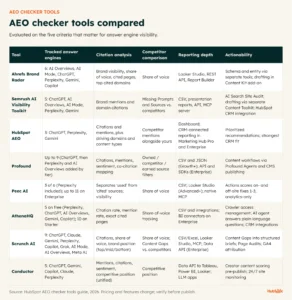
The software market has responded to this need with a variety of specialized tools, each tackling different aspects of the AI visibility challenge.
1. Tools for AI Overviews (AIO) Tracking
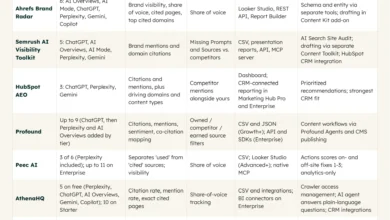
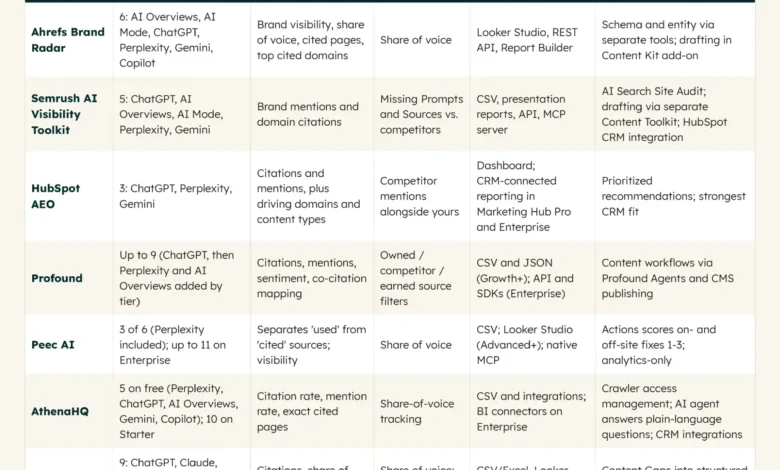
Platforms like Ahrefs (Brand Radar) and Semrush (AI Visibility Toolkit) have adapted their existing SEO infrastructure to monitor Google’s AIO features. These tools are essential for brands that rely heavily on organic search traffic. They allow teams to identify which of their high-ranking keywords are currently triggering AI summaries, enabling a pivot from standard SEO content to AI-optimized long-form answers.
2. Specialized Citation Detection
Tools like HubSpot AEO and Profound focus specifically on the "citation" element of the answer. These platforms distinguish between a "mention" (where a brand is named) and a "citation" (where the engine provides a clickable link to the brand’s domain). This distinction is vital; a mention builds brand awareness, but a citation drives the high-value traffic that signals to the AI that the content is a trusted source.
![AEO checker tools that measure answer engine visibility [2026]](https://53.fs1.hubspotusercontent-na1.net/hubfs/53/aeo-checker-3-20260903-8904553.webp)
3. Perplexity-Specific Analytics
Perplexity has become a favorite among professional researchers and power users. Because Perplexity is built entirely on a citation-first model, tools like Peec AI and AthenaHQ have emerged to provide granular reporting on how the engine sources its data. These tools are increasingly necessary for B2B brands whose buyers prioritize technical accuracy and deep-dive reporting.
Quantitative Metrics: How to Measure Success
Measuring AEO success requires a shift in key performance indicators (KPIs). Traditional metrics like "organic sessions" or "page rank" are insufficient. Instead, digital marketing teams should track:
- Citation Share: The percentage of queries in your category where your brand is cited as a source.
- Brand Mention Frequency: How often your brand is included in the synthesized text of an answer, even when a direct link is not present.
- Competitive Citation Gap: The frequency with which a competitor is cited for queries that align with your core product offerings.
- AI-Referral Revenue: Using CRM integration to track the specific conversions that originated from an AI engine interaction.
The Strategic Shift: Integrating Measurement and Action
The most significant challenge for modern marketing teams is the disconnect between "diagnosis" and "execution." Many AEO tools provide data on why a brand is missing from a citation but do not facilitate the content creation required to fix the issue.
![AEO checker tools that measure answer engine visibility [2026]](https://53.fs1.hubspotusercontent-na1.net/hubfs/53/aeo-checker-4-20260903-6212698.webp)
The next generation of AEO platforms, such as those integrated into HubSpot’s Marketing Hub, attempt to bridge this gap. By utilizing "Content Agents" or similar generative AI features, these tools can take a flagged "citation gap" and draft a researched, schema-compliant article in the brand’s voice. This shortens the feedback loop from weeks to hours.
However, there is an important caveat: AI engines do not always convert visibility into clicks. Even if a brand is the primary cited source, the user may find the answer sufficient and never visit the website. Therefore, marketing teams must view AEO as a dual-purpose investment. It serves as a defensive measure—preventing competitors from monopolizing the conversation—and an offensive measure—establishing the brand as the authoritative voice in the AI ecosystem.
Conclusion: Preparing for a Future of Synthesis
The era of "search" as we once knew it is not ending, but it is being subsumed by the era of "synthesis." As models like Gemini, Claude, and GPT continue to improve their reasoning capabilities, the reliance on human-curated links will likely decrease further.
![AEO checker tools that measure answer engine visibility [2026]](https://53.fs1.hubspotusercontent-na1.net/hubfs/53/aeo-checker-5-20260903-8938354.webp)
For brands, the mandate is clear: you must treat AI engines as the primary "customer service" and "information retrieval" touchpoints. Relying on manual, sporadic checks will result in a fragmented view of your brand’s presence. By investing in dedicated AEO software, aligning your content strategy with the requirements of LLMs, and tracking your citation share with the same rigor once applied to keyword rankings, you can ensure that your brand remains the primary source of truth in a new, automated digital landscape. The organizations that adapt to this reality today will hold the most significant influence in the AI-driven marketplaces of tomorrow.