-Testing Real-Time Visual Assistants
Imagine a technician kneeling in a utility room, propping a smartphone against a copper pipe while an artificial intelligence assistant watches the workspace through the live camera feed. When the technician reaches for the wrong valve, the AI immediately cautions, “Stop, that’s the supply line.” Whether this intervention is genuinely useful depends entirely on a sequence of dynamic variables: Did the warning arrive quickly enough to prevent a costly error? Did the worker trust the machine’s judgment? Did the guidance inadvertently cause confusion about the subsequent step?
As artificial intelligence rapidly transitions from static chat windows on computer screens into active, real-time guides for physical labor, these questions are becoming critically important. Industry advancements throughout recent years have pushed multimodal AI from theoretical research papers into practical, real-world deployment. However, evaluating how well these digital assistants perform in messy, unpredictable physical environments has exposed a significant blind spot in traditional software testing methodologies. To address this, Salesforce AI Research has developed the Interactive Visual Gym (IVG), a simulated proving ground designed to stress-test real-time AI assistants by pairing them with responsive virtual workers at scale.
The Evolution of Multimodal AI and Physical Guidance
The technological frontier for real-time, multimodal artificial intelligence has advanced at a breakneck pace. For years, AI systems operated on a turn-based paradigm, requiring users to complete an action, finish typing or speaking, and then wait for the model to process the input and generate a response.
The paradigm shifted significantly in May, when AI developer Thinking Machines previewed interaction models capable of continuously ingesting audio, video, and text streams simultaneously. These models were designed to respond in real time without waiting for a user to explicitly yield the conversational floor. Shortly thereafter, in June, researchers at Meta released a comprehensive wearable video dataset engineered specifically for proactive procedural assistance. This dataset included detailed annotations highlighting moments when human users deviated from an established plan and documenting effective strategies for recovery. By September, Google introduced Gemini 3.8 Live, an offering that successfully combined real-time visual understanding, natural spoken conversation, and the capability to execute background tasks concurrently.
Despite these breakthroughs, a fundamental methodological challenge has persisted across the tech industry: the vast majority of evaluations for visual AI assistants rely on static, prerecorded video datasets. In these traditional tests, an AI’s responses are graded against a fixed answer key. While this approach can confirm whether a model correctly identified a mistake in a recorded clip, it fails to measure whether the warning actually worked in practice. A prerecorded video cannot react to an AI’s advice, meaning testers cannot observe whether the user paused, became confused, ignored the warning, or successfully course-corrected.
Overcoming the Scaling Barrier Through Simulation
For enterprise leaders considering the deployment of real-time visual AI assistants to frontline operational teams, the core metric of value is straightforward: Do workers finish jobs more frequently, and more accurately, with the assistant than without it?
Historically, answering this question required empirical testing with human participants. However, human trials do not scale efficiently. Accurately determining whether an assistant reliably aids technicians across diverse industries would necessitate thousands of rigorous training runs involving personnel of varying skill levels making unpredictable mistakes at random moments. Recruiting, scheduling, and compensating thousands of participants for every conceivable hardware device, software setup, and procedural workflow would prove prohibitively expensive and logistically impossible.
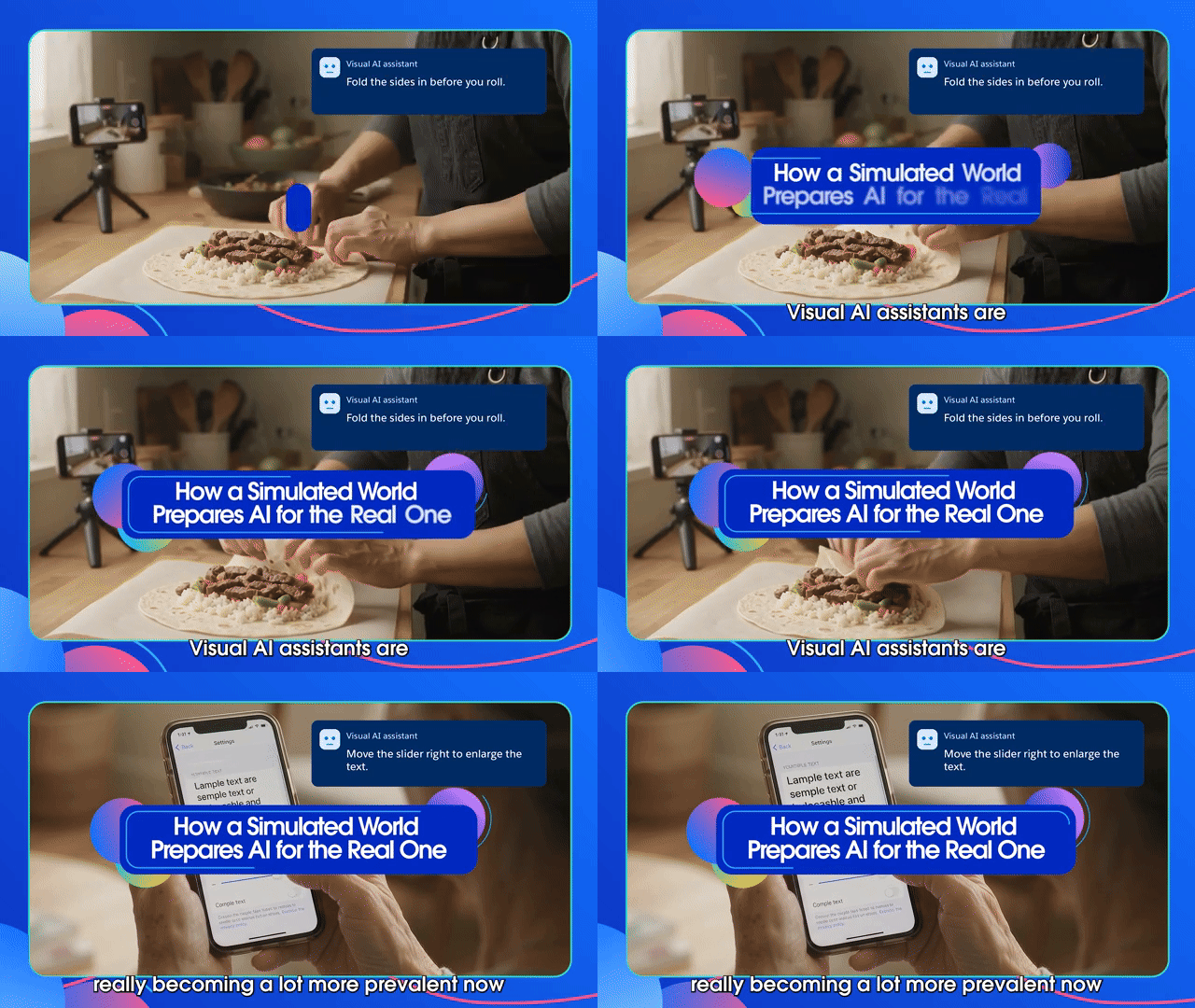
To bypass this bottleneck, researchers needed a methodology that could deliver the complex feedback loop of a live human trial at the massive scale of a software dataset. The Interactive Visual Gym was engineered to solve this exact problem. IVG recreates everyday physical tasks—ranging from complex culinary preparation to intricate smartphone configurations—and pairs each scenario with a simulated user. This virtual worker performs the assigned task while receiving real-time guidance from the visual AI assistant. Crucially, both the simulated user’s behavior and the virtual environment dynamically adapt in real time to the AI’s instructions.
For instance, in a simulated kitchen environment, a virtual cook works methodically through a recipe, such as assembling a multi-ingredient hamburger by layering a bun, a cooked patty, and a slice of cheese. If the virtual cook reaches for an incorrect ingredient, the watching AI assistant must detect the error and issue a timely warning, allowing the simulated worker to process the guidance and alter its next move accordingly.
Core Architectural Innovations of the Interactive Visual Gym
The practical utility of IVG relies on three foundational design choices that distinguish it from classical robotics simulations.
First, the AI assistants communicate using natural, conversational language—such as directing a worker to “go to the pan with the meat”—rather than outputting complex joint velocities or spatial degree coordinates typical of traditional robotic testing frameworks.

Second, the system allows researchers to schedule out-of-plan scenarios at exact, predetermined moments within a task while keeping the simulated user’s dialogue consistent with its ongoing behavioral state. These injected anomalies include sudden procedural mistakes, mid-task plan modifications, spontaneous questions, and requests for reminders.
Third, the simulated users are programmed with diverse profiles along four distinct axes: baseline skill level, inherent trust in artificial intelligence, preferred execution speed, and tolerance for interruptions. This variation is vital because a seasoned veteran technician who prefers minimal interference requires an entirely different style of assistance than a nervous novice who needs every single step explicitly spelled out.
Evaluating Frontier Models Through IVG-Bench
Utilizing the capabilities of the Interactive Visual Gym, researchers constructed IVG-Bench, a rigorous benchmark encompassing 315 distinct scenarios spread across three varied environments. This benchmark was deployed to evaluate 15 different AI assistants, each powered by a unique underlying foundational model.
The results underscored just how challenging real-time visual assistance remains for current technology. The top-performing assistant, powered by Gemini 4 Argon, successfully completed only 53.4% of assigned tasks within the designated time limits, averaged across all test environments. Furthermore, open-weight models consistently trailed behind the leading proprietary frontier models.
This dynamic evaluation methodology successfully exposed several systemic flaws that traditional static testing completely misses. Most notably, the tests revealed a divergence between task success and interaction quality: a model might help a user successfully cross the finish line more often, yet deliver clumsy, poorly timed, or confusing advice along the way. Consequently, researchers concluded that evaluating visual assistants requires dual metrics tracking both overall task success and nuanced interaction quality.
Additionally, dynamic testing highlighted severe latency issues that render otherwise correct advice completely useless. For example, instructing a technician to approach a workbench after the technician has already arrived at the location provides zero operational value. Other observed failures included assistants redundantly repeating instructions that users had already acknowledged, as well as a noticeable degradation in guidance quality among certain open-weight models as tasks progressed over extended periods.
Validating Simulation Against Human Experience
To ensure that simulation-based scores accurately mirror real-world human experiences, Salesforce AI Research conducted validation studies where human participants directly controlled the virtual cook within the simulator. These human-guided runs interacted with various AI assistants and subsequently ranked their effectiveness.
The data revealed a strong correlation: when human participants preferred one assistant over another, the automated interaction-quality score generated by the simulation matched human preference 78.5% of the time. Interestingly, human users and simulated workers behaved remarkably similarly during trials, with only one minor behavioral discrepancy: simulated users communicated and replied far more frequently than their human counterparts.
Beyond evaluation, the simulated environments proved capable of actively enhancing the performance of visual assistants. In initial proof-of-concept trials, researchers utilized the simulator to fine-tune an open-source model, incentivizing algorithmic behaviors that prioritized overall task completion and preemptive error prevention. Following this simulation-based training, the model’s success rate measurably improved, and the assistant became noticeably more adept at delivering precise advice at the exact right moment, stepping in proactively before errors occurred.
Strategic Implications for Enterprise Leaders
As multimodal artificial intelligence continues its rapid migration from digital chat interfaces into physical operational environments, enterprise and industrial leaders face critical deployment decisions. The emergence of simulation-based evaluation frameworks like the Interactive Visual Gym signals a mature shift toward rigorous, empirical accountability in AI deployment.
Organizations preparing to integrate real-time visual assistants into frontline operations must look beyond marketing claims and evaluate systems against rigorous practical criteria. Before rolling out AI coaching tools to technicians, warehouse workers, or assembly line personnel, leadership teams must ask three fundamental questions: Does the assistant measurably improve task completion rates? Does its guidance arrive with sufficient speed to alter outcomes in real time? And does the system maintain its accuracy and reliability deep into long, complex shifts or when workers inevitably deviate from standard operating procedures?
Answering these questions requires moving beyond static benchmarks and testing the interaction itself within dynamic environments where advice carries real-world consequences. As simulation platforms continue to bridge the gap between controlled testing and messy physical reality, the future of frontline labor guidance will increasingly be forged in virtual proving grounds before ever meeting the factory floor.