Salesforce Introduces Agent Evals and Advanced Cost Controls to Agent Fabric to Tame Runaway Enterprise AI

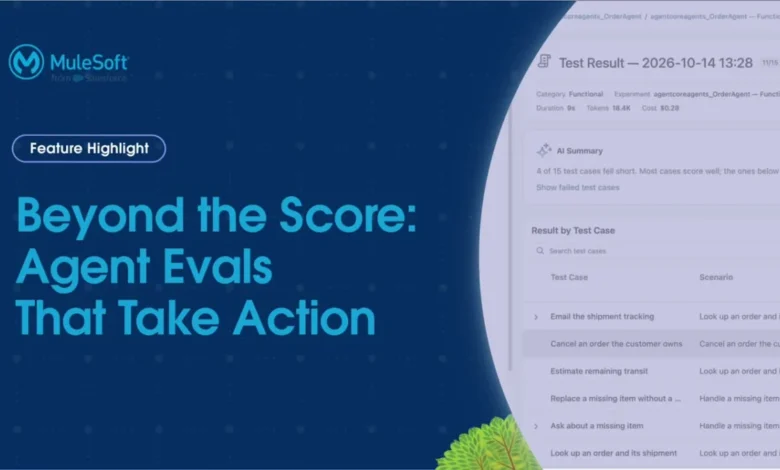
The landscape of enterprise artificial intelligence is experiencing a profound paradigm shift. As organizations rapidly transition from isolated pilot programs to fully integrated, multi-platform agentic ecosystems, the underlying infrastructure required to manage these autonomous systems is being tested to its limits. Today, Salesforce announced a significant expansion of its Agent Fabric platform, introducing Agent Evals, API Evals, and advanced cost controls designed to give Chief Information Officers and AI leaders unprecedented oversight. Operating against a backdrop where AI agents handle more than 1.2 billion requests daily for enterprise users globally, the newly unveiled features aim to eliminate "silent failures"—instances where autonomous agents deliver erroneous outputs, drift from their intended parameters, or rack up catastrophic token costs long before human operators become aware.
The announcement addresses a critical vulnerability in modern enterprise technology stacks. Industry data indicates that 96 percent of enterprises currently deploy AI agents across more than one platform, creating a fragmented operational environment. Furthermore, recent studies from the state of agent engineering reveal that fewer than half of organizations actively evaluate their deployed AI agents on live traffic. This reliance on post-hoc troubleshooting often leaves businesses vulnerable to reputational damage, poor customer service interactions, and ballooning cloud infrastructure bills. By embedding automated evaluation and rigid financial guardrails directly into the control plane, Salesforce is attempting to move the industry away from what insiders characterize as "cross-your-fingers AI" toward a model of continuous governance.
The Evolution and Chronology of Enterprise AI Governance
To understand the weight of Salesforce’s latest release, it is necessary to examine the rapid evolution of autonomous agents within corporate IT structures. Over the past twenty-four months, enterprise adoption has accelerated from basic, rules-based chatbots to complex LLM-driven agents capable of executing multi-step workflows, calling external APIs, and making autonomous business decisions. However, the tooling required to monitor these systems has historically lagged behind their deployment velocity.
Historically, when an AI agent malfunctioned—whether by hallucinating a return policy, executing an incorrect transaction, or failing to utilize proper database tools—resolution depended entirely on manual discovery. IT teams had to track down the specific department owner, file tickets, secure executive approval, and manually restrict the agent’s permissions. Meanwhile, the compromised agent would continue to process traffic, exacerbating the problem.
The introduction of Agent Fabric by MuleSoft previously established a centralized architecture to discover and govern agents across disparate platforms. With today’s update, Salesforce is introducing a chronological shift from reactive discovery to proactive intervention. The new features—Agent Evals, API Evals, and advanced cost controls—are engineered to intercept anomalies in real time. When an agent’s quality metrics dip below predefined thresholds, Agent Fabric can now automatically trigger alerts, notify designated system owners, or safely pull the compromised agent offline before minor glitches cascade into widespread customer service failures.
Core Capabilities and Technical Mechanics
The newly integrated features within Agent Fabric are designed to function cohesively across complex, multi-vendor environments. At their core, these updates solve the dual challenge of quality assurance and financial predictability.
Agent Evals operates by continuously monitoring live interactions against established business rules, security guidelines, and task-completion parameters. Rather than relying solely on offline testing environments, Agent Evals analyzes live traffic to assess whether an agent is utilizing the correct backend tools, operating with optimal efficiency, and adhering to strict corporate compliance frameworks. If an evaluation indicates a performance degradation, the system’s automated intervention protocols take over instantly.
Complementing Agent Evals is the introduction of API Evals, which extends governance capabilities to the application programming interfaces that power agentic workflows. Because modern agents frequently query internal databases and third-party SaaS applications, API failures or latency spikes can cripple an agent’s reasoning loop. API Evals monitors these connections to ensure that external dependencies do not silently compromise end-user experiences.
Simultaneously, the advanced cost controls address the financial anxiety that frequently accompanies generative AI deployments. Enterprises can now implement hard spending limits that automatically cap token usage and API calls at predetermined budget thresholds. In practice, this prevents situations where runaway loops or recursive prompt engineering result in unexpected, exorbitant invoices from foundation model providers. By unifying evaluations, cost monitoring, and automated interventions into a single control plane, Salesforce is providing organizations with the tools necessary to scale their operations securely.

Industry Perspectives and Early Adopter Reactions
The reception from early enterprise partners highlights the pressing demand for centralized oversight in agentic deployments. Organizations operating at global scales are increasingly finding that manual governance is unsustainable.
Poonam Deshpande, Director of Engineering for Digital Commerce at ASICS Digital, emphasized the operational confidence provided by the new beta features. "What excites us most about Agent Evals is that it doesn’t stop at telling us something is wrong," Deshpande noted. "When an agent’s quality drops, Agent Fabric can step in automatically, alerting the right owner or pulling the agent offline before a small issue becomes a widespread customer problem. That’s the missing piece for running agents at scale."
Similarly, Andrew Comstock, Senior Vice President and General Manager of MuleSoft and Agent Fabric at Salesforce, underscored the strategic necessity of unifying cost and quality controls. "Enterprises can only scale agents as fast as they can keep them accurate and on budget," Comstock stated. "Today, spotting a wrong answer or a spending spike is one job, and stopping it is another. Agent Fabric unifies them, bringing evaluations, cost controls, and intervention together so teams can contain issues instantly."
Global enterprises across diverse sectors have echoed these sentiments. Tiina Stephens, Director of AI Engineering at Capita, pointed out that centralized control planes are vital for maintaining customer trust in mission-critical operations. "Agent Fabric gives us a central AI control plane to govern agents at scale, while Agent Evals will help us validate that agents are performing against clear business and service outcomes," Stephens remarked.
In the manufacturing and appliance sector, GE Appliances—a Haier company—has encountered similar organizational hurdles regarding uncoordinated AI experiments. Adam Jones, Executive Director of Enterprise Transformation, observed that large organizations frequently suffer from siloed, one-offs lacking visibility. "With Agent Fabric, we now have that single control plane where we can see our agents, who built them, and shut them down if something goes wrong," Jones explained. "That’s how you move from experiments to real enterprise scale with trust."
Meanwhile, Steve Sigrist, Vice President of Global Customer Service at Newell Brands, emphasized the customer-facing implications of governed autonomy. "As we bring AI agents into customer service, we want to be sure we can guide and oversee them every step of the way," Sigrist said. "With Agent Fabric as our secure AI control plane, Newell Brands is building an agentic enterprise where every agent across every brand is visible, governed, and accountable."
Broader Market Implications and Future Outlook
The release of these advanced governance tools marks a maturity milestone for the enterprise artificial intelligence market. As organizations move past the initial novelty phase of generative AI, the focus has shifted inexorably toward operational efficiency, risk mitigation, and return on investment.
The ability to continuously evaluate agents on live traffic while enforcing strict financial boundaries addresses the primary anxieties held by corporate boardrooms. Without robust oversight mechanisms, the proliferation of autonomous agents introduces significant operational vulnerabilities, ranging from data leakage to brand erosion caused by erratic conversational outputs. By positioning Agent Fabric as a universal control plane capable of discovering and managing agents built across diverse internal and third-party frameworks, Salesforce is attempting to establish an industry standard for AI governance.
Furthermore, the integration of API Evals reflects a growing understanding that AI agents do not operate in a vacuum. Their efficacy is intrinsically tied to the health and responsiveness of the broader enterprise digital ecosystem. Ensuring that APIs remain stable, secure, and cost-effective underpins the entire premise of the agentic enterprise.
As these capabilities roll out to the market—with specific features targeted for beta availability and subsequent general release—enterprises will be closely watching to see how effectively automated interventions can replace manual oversight. If platforms like Agent Fabric can successfully mitigate silent failures and runaway spending, organizations will likely accelerate their transition from experimental AI proofs-of-concept to deeply embedded, mission-critical autonomous workflows. For now, Salesforce’s latest announcements signal that the era of unmonitored, experimental AI is rapidly drawing to a close, replaced by an era defined by continuous control, financial discipline, and rigorous accountability.
Related posts: