Salesforce Expands Its AI Arsenal with Koa Decisions to Accelerate Enterprise Workflows

The enterprise artificial intelligence landscape is undergoing a structural shift toward operational specialization, moving away from a heavy reliance on generalized large language models (LLMs) toward hyper-focused, efficient architectures. Amid this industry-wide transformation, Salesforce has officially announced the launch of Koa Decisions, the next generation of its proprietary HyperClassifier model. Designed to execute high-speed classification, routing, and categorical evaluation, Koa Decisions represents Salesforce’s strategic effort to optimize enterprise workloads by offloading routine cognitive tasks from expensive, general-purpose generative models.
The release arrives at a time of intensifying competition within the specialized decision-model sector. The market has seen a surge of activity as companies seek alternatives to using resource-heavy LLMs for binary
choices, option selections, and intent-based routing. In mid-September, TypeSafe AI emerged from stealth mode to introduce Jev, a model engineered explicitly for discrete option selection. Roughly a month later, OpenAI made its Decisions API generally available to developers, touching off a wave of similar offerings across the tech sector. While startups and major cloud players alike race to capture this emerging market, Salesforce has quietly leveraged decision models within its ecosystem for years, notably through HyperClassifier to route live inquiries within its Agentforce customer service platform.

The architectural mechanics underpinning Koa Decisions highlight a departure from traditional generative text creation. General-purpose LLMs generate responses sequentially, producing text one token at a time while calculating probabilities based on preceding tokens. This iterative process introduces computational latency, often requiring more than a full second to parse a straightforward request. Conversely, decision models are engineered to ingest an entire user query and a predefined list of parameters simultaneously, evaluating the inputs in a single processing step.
According to internal Salesforce benchmarks evaluating routing requests within Agentforce, Koa Decisions executes classification tasks in approximately 26 milliseconds. This marks a dramatic reduction in latency compared to the roughly 1.4-second processing time typically required by a general-purpose LLM for the same task. Built by Salesforce’s data science team through advanced post-training techniques applied to Google’s open-weight Gemma model, Koa Decisions also introduces native multimodal capabilities, allowing the system to process both image and audio inputs alongside traditional text.
The evolution of enterprise request classification reflects a broader generational shift in software engineering. Historically, organizations seeking to categorize customer inquiries, support tickets, or transactional data relied on custom predictive machine learning models. Implementing these legacy systems was a laborious undertaking that often spanned several months. Development teams were required to define desired outcomes, manually gather and label extensive training datasets, train the model, rigorously test for accuracy, and continuously re-tune the parameters.
Decision models streamline this lifecycle by capitalizing on the foundational semantic understanding already embedded within advanced language frameworks. Because models like Gemma have already processed vast corpuses of text and understand the underlying relationships between concepts—such as associating phrases like "send back the order" with "returns"—enterprise developers can simply input new operational categories. Consequently, businesses can deploy and scale custom classification workflows in hours rather than months, drastically lowering the technical barrier to entry for workflow automation.
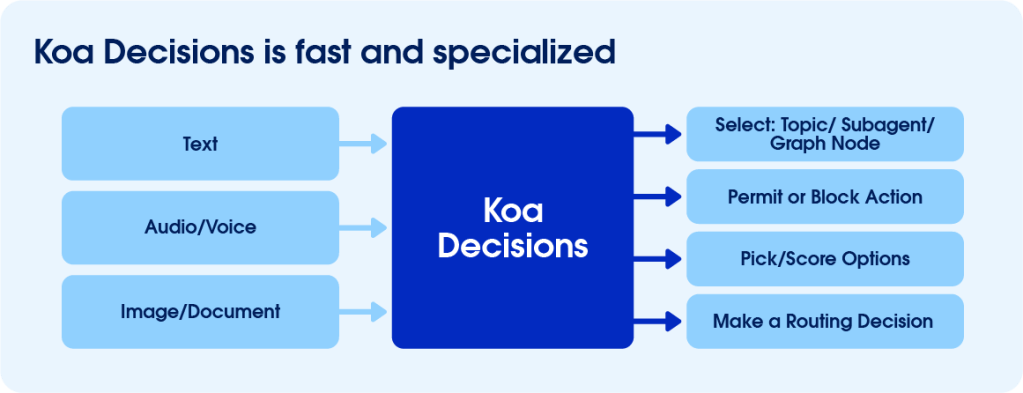
Salesforce has outlined an expansive deployment strategy for Koa Decisions, signaling plans to integrate the model well beyond its initial customer service routing applications. The company intends to embed Koa Decisions into core platform mechanics, including enterprise flows, Apex code logic, and prompt templates designed for Salesforce administrators and developers, alongside a dedicated external API.
This multi-tiered integration strategy places Koa Decisions alongside other advanced architectures within the broader Koa family of models, which includes specialized reasoning systems developed in collaboration with NVIDIA. By right-sizing AI infrastructure, Salesforce aims to reserve resource-intensive LLMs strictly for complex generative writing, contextual summarization, and deep reasoning tasks, while leaving high-frequency operational triage to the faster decision model.
Industry analysts note that the financial and environmental implications of right-sizing enterprise AI infrastructure could be substantial. As corporations scale artificial intelligence deployments across millions of daily customer interactions, the cumulative cost of inference using large, general-purpose LLMs presents a significant budgetary hurdle. By routing up to eighty percent of preliminary triage, intent recognition, and routing tasks through single-token decision models, enterprises can substantially curb operational expenditures and reduce the energy footprint associated with data center inference workloads.
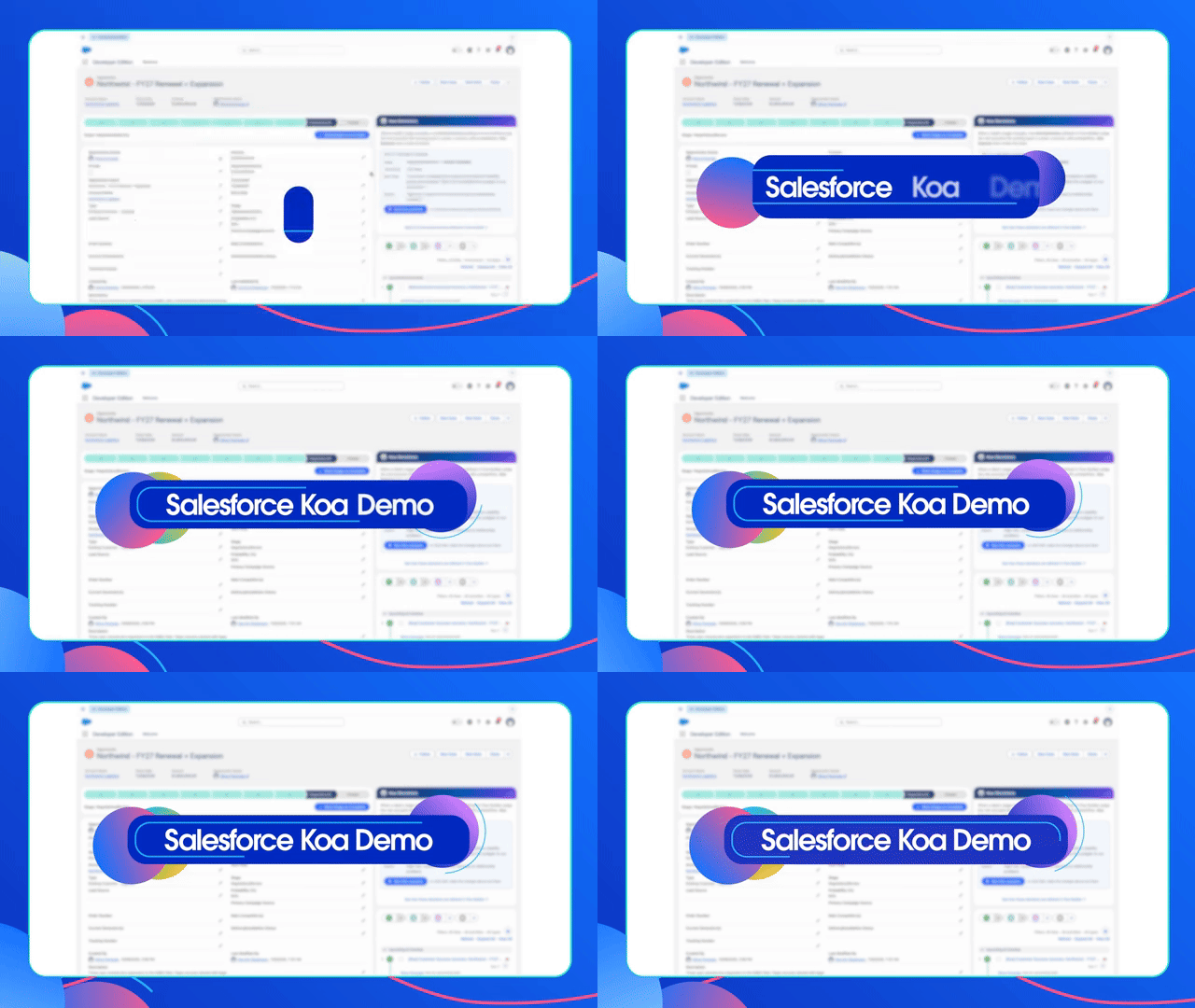
To demonstrate the practical application of the technology in everyday business environments, Salesforce has detailed multi-system orchestration use cases. In a standard sales pipeline scenario, for instance, if a high-value deal begins to show signs of stagnation, Koa Decisions can instantly evaluate the risk parameters, classify the nature of the delay, and dynamically assign the appropriate internal response team. Simultaneously, an LLM can be invoked to generate a succinct qualitative summary of recent account changes. By the time a human account executive opens the enterprise record, the classification, risk assessment, and routing have already been finalized, and relevant notifications can be automatically dispatched to collaboration platforms like Slack.

To encourage broader adoption and evaluation, Salesforce has made Koa Decisions accessible to external users through its Trailhead learning platform, enabling developers and enterprise leaders to test the model’s performance on custom datasets without requiring an existing commercial Salesforce contract.
As the enterprise AI market matures, the competitive race toward model specialization underscores a fundamental industry realization: not every business problem requires the creative breadth of a massive language model. With the rollout of Koa Decisions, Salesforce is positioning its ecosystem for an era where speed, cost-efficiency, and operational precision dictate the success of enterprise automation.