The Comprehensive Guide to Selecting the Best Peec AI Alternatives for Modern Marketing Teams in 2026

The landscape of digital discovery has undergone a fundamental transformation. As of 2026, the reliance on traditional keyword rankings and organic search traffic has been superseded by the rise of generative AI answer engines. Modern buyers no longer scroll through static lists of search results; instead, they query platforms like ChatGPT, Perplexity, and Gemini to receive synthesized recommendations. Consequently, marketing teams are moving away from legacy search engine optimization (SEO) toward the era of Answer Engine Optimization (AEO). While platforms like Peec AI have provided initial visibility into this space, organizations are increasingly seeking robust alternatives that offer deeper CRM integration, automated content remediation, and scalable cross-regional workflows.
Understanding the Shift: From Search Engines to Answer Engines
To grasp the necessity of evolving one’s marketing stack, one must first recognize the mechanics of modern information retrieval. Between 2021 and 2026, the primary interface for B2B and B2C research shifted from static search engine results pages (SERPs) to dynamic AI-generated responses. Traditional rank tracking, which relies on crawling SERPs to determine a page’s position for a specific keyword, is no longer sufficient to capture a brand’s actual presence.
AI visibility monitoring focuses on the "citation layer"—the specific sources an AI model synthesizes to construct a recommendation. This evolution requires tools that track brand sentiment, citation frequency, and competitive positioning across multiple AI models simultaneously. Whereas previous tools measured the "where" (rank position), current requirements demand an understanding of the "how" (why a brand is or is not being recommended).
Criteria for Evaluating AEO Platforms
As procurement teams and CMOs evaluate the current market, the focus has shifted from mere data visualization to actionable intelligence. A high-performing AEO platform in 2026 must adhere to a rigorous set of functional requirements:
-1.png)
- CRM Integration: The ability to bridge the gap between AI visibility and revenue attribution. If a platform cannot link an AI-sourced visit to a specific contact or deal in a CRM, it remains a siloed dashboard.
- Remediation Capability: The tool should not only identify why a brand is missing from an AI response but also provide the content briefs or AI-assisted drafting tools to rectify that omission.
- Multi-Model Coverage: Effective monitoring must span a diverse array of engines, including ChatGPT, Perplexity, Claude, Gemini, and emerging niche models.
- Historical Benchmarking: The ability to track performance trends over time, rather than starting data collection only upon activation.
- Technical Diagnostics: Advanced tools now offer "fan-out" query visibility—showing the actual searches an AI runs before it generates an answer—which provides critical insight into the AI’s reasoning process.
Leading Alternatives and Market Segmentation
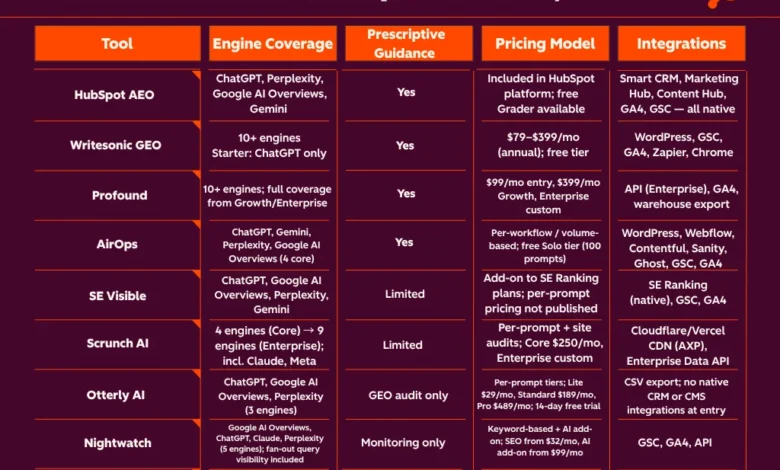
The 2026 market offers a variety of solutions tailored to different organizational needs. HubSpot AEO has emerged as the premier choice for organizations already utilizing a CRM-centric growth strategy. By surfacing AI visibility data directly within the HubSpot Smart CRM, it eliminates the need for manual CSV exports or complex API maintenance. This integration allows sales and marketing teams to identify exactly which AI-generated prompts influenced a prospect’s journey, effectively closing the attribution loop.
For organizations struggling with the bottleneck of content production, Writesonic GEO and AirOps represent the most efficient solutions. These platforms distinguish themselves by bridging the gap between insight and output. When these tools detect that a competitor has captured a citation, they offer integrated workflows to research, draft, and publish the necessary content to reclaim that visibility.
For the enterprise sector, Profound has solidified its position as the industry leader in data security and scale. With a proprietary database of over 1.5 billion real user prompts, it provides the most credible research data for organizations where AI recommendation positioning directly impacts multi-million dollar revenue pipelines. Its enterprise-grade compliance, including SSO and rigorous data residency policies, makes it the standard for global corporations.
Technical SEO teams, particularly those working within agencies, often favor Scrunch AI. By offering deep-level AI crawler analytics, it provides a diagnostic view of how AI agents interact with site architecture—a necessity for brands that need to optimize their technical infrastructure to appease both human users and AI crawlers.
Economic Considerations and Strategic Budgeting
The cost structure of AEO tools varies significantly based on functionality. Entry-level options such as Otterly AI and AthenaHQ provide affordable gateways for startups and teams that need to build a business case for AEO before requesting significant capital. These tools, often priced under $100 per month, allow for the establishment of a baseline measurement—a crucial step before scaling.

Conversely, enterprise-grade platforms such as Profound or advanced custom solutions can reach several hundred dollars per month. When negotiating these contracts, organizations should focus on seat-based pricing versus volume-based pricing. Given the collaborative nature of modern content marketing, opting for platforms with unlimited seat access—such as SE Visible by SE Ranking—can significantly reduce the total cost of ownership as the team grows.
The 90-Day Activation Roadmap
Implementing an AEO tool is only the beginning of a larger organizational shift. A common failure mode in 2026 is the "dashboard trap," where teams subscribe to a powerful tool but fail to integrate its data into their daily operations. A successful 90-day implementation plan should follow a disciplined structure:
- Days 1-30: Establishing the Baseline. Utilize tools like HubSpot’s free AI Search Grader to determine current standing. Configure UTM parameters to ensure that all incoming traffic from AI engines is properly tagged in GA4 and the CRM.
- Days 31-60: Gap Analysis and Prioritization. Identify the "low-hanging fruit"—queries where the brand is close to being cited but currently lacks the specific entity-based content required by the AI. Execute content production sprints to address these gaps.
- Days 61-90: Measuring Impact and Iterating. Review the attribution data. Are the AI-referred leads converting at a higher rate than organic traffic? Adjust the prompt methodology to focus on high-intent personas rather than broad, low-value queries.
Best Practices for Sustained AI Visibility
To maintain a competitive advantage, marketing teams must adopt a rigorous set of standards for content and technical maintenance. First, entity hygiene is paramount. AI systems rely on structured data and clear, consistent brand descriptors. If a brand refers to itself by different names across its digital footprint, it confuses the AI’s entity resolution, leading to reduced citation rates.
Second, the "Answer-First" content standard is essential. Modern AI models prioritize content that delivers a concise answer within the first 100 words. Content that relies on long, SEO-padded introductions is increasingly likely to be overlooked by AI systems in favor of more direct, utility-driven competitors.
Finally, citation retention should be treated as a form of maintenance. Just as a page might lose its Google ranking if not updated, a page that is currently cited by an AI engine can lose its position as competitors update their own content. A 90-day refresh cycle for top-performing assets is recommended to keep information current and maintain the trust of the AI models.
.png?width=650&height=488&name=White%20Simple%20Comparison%20Graph%20(2).png)
The Broader Impact: A Shift in Accountability
The transition to AEO is not merely a technical change; it is a shift in how marketing success is measured. By moving away from vanity metrics like organic clicks toward tangible outcomes like AI-influenced pipeline and revenue, marketing teams can better justify their budgets to executive leadership.
The rise of these tools has also forced a more collaborative relationship between technical SEO teams and content operations. Because AI visibility depends on both a clean technical entity graph and high-quality, authoritative content, the silos that once separated these departments are breaking down. In 2026, the most successful organizations are those that have unified their search and content strategies into a single, cohesive workflow.
Conclusion: Choosing the Right Path
The choice of an AEO platform should be dictated by the specific bottlenecks currently facing the organization. For those needing CRM-native attribution, HubSpot AEO is the clear leader. For teams limited by production capacity, Writesonic or AirOps are the most logical upgrades. For enterprises requiring absolute security and massive data sets, Profound remains the standard. Regardless of the chosen platform, the underlying principle remains the same: monitor the citation, understand the reasoning, and act with intent. As the search landscape continues to evolve, those who treat AEO as a core business function—rather than a secondary SEO task—will lead their respective markets.