Mastering AEO Benchmarking: How to Decipher AI Search Visibility in a Volatile Market

The rapid evolution of generative AI, led by platforms such as OpenAI’s ChatGPT, Google’s Gemini, and Perplexity, has fundamentally altered the digital search landscape. For modern brands, the challenge is no longer just ranking on a search engine results page; it is securing a position within the synthesized answers provided by AI agents. Answer Engine Optimization (AEO) benchmarking has emerged as the critical methodology for brands to measure their visibility, ensuring that marketing teams can distinguish between systemic market fluctuations and genuine performance shifts. Without a robust benchmarking framework, organizations risk misinterpreting volatile data, leading to unnecessary tactical pivots or the failure to address legitimate brand visibility crises.
The fundamental problem facing digital marketers today is the "accountability gap." When a brand experiences a sudden dip in AI-driven traffic or citations, it is often unclear whether the decline is the result of an algorithm update within the AI models themselves or a loss of brand relevance. Historically, SEO professionals could rely on stable ranking positions to diagnose traffic drops. However, in the age of generative AI, answers are synthesized in real-time, often bypassing traditional links entirely. This shift necessitates a move away from legacy metrics toward a two-tier benchmarking model: market-level trends and brand-level performance data.
Understanding the Mechanics of AEO Benchmarking
AEO benchmarking operates on the principle of comparative analysis. By measuring a brand against industry peers, historical baselines, and aggregate market trends, marketers can assign meaning to raw data points. If a brand holds a 35% visibility score, that figure remains abstract without a frame of reference. When contextualized against competitors—or against the overall industry average—that number becomes a clear indicator of market standing.
This practice is essential because of the increasing volatility inherent in Large Language Models (LLMs). Unlike traditional search engines that crawl and index, AI answer engines process vast datasets to generate unique responses. This dynamic nature means that citation rates can fluctuate based on the model’s "temperature" or recent updates to its training data. Consequently, treating every shift as an internal failure is a strategic error. A professional benchmarking approach requires teams to ask two distinct questions: What happened to the market, and what happened to our brand? By answering the former, teams can isolate the variables within their control, thereby optimizing their content strategy with precision.
The Two-Tiered Measurement Model

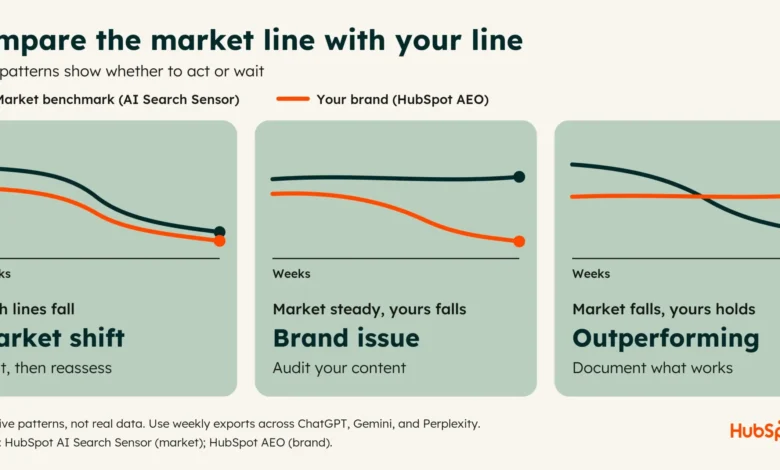
To effectively navigate this landscape, the industry has gravitated toward a two-tier measurement model. The first tier utilizes market-wide benchmarks, often provided by tools like the AI Search Sensor, which tracks the aggregate behavior of engines like ChatGPT, Gemini, and Perplexity. These tools identify industry-wide shifts in citation frequency and volatility. The second tier involves internal brand performance tracking, which measures specific metrics such as entity alignment, topic coverage, and sentiment analysis.
This bifurcated approach prevents the most common error in contemporary marketing: "chasing ghosts." For instance, if a brand’s citation rate drops simultaneously across the entire financial services sector, it is likely a result of an engine-side algorithm change. If, however, the brand’s visibility dips while the sector remains stable, a content audit or a recalibration of the brand’s digital footprint is necessary. Case studies have demonstrated the efficacy of this model; in 2026, data revealed that several major firms were failing to capture citations in specific international markets like France and Germany. By applying targeted, localized content campaigns, these brands were able to elevate their mention rates from near-zero to over 30% in just one month.
Key Metrics for Evaluation
A comprehensive AEO benchmark rests on four pillars: citation rate, share of voice, sentiment, and source attribution. Each metric serves a distinct diagnostic purpose.
Citation rate—the frequency with which an AI engine cites a specific domain—is perhaps the most vital indicator of authority. Recent guides, including the September 2026 industry standards, highlight the importance of "visibility scores," which calculate how often a brand is mentioned relative to its peers. Share of voice, meanwhile, provides a direct look at prominence; if a brand occupies 25% of the mentions in a category, it effectively dominates the conversation at the point of decision-making.
Sentiment analysis adds a qualitative layer to these quantitative metrics. If a brand’s visibility remains high but sentiment trends downward, it indicates a perception problem rather than a discovery problem. In such cases, the solution lies in PR and brand health management rather than technical SEO adjustments. Furthermore, source attribution analysis has revealed that for many industries, third-party aggregators—such as NerdWallet or Bankrate in the financial sector—often out-cite the primary service providers themselves. Understanding this "intermediary influence" is crucial; it teaches marketers that their own website is sometimes not the primary target for AI engines, necessitating a strategy that includes managing off-site mentions.
Designing a Reliable Benchmark: The Role of Prompt Cohorts

A benchmark is only as reliable as the methodology behind it. Central to this is the concept of "prompt cohorts"—a fixed, consistent set of queries used to track AI engine behavior over time. Using ad-hoc, inconsistent questions leads to noisy, unusable data. Experts recommend maintaining a cohort of 50 to 100 prompts, stratified by intent: category-level questions, brand-adjacent questions, and direct brand inquiries.
Consistency in cadence is equally important. Weekly monitoring is currently considered the industry standard, aligning with the update cycles of most major AI search platforms. Furthermore, teams must be aware of the "noise floor" in AI answers. As noted in a 2026 study by researcher Ronald Sielinski, AI engines are inherently stochastic; they may provide different answers to the same query on successive runs. Consequently, reporting must include uncertainty estimates, and data analysis should favor 30-to-60-day trend windows over volatile day-to-day snapshots.
Strategic Implications and Best Practices
The transition toward AEO benchmarking is not merely a technical shift but a governance requirement. Teams should implement a structured checklist to ensure data integrity. This includes standardizing the prompt cohort, maintaining a fixed schedule for data collection, and distinguishing clearly between evidence-based findings and experimental hypotheses.
When reporting to leadership, the focus should remain on the two-tier comparison. By presenting the market trend alongside the brand’s performance, marketers can demonstrate a sophisticated understanding of the environment. This transparency builds trust, particularly when explaining periods of high volatility where the cause may be external.
The long-term implication of AEO benchmarking is a move toward more proactive content strategy. By identifying which topics are currently driving citations, brands can map their content roadmaps to the specific informational needs of AI agents. If the data shows that engines prioritize long-form, data-rich reports over short blog posts, the content team can adjust their output accordingly.
As the industry moves toward 2027, the gap between brands that rely on intuition and those that rely on rigorous AI benchmarking will continue to widen. The ability to distinguish between a temporary market shift and a structural loss of brand authority is no longer a luxury; it is the cornerstone of modern digital strategy. By adopting a disciplined, data-first approach, organizations can navigate the complexities of AI search, ensuring their brand remains a central, authoritative source in an automated digital world. The tools for this analysis are now available, and the methodology has been established—the challenge now lies in the consistent, disciplined application of these benchmarks to drive meaningful, evidence-based growth.