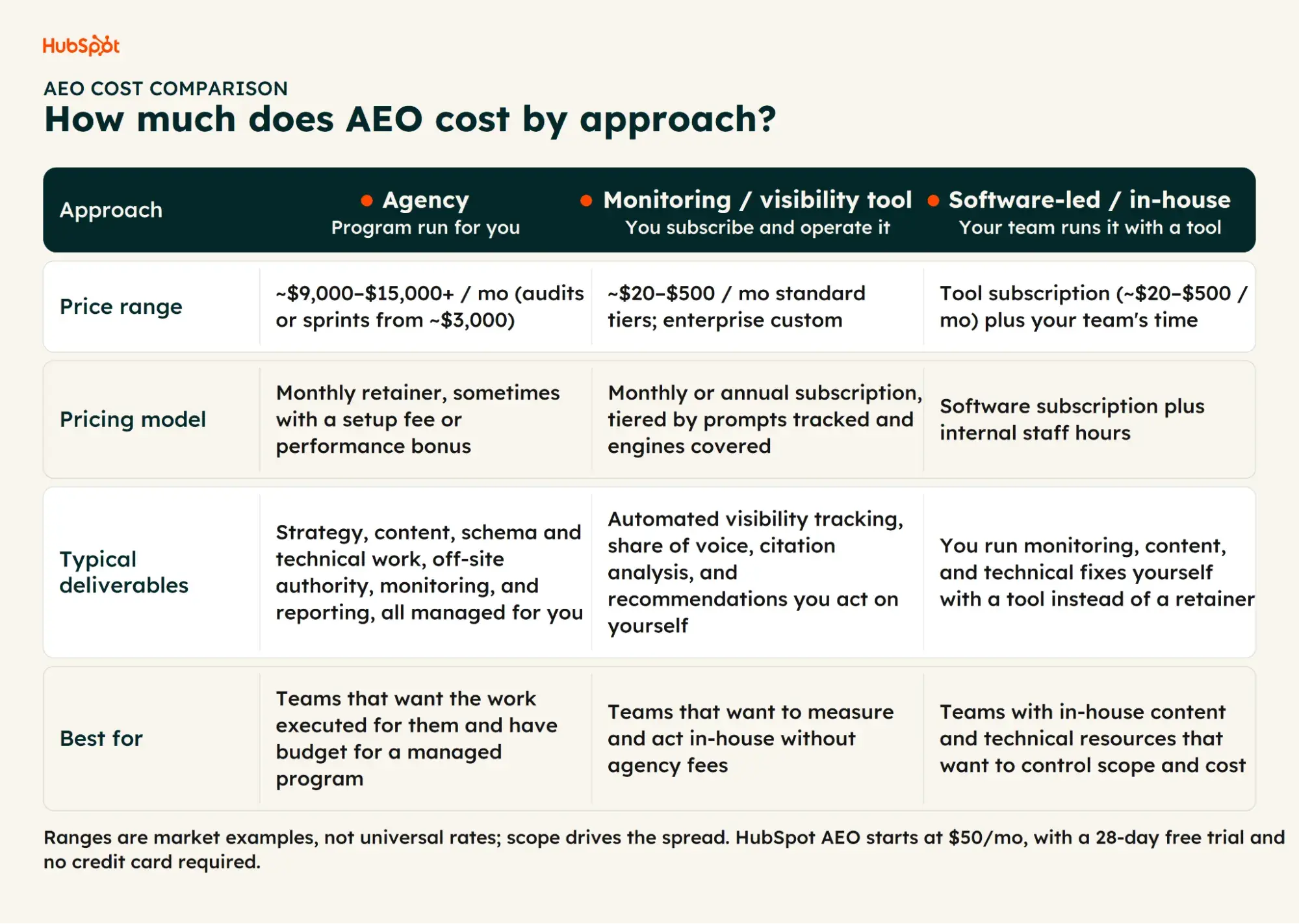
The rapid shift in how users interact with search engines—transitioning from traditional blue-link queries to generative AI-powered responses—has birthed a new discipline known as Answer Engine Optimization (AEO). As brands scramble to ensure their products, services, and expertise appear within the conversational summaries of platforms like ChatGPT, Gemini, and Perplexity, they are faced with a complex and often opaque pricing landscape. Unlike mature marketing fields such as Search Engine Optimization (SEO), where standardized service tiers have existed for decades, AEO is currently in a state of flux, with costs ranging from as little as $30 per month for self-service monitoring tools to upwards of $15,000 per month for comprehensive, white-glove agency management.
Understanding these costs requires an analysis of the scope of work involved. At the entry level, businesses are paying primarily for visibility data—the ability to see when and how their brand is cited in AI responses. At the enterprise level, the cost covers a full-scale digital strategy, including technical schema markup, content production, entity building, and ongoing reputation management.
The Evolution of the AEO Landscape
The emergence of AEO as a distinct marketing line item follows the dramatic rise of Large Language Models (LLMs) over the last 24 months. By late 2024, data from industry researchers indicated that while AI-referral traffic was still a fraction of total web traffic, it was growing at an exponential rate. Early adopters realized that being the "cited source" in a ChatGPT response provided a level of brand authority that traditional SEO could no longer guarantee.
By early 2025, the market saw a split between "monitoring" and "execution." Vendors began to differentiate their products based on the depth of the AI "brain" they could analyze. While simple tools could track whether a brand was mentioned, sophisticated platforms began offering citation analysis—telling companies why a competitor was chosen for a specific query and what content gaps the brand needed to bridge to win that slot.

Analyzing the Cost Tiers: A Comparative Breakdown
To make informed financial decisions, marketing leaders must categorize AEO spending into three distinct buckets: software-led, hybrid, and agency-managed.
1. Software-Led Monitoring (The "DIY" Approach)
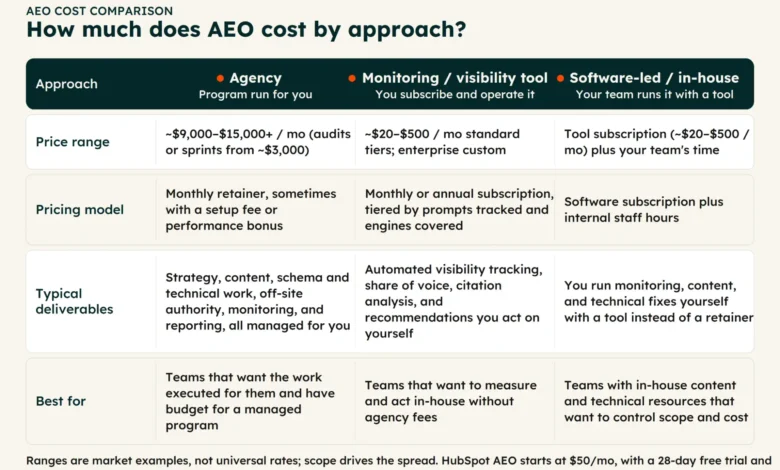
For organizations with internal SEO or content teams, the most cost-effective entry point is through dedicated monitoring tools. Monthly subscriptions typically range from $29 to $489, depending on the volume of prompts tracked and the number of engines covered. HubSpot’s AEO tool, for instance, enters the market at $50 per month, providing a streamlined view of brand visibility across the major AI search players. These tools do not perform the work; rather, they provide the intelligence—such as competitor benchmarking and citation tracking—that allows internal staff to adjust their content strategies.
2. The Hybrid Model
Many mid-sized companies opt for a hybrid approach. They utilize a SaaS platform for continuous data collection but engage specialized consultants for a one-time "AEO Audit." A typical audit can range from $3,000 to $5,000. During this engagement, a specialist analyzes the brand’s current digital footprint, recommends technical fixes—such as optimizing for entity recognition and structured data—and provides a roadmap for the internal team to execute over the following six months.
3. Agency-Managed Programs
For enterprise-level firms, full-service agencies now offer AEO as part of a broader "Total Market" retainer. These packages, often priced between $9,000 and $15,000+ per month, encompass the entire lifecycle of AI search visibility. This includes ongoing content production, technical schema implementation, off-site authority building (earning backlinks from high-authority sources that AI models trust), and monthly reporting. Agencies in this space often employ a mix of data scientists and content strategists to navigate the non-deterministic nature of LLM responses.
Drivers of Price Variance
The wide variance in pricing is not merely a result of different profit margins; it is fundamentally driven by the scope of labor required. Five factors consistently influence the final invoice:

- Prompt Volume: The number of unique queries or "prompts" a tool or agency monitors. Tracking 500 high-intent transactional queries is significantly more resource-intensive than tracking 50 brand-awareness terms.
- Engine Coverage: Monitoring visibility across ChatGPT, Gemini, Perplexity, and emerging specialized search tools requires multiple API calls and complex processing, which drives up the cost of software subscriptions.
- Content Complexity: Producing "AI-ready" content requires a different editorial rigor than standard blogging. It involves structuring information for machine comprehension, which often requires more time from senior writers.
- Entity Authority: Building a brand’s "entity" footprint—ensuring that AI models recognize the brand as a primary source for specific topics—is a slow, manual process involving PR, link-building, and high-level digital footprint management.
- Technical Integration: Customizing technical schemas to feed search engines accurate, structured data is a development-heavy task that often falls outside the scope of basic marketing retainers.
AEO vs. SEO: A Necessary Distinction
A common pitfall for budget-conscious marketers is attempting to substitute AEO for SEO. Experts emphasize that the two are symbiotic, not interchangeable. SEO remains the primary driver of traffic for search engines that rely on link-based ranking, while AEO ensures brand presence in the concise, synthesized answers of generative models.
Crucially, AEO relies on the foundation of a healthy SEO strategy. Search engines and AI models often cross-reference the same high-authority websites. If a brand cuts its SEO budget to fund an AEO campaign, it may inadvertently lose the very rankings that AI models use as their "source of truth." Consequently, the most stable budgets for 2026 and beyond are those that integrate AEO as a specialized subset of a broader search strategy.
Strategic Planning for an AEO Pilot
For organizations looking to dip their toes into AEO without committing to a long-term, high-cost contract, a 60-to-90-day pilot is recommended. This window is long enough to establish a baseline and see the results of initial technical optimizations, but short enough to mitigate financial risk.
The Pilot Framework:
- Weeks 1-2: Establish a baseline. Run a diagnostic audit to identify where the brand is currently being cited—and, more importantly, where it is being omitted in favor of competitors.
- Weeks 3-8: Implement low-hanging fruit. Focus on structured data updates and optimizing existing high-traffic pages to be more "citation-friendly."
- Weeks 9-12: Measure and iterate. Compare the share-of-voice metrics against the baseline.
The use of free trials, such as the 28-day trial offered by HubSpot, allows teams to gather significant data before any capital is deployed. By the end of the 90-day period, a team should have clear evidence of whether AEO efforts are moving the needle on brand visibility.
Potential Red Flags in AEO Proposals
As the market matures, "AEO" is occasionally used as a buzzword by agencies to upsell standard SEO services. Buyers should exercise caution if an agency promises "guaranteed #1 placements" in AI answers. Because AI models are non-deterministic—meaning they may provide different answers to the same query based on a variety of contextual factors—guarantees are inherently misleading.
Furthermore, transparency in reporting is critical. A reputable provider should be able to show a direct link between their activities and changes in citation frequency or share of voice. If a vendor cannot define exactly which engines they are tracking or how they are measuring "visibility," it is a signal to reconsider the partnership.
Broader Implications and Future Outlook
The financial commitment to AEO is expected to stabilize as AI search becomes a standard component of the digital marketing mix. As tools become more sophisticated, the "manual" cost of AEO will likely decrease, while the strategic cost—creating content that is genuinely valuable enough for an AI to cite—will remain a premium service.
The long-term implication for businesses is clear: the era of simply "ranking" for keywords is evolving into an era of "being the source." Brands that invest early in understanding the mechanics of AI visibility, while maintaining their foundational SEO health, are positioned to capture the growing audience that increasingly bypasses traditional websites in favor of AI-generated summaries. By approaching AEO as a data-backed, iterative investment rather than a one-time fix, companies can ensure they remain relevant in an increasingly automated search landscape.