Modern corporate training environments are increasingly defined by a high degree of demographic and professional diversity. As organizations expand globally and hire from a wider range of backgrounds, the traditional "average learner" model—which treats the workforce as a monolith—is proving to be a significant liability. When instructional designers rely on a one-size-fits-all approach, they inadvertently introduce structural barriers that impede knowledge retention and hinder professional development. Universal Design for Learning (UDL) has emerged as the industry-standard framework to dismantle these obstacles, shifting the focus from fixing the learner to optimizing the environment in which they learn.
The Evolution of the UDL Framework
The origins of UDL can be traced back to the early 1990s, when researchers at CAST (the Center for Applied Special Technology) began applying the principles of architectural universal design—which creates physical spaces accessible to all, such as wheelchair ramps and automatic doors—to the field of education. By the mid-2000s, the framework had migrated from K-12 classrooms into higher education and, more recently, into the high-stakes world of corporate Learning and Development (L&D).
The framework gained significant momentum on July 30, 2024, when CAST released the UDL Guidelines 3.0. This iteration marked a paradigm shift in how organizations view instructional design. Unlike previous versions, the 3.0 update explicitly addresses identity, belonging, systemic bias, and learner agency. It moves beyond simple accessibility, such as adding closed captions to a video, and instead asks designers to consider how emotional capacity, social identity, and cultural bias influence an employee’s ability to engage with complex material.
Core Principles of Modern Instructional Design
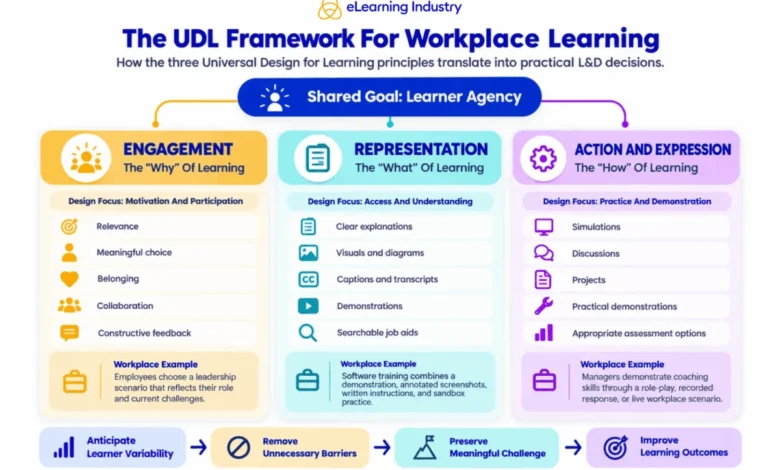
The efficacy of UDL rests upon three foundational pillars. These principles are not merely suggestions but are designed to function as a holistic system that addresses the "why," "what," and "how" of learning.
- Multiple Means of Engagement (The "Why"): This principle addresses the motivational aspect of learning. Organizations are discovering that employees are more likely to persist through training modules when the content is tethered to their specific roles. By offering choice—such as allowing a manager to choose between a remote-leadership case study or a conflict-resolution simulation—designers tap into the learner’s intrinsic motivation.
- Multiple Means of Representation (The "What"): This principle mandates that information be presented in various formats to accommodate different cognitive processing styles and accessibility needs. A robust training program no longer relies solely on slide decks; it integrates interactive diagrams, searchable transcripts, audio summaries, and hands-on demonstrations. This ensures that a learner’s inability to process information in one format does not equate to an inability to learn the concept.
- Multiple Means of Action and Expression (The "How"): This principle focuses on output. If a training goal is to master a new software interface, the assessment should test proficiency with that interface, not the employee’s writing ability. By allowing learners to demonstrate competency through simulations, role-plays, or project-based work, organizations gain a more accurate measurement of skill acquisition.
Analyzing the Impact: Why One-Size-Fits-All Fails
Data from recent workplace performance studies suggests that traditional, rigid training programs suffer from high attrition rates and low application of knowledge. When training is standardized, approximately 30% of learners may struggle due to mismatched pacing, while another 20% may become disengaged because the content is too elementary for their existing expertise.
By implementing UDL, corporations have reported a shift in these metrics. For instance, in organizations that transitioned from static compliance modules to dynamic, scenario-based learning, completion rates often increase as the relevance of the material becomes apparent to the learner. Furthermore, the reduction in support tickets and "help" requests indicates that the content is more intuitive and easier to navigate when designed with diverse needs in mind.

Implementation Strategies for L&D Professionals
Transitioning to a UDL-centric design process requires a fundamental change in how L&D teams operate. The process typically follows a five-stage chronology:
- Goal Definition: Designers must first isolate the core competency. What is the essential outcome? By stripping away non-essential constraints—such as requiring a video-only format when a text-based guide would suffice—the designer creates more room for flexibility.
- Barrier Identification: During the pre-production phase, designers must conduct a "barrier audit." This involves analyzing the proposed content for potential friction points: Is the language overly academic? Is the technology requirement too high for remote employees with limited bandwidth?
- Strategy Integration: Options are built into the design from the outset. If a module requires a demonstration, the designer ensures that an annotated screenshot guide and a recorded video walk-through are provided simultaneously.
- Meaningful Challenge: A common misconception is that UDL is about lowering standards. In reality, it is about removing "accidental" barriers while maintaining the rigor of the learning objective.
- Feedback Loops: Post-training analytics are used to refine future iterations. By analyzing where learners consistently struggle, designers can update specific assets without needing to overhaul the entire curriculum.
The Role of Technology in Modern UDL
The current landscape of learning technology—ranging from Learning Management Systems (LMS) to AI-driven authoring tools—provides the infrastructure for UDL, but it does not provide the strategy. Many organizations purchase expensive software under the impression that it will solve their inclusivity challenges. However, an LMS with accessibility features is only as effective as the content uploaded into it.
The rise of AI has introduced new opportunities for "just-in-time" learning. Modern AI tools can instantly generate summaries, convert text to audio, or adjust reading levels, allowing for a degree of personalization that was previously labor-intensive. However, the reliance on these tools necessitates a rigorous quality-control process to ensure that bias is not being introduced into the training materials. Designers are cautioned that automated systems can sometimes reinforce stereotypes or simplify information to a point where it loses its professional nuance.
Broader Implications and Future Outlook
As the workforce continues to evolve, the integration of UDL is shifting from a "nice-to-have" accessibility feature to a competitive business necessity. Organizations that adopt UDL principles are better equipped to navigate the challenges of a multi-generational workforce, international teams, and the rapid pace of technological change.
The long-term impact of this shift is a more resilient and agile workforce. When employees are taught in a way that respects their individual context, they develop a higher degree of self-advocacy and a stronger sense of belonging. Furthermore, by proactively designing for variability, companies save significant resources that would otherwise be spent on reactive accommodations and remediation training.
Ultimately, the UDL framework serves as a diagnostic tool for organizational excellence. It forces leadership to stop asking, "Why is this employee failing to learn?" and start asking, "What barriers have we built into our training that prevent this employee from succeeding?" By answering the latter, organizations unlock the full potential of their human capital, ensuring that every member of the team has an equitable path to mastery. As the CAST Guidelines 3.0 continue to shape the industry, the emphasis on agency and emotional capacity will likely become the next frontier in the ongoing effort to modernize professional education.