The modern professional landscape is undergoing a significant shift as the traditional "job for life" model gives way to a dynamic, skill-centric career path. Data from global workforce reports indicate that over 60% of employees express frustration with the lack of structured guidance regarding their long-term career trajectory. This disconnect often leads to stagnation, decreased productivity, and higher turnover rates within organizations. To bridge this gap, career development goals—defined as strategic, actionable milestones—have become essential components of modern Learning and Development (L&D) frameworks.
The Evolution of Workplace Growth
Historically, career development was viewed as a linear vertical climb: entry-level, management, and executive leadership. Today, however, career progression is increasingly multidimensional. It encompasses lateral moves, skill acquisition, and the pursuit of specialized knowledge. The lack of clarity surrounding these goals is a primary contributor to the "quiet quitting" phenomenon. When employees lack a defined roadmap, they frequently fall into a cycle of performing daily tasks without a sense of professional purpose. By formalizing career development goals, organizations provide the necessary framework for employees to translate vague professional desires into measurable outcomes.
The Strategic Necessity of SMART Frameworks
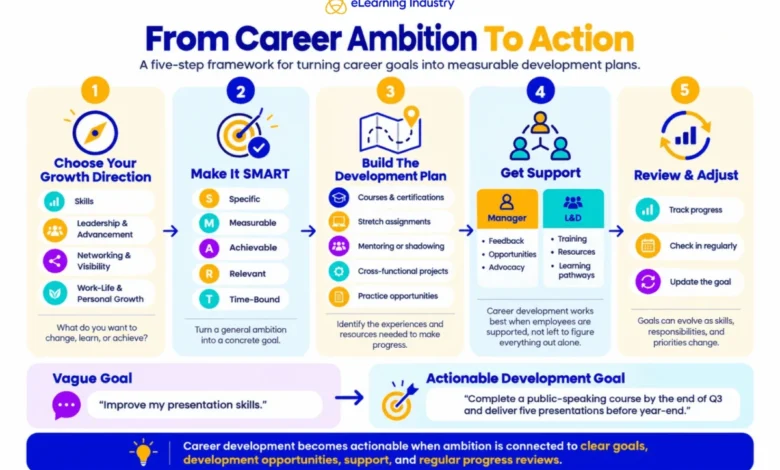
The most effective method for professional goal setting involves the SMART framework: Specific, Measurable, Achievable, Relevant, and Time-bound. While the concept has been a staple in corporate management for decades, its application to individual career growth is increasingly critical.
A specific goal clearly defines what the employee intends to achieve. Measurability ensures there is a standard for success, whether it is a certification, a project completion, or a performance metric. Achievability keeps the employee grounded, preventing burnout from unrealistic expectations. Relevance ensures that the goal aligns with both the individual’s long-term aspirations and the organization’s broader business objectives. Finally, the time-bound nature of the goal creates the necessary urgency to prevent procrastination.
For instance, an employee aiming to improve presentation skills might set a SMART goal to complete an advanced public speaking course by the end of the second quarter, followed by leading at least five internal team presentations before the end of the fiscal year. This structure provides a clear audit trail of professional growth.
Categorizing Professional Development
Career development is not a monolith; it comprises several distinct categories, each requiring a different strategic approach.
- Skill-Building Goals: These focus on technical or soft-skill competencies. In an era where AI is disrupting traditional workflows, upskilling in data literacy, digital tool proficiency, and human-centric skills like emotional intelligence is paramount.
- Leadership and Advancement: These are macro-level goals involving the transition from individual contributor to team lead or department head. These goals require a longer timeline and are often contingent on the organization’s succession planning and budget availability.
- Networking and Visibility: Often overlooked, these goals are essential for career mobility. They involve cross-departmental engagement, mentorship, and contributing to high-profile projects that place the employee in front of senior decision-makers.
- Work-Life Integration: Contemporary development also prioritizes sustainability. Goals concerning hybrid work arrangements, task prioritization, and setting boundaries are increasingly recognized as vital for long-term retention and mental health.
The Role of L&D and Management
The responsibility for professional development lies at the intersection of individual agency and institutional support. L&D departments are increasingly moving away from "one-size-fits-all" training modules in favor of personalized learning pathways. By analyzing individual career goals, L&D teams can curate resources that directly support employee ambitions, which in turn leads to higher engagement levels.

Managers serve as the primary catalyst in this process. However, a recurring issue in corporate settings is the tendency for managers to focus solely on immediate output rather than the employee’s future potential. A study on management efficacy suggests that employees who engage in quarterly career-check-ins with their supervisors are 30% more likely to remain with their employer for more than three years. These check-ins should not be confused with performance reviews; they are forward-looking conversations about potential, resource allocation, and skill gaps.
Chronology of an Effective Development Plan
A robust career development cycle typically follows a four-phase timeline:
- Phase 1: Assessment (Month 1): The employee and manager conduct a gap analysis. This involves identifying current skill sets versus the requirements of the desired future role.
- Phase 2: Goal Setting (Month 2): Utilizing the SMART framework, the employee drafts 3-5 key objectives for the upcoming six to twelve months.
- Phase 3: Execution and Support (Months 3-10): The employee engages in training, project work, and networking. The manager provides the necessary resources—whether financial support for certifications or protected time for learning.
- Phase 4: Review and Calibration (Month 11-12): A formal review determines which goals were met, which were missed, and how the employee’s trajectory should be adjusted for the following year.
Data-Driven Implications for Organizations
Organizations that prioritize transparent career development paths report significantly higher levels of internal mobility. According to HR analytics, internal hires are typically more cost-effective and have a faster "time-to-productivity" than external recruits. When an organization invests in the growth of its existing workforce, it effectively builds a culture of loyalty.
Furthermore, the data suggests that employees who feel they have a clear development path are less likely to experience "career stagnation," a leading cause of the talent drain currently observed in sectors like technology and finance. The implication for corporate leadership is clear: failing to integrate career development into the standard employee lifecycle is a direct risk to organizational sustainability.
Addressing Common Barriers
Despite the clear benefits, many organizations struggle with implementation. Common barriers include lack of time, budget constraints, and a culture that prioritizes urgent tasks over long-term growth. To overcome these, experts suggest integrating development tasks into the standard workflow. For example, rather than requiring an employee to take a week off for training, companies are increasingly adopting "micro-learning"—short, focused training sessions that can be completed during the workday.
Another challenge is the misalignment between employee goals and company needs. While it is true that not every employee goal can be fully supported by the organization, successful management involves finding the "sweet spot" where individual interests overlap with organizational requirements. For example, if an employee wants to learn project management, this aligns perfectly with the company’s need for better operational efficiency.
Conclusion: A Collaborative Future
The shift toward self-directed, goal-oriented career development is not merely a trend; it is a necessary adaptation to the modern economy. By utilizing the SMART framework, distinguishing between different types of growth, and fostering a culture of ongoing dialogue between managers and employees, organizations can transform their workforce into a dynamic, highly skilled asset.
As we look toward the future of work, the success of an organization will be defined not just by its financial performance, but by its ability to facilitate the professional growth of its people. When employees see a clear path forward, their output, loyalty, and innovation reach their full potential, creating a mutually beneficial environment where both the company and the individual thrive.