AI Startup Gritt Emerges from Stealth with 26 Million Series A to Automate Solar Infrastructure and Address Labor Shortages

The global transition to renewable energy is currently facing a paradoxical bottleneck: while the demand for solar power and the capital to fund it have reached record highs, the physical capacity to install these systems is constrained by a dwindling supply of specialized labor. To address this critical gap, Gritt, a robotics and artificial intelligence startup founded by Carnegie Mellon-trained engineers, officially exited stealth mode on Tuesday. The company announced it has secured a $26 million Series A funding round, bringing its total capital raised to $34 million. This investment, led by Obvious Ventures, signals a growing confidence in the use of "physical AI" to transform the construction of large-scale utility infrastructure.
As countries race to meet ambitious decarbonization goals and achieve energy independence, the solar energy build-out has become one of the most significant industrial undertakings of the 21st century. However, the traditional methods of solar farm construction remain stubbornly manual and labor-intensive. Gritt’s entrance into the market comes at a time when the industry is desperate for technological interventions that can operate in the unpredictable, "unstructured" environments of outdoor construction sites—locations where traditional industrial robots have historically failed.
The Funding Landscape and Strategic Backing
The $26 million Series A round was led by Obvious Ventures, a firm known for investing in "world-positive" startups. Joining the round were high-profile investors including Union Square Ventures and Active Impact Investment. This latest injection of capital follows an earlier $8 million seed round supported by a diverse group of venture capital firms, including First Round Capital, Climactic, Congruent Ventures, and VSC Ventures.
The founders of Gritt, CEO Puneet Puri and CTO Vishal Dugar, are veterans of the Carnegie Mellon University robotics ecosystem, a hub that has produced some of the world’s most advanced autonomous systems. Their pedigree played a significant role in attracting top-tier investors. Andrew Beebe, a partner at Obvious Ventures who led the Series A, highlighted the founders’ unique approach to the problem. He noted that while many robotics startups focus on high-budget, niche applications like aerospace, the Gritt team is focused on the "dirty, dull, and dangerous" jobs that require massive scale and operational grit.
This capital will be used to scale Gritt’s operations and expand its fleet of intelligent systems. The company plans to increase its presence on construction sites across the United States, moving from pilot programs to full-scale commercial deployments.
A New Philosophy: AI Intelligence Over Custom Hardware
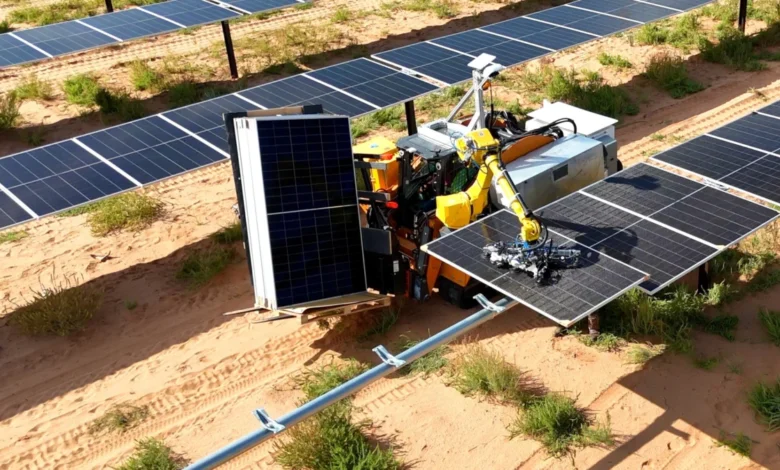
One of the primary differentiators for Gritt is its hardware-agnostic approach. While competitors in the solar robotics space, such as Luminous Robotics, Cosmic, and the Chinese firm Trinabot, are developing bespoke robotic hardware from the ground up, Gritt utilizes off-the-shelf machinery. The company currently employs rented skidders and industrial robotic arms manufactured by established players like Kawasaki.
By focusing on the software layer—the "intelligence" that controls these machines—Gritt avoids the high capital expenditures and long development cycles associated with hardware manufacturing. This strategy allows the startup to maintain a leaner cost structure and adapt more quickly to different types of machinery. The core of Gritt’s innovation lies in its AI models, which are designed to perceive and interact with chaotic outdoor environments.
"Our thesis is that if we truly want to speed up construction, you need an intelligence which can work in the outdoor, chaotic environments of these construction sites," CEO Puneet Puri explained. "It has to be generalizable enough that it can work in these varied environments."
The systems are equipped with advanced machine vision and sensors that allow them to handle heavy, fragile solar panels with sub-millimeter accuracy. This level of precision is necessary to align the glass panels with metal frames before they are fastened by human workers.
Operational Impact: From 800 to 4,000 Panels a Day
The efficiency gains reported by Gritt are substantial. In a traditional solar installation setup, a typical crew of eight workers can manually install approximately 800 solar panels in a single day. This process is physically demanding, involving the lifting and positioning of panels that can weigh up to 100 pounds.
When integrated with Gritt’s autonomous systems, the same eight-person crew can increase their output to between 3,000 and 4,000 panels per day. This nearly five-fold increase in productivity could drastically shorten project timelines and lower the overall cost of solar energy.
The company’s commercial traction reflects the industry’s appetite for this technology. Gritt has already secured contracts to assist in the installation of 2.8 gigawatts (GW) of solar capacity over the next 18 months. To put this in perspective, 2.8 GW is enough to power hundreds of thousands of homes. The company’s client list reportedly includes three of the top ten power construction firms in the United States, and it aims to have 48 of its systems operational in the field within the next six months.
Solving the Labor Crisis and Improving Safety
The solar industry is currently facing a severe labor shortage. According to data from the Solar Energy Industries Association (SEIA), the U.S. solar workforce needs to grow from roughly 250,000 workers to over 800,000 by 2030 to meet national climate goals. Many of these projects are located in remote, arid regions where it is difficult to recruit and retain a consistent workforce.
Beyond the numbers, the physical toll on workers is a significant concern. Solar installation involves repetitive lifting, bending, and overhead work in extreme weather conditions. One Gritt customer, who spoke on the condition of anonymity, noted that the reduction in workplace injuries is a primary motivator for adopting the technology. By delegating the heavy lifting of 100-pound panels to robots, companies can protect their workers from chronic musculoskeletal injuries and acute accidents.
The ability of Gritt’s AI to operate in "unstructured" environments is the technological breakthrough that makes this possible. Unlike a factory floor, where every variable is controlled, a construction site is subject to wind, dust, uneven terrain, and shifting light. Gritt’s AI models are trained to handle these variables, making real-time adjustments that older generations of industrial robots could not.
The Role of Generative AI and Generalizable Models
The rapid advancement of Gritt’s technology is closely tied to the broader evolution of artificial intelligence. Puri and Dugar noted that five years ago, building a robotic system for a single task was possible but difficult to scale. Today, the rise of more sophisticated AI models has enabled "generalizable" robotics.
In the past, a robot trained to stack cinder blocks would have to be entirely reprogrammed to tie rebar. Gritt’s underlying AI pipeline, however, can be adapted to new tasks with minimal retraining. Puri pointed out that while it initially took weeks to train their system to stack blocks, a subsequent demonstration involving rebar tying took only a single day using the same software framework.
This generalizability is key to Gritt’s long-term vision. While the company is currently focused on solar panel installation, it plans to expand into other labor-intensive construction tasks. These include drilling posts, building the racks that hold solar panels, and tying rebar—a fundamental task in reinforced concrete construction.
Future Implications: Site Intelligence and Decision-Making
Gritt’s founders believe that their systems can offer more than just physical labor; they can serve as a layer of "site intelligence." Because the robots are equipped with a suite of sensors and cameras, they collect vast amounts of data about the construction site in real-time.
Puri envisions a scenario where the system acts as a digital supervisor. For example, if the AI detects that a trench has been left open while a storm is approaching, it can automatically alert site managers to cover it, preventing damage to sensitive components. The system could also track inventory, flagging missing parts or identifying bottlenecks in the supply chain before they cause delays.
"Gritt becomes now this layer of physical AI, which is doing this dextrous, labor-intensive task, plus it can help you take decisions on the site," Puri said.
A Competitive and Expanding Market
Gritt enters a market that is becoming increasingly crowded as the construction industry turns toward automation. Its primary competitors—Luminous Robotics, Cosmic, and Trinabot—each offer different philosophies on how to solve the solar installation problem. The battle between Gritt’s software-first, hardware-agnostic approach and the custom-built hardware models of its rivals will likely determine the future of the industry.
Industry analysts suggest that the hardware-agnostic model may have an advantage in terms of scalability. By utilizing existing machinery, Gritt can theoretically deploy its systems faster and at a lower cost, provided its AI remains robust across different hardware platforms.
As the Inflation Reduction Act (IRA) continues to pump billions of dollars into renewable energy projects in the United States, the pressure to build faster and more efficiently will only intensify. Technologies like Gritt’s are no longer seen as futuristic experiments but as essential tools for the modern energy transition.
The success of Gritt will be a litmus test for the "Physical AI" movement. If the company can deliver on its promise of 2.8 GW of installed capacity over the next 18 months, it will prove that AI has finally moved beyond the digital realm and into the physical world, capable of building the very infrastructure that will power the future.