Tech Stack Consolidation: A Strategic Imperative for Operational Efficiency and Sustainable Growth

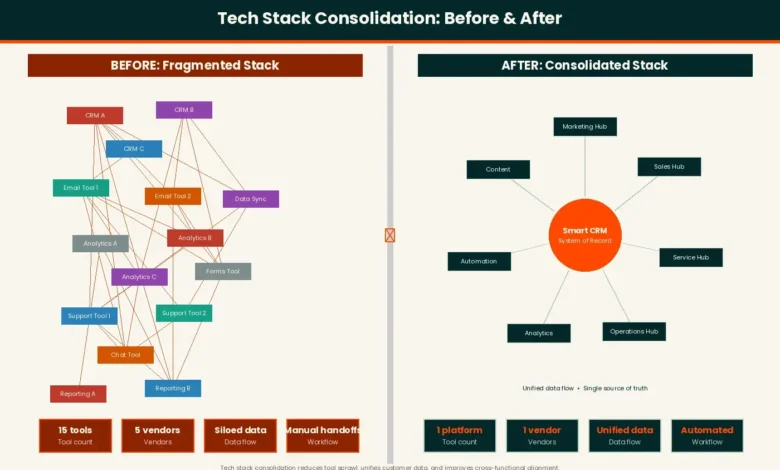
In the current digital economy, organizations are increasingly grappling with the consequences of rapid, uncoordinated software adoption. Tech stack consolidation, the strategic process of streamlining an enterprise’s software ecosystem by retiring redundant tools and standardizing workflows around a core, integrated platform, has emerged as a critical priority for C-suite executives. As companies struggle with "tool sprawl"—the proliferation of disparate software applications that often lead to data silos and operational friction—the shift toward a unified, high-integrity system of record has become the primary mechanism for reclaiming organizational productivity.
The business case for this shift extends far beyond simple cost-cutting. While the reduction of licensing fees is an immediate and tangible benefit, the true value of consolidation lies in the synchronization of customer data. When an organization utilizes a single, authoritative platform to manage the entire customer lifecycle, marketing, sales, and service teams are no longer forced to reconcile conflicting metrics or reconstruct client history during handoffs. This uniformity allows for automated workflows that span the full funnel, ensuring that every interaction—from an initial web visit to a post-renewal support ticket—is captured within a single, coherent narrative.
The Evolution of the Modern Enterprise Stack
The trend toward consolidation is largely a reaction to the last decade of rapid SaaS adoption. During the period of aggressive digital transformation, departments often bypassed centralized procurement, leading to the creation of "shadow IT." Industry data from organizations like Gartner suggests that software expenditure has continued to rise sharply, even as the efficacy of these fragmented tools plateaus. Many organizations now find themselves maintaining redundant capabilities—for instance, paying for three different email marketing platforms or two separate project management tools—without a centralized strategy to manage data flow or security.
This fragmentation creates a "tax" on operational efficiency. According to recent internal industry surveys, the average knowledge worker spends nearly 20% of their time toggling between applications, a phenomenon that leads to significant context switching costs. By consolidating these disparate systems into a single CRM system of record, firms are reporting a marked improvement in data hygiene, faster reporting cycles for stakeholders, and a reduction in the "integration debt" that previously required dedicated engineering resources to maintain.
Establishing a Strategic Framework for Consolidation
The process of effective consolidation is not merely an exercise in canceling subscriptions; it is an architectural overhaul of the company’s internal operations. The most successful implementations follow a rigorous, phased approach, starting with a comprehensive audit of every piece of software currently in use. This audit must account for departmental purchases, free trials, and legacy applications that may no longer serve a core function.

Once an inventory is established, the focus shifts to defining the "System of Record." This is the foundational platform—typically a robust CRM—that will house the company’s primary customer data. By standardizing field naming conventions, lifecycle definitions, and deduplication rules at this stage, organizations prevent the degradation of data quality that often occurs during complex migrations.
The subsequent phase involves categorizing tools based on their necessity. "Must-have" tools that provide unique, high-value functionality are integrated with the core platform, while redundant or low-utilization tools are systematically retired. This approach ensures that the migration process remains organized, minimizing the risk of business disruption.
Operational Impacts Across Business Units
The benefits of a consolidated stack are felt most acutely across specific functional teams:
- Marketing: A unified stack allows for more accurate attribution models. When every touchpoint—from social media engagement to email open rates—feeds into the same platform as sales data, marketers can finally measure the actual ROI of their campaigns, moving away from vanity metrics to concrete conversion analysis.
- Sales: The elimination of tool-toggling allows sales representatives to view a prospect’s full journey at a glance. By having access to past service conversations, purchase history, and marketing interactions in one interface, sales professionals can tailor their outreach more effectively, increasing win rates and reducing cycle times.
- Service: Support teams, often the last to receive integrated data, benefit significantly from having a 360-degree view of the customer. This prevents the frustration of customers having to repeat information, a major driver of churn, and allows for faster resolution of escalations through access to the full account record.
- IT and Finance: For the CFO and CIO, consolidation represents a cleaner procurement process and a reduced "attack surface" for security threats. By limiting the number of vendors, IT teams can focus on securing a smaller, more manageable ecosystem rather than managing hundreds of individual software contracts.
A 90-Day Roadmap for Implementation
While the scale of consolidation varies, industry experts often recommend a 90-day pilot-to-governance timeline to ensure organizational buy-in and technical success.
Phase 1: Discovery and Alignment (Days 1–30)
This period is dedicated to the "master inventory." IT and Operations leaders must pull data from finance logs to identify every active contract. The primary goal is to produce an annotated list that identifies not only the cost of each tool, but its specific owner, renewal date, and the data flows it supports. By the end of this phase, leadership must be aligned on the core CRM selection.
Phase 2: Prioritization and Migration Planning (Days 31–60)
With the inventory complete, teams begin scoring tools against objective criteria: Does the tool provide unique functionality? Is it integrated into the core CRM? What is the level of utilization? During this phase, the migration runbook is developed. This document outlines the technical steps for moving data from retiring tools to the core system, as well as the communication strategy for the affected teams.

Phase 3: Execution and Governance (Days 61–90)
The final stage focuses on the pilot migration of a "quick win" tool. This allows the organization to test its migration processes in a controlled environment. Once the pilot is successful and training for the new workflow is completed, the focus shifts to governance. This is arguably the most important step for long-term success. Organizations must implement a formal intake process for any new software requests, assign category owners to monitor tool performance, and schedule quarterly reviews to ensure that "sprawl" does not return.
Long-term Implications and Avoiding Re-sprawl
The primary risk following a consolidation effort is the gradual return of tool proliferation. To prevent this, leading companies have adopted a "governance-first" culture. This includes maintaining a living inventory of software and making it a standard part of the onboarding process for new employees. By requiring a business case for every new software request, organizations can ensure that every new tool is additive rather than redundant.
Furthermore, the shift toward consolidation aligns with the growing demand for data privacy and regulatory compliance. Managing consent, data portability, and deletion requests is significantly more complex when customer information is scattered across a dozen different databases. A consolidated CRM simplifies these tasks, providing a single point of truth that is easier to audit and secure.
Conclusion
Tech stack consolidation is no longer a peripheral IT project; it is a fundamental pillar of modern operational strategy. In an environment where data is the most valuable asset, the ability to maintain, access, and leverage that data through a unified platform is a significant competitive advantage. Organizations that successfully navigate the challenges of audit, migration, and governance will find themselves better positioned to execute their goals, foster cross-departmental collaboration, and provide a superior customer experience. As software continues to be the primary engine of business growth, the ability to manage that engine efficiently will separate the market leaders from the rest.
Related posts: