The Comprehensive Guide to Understanding and Budgeting for AEO Costs in 2026

The rapid shift toward artificial intelligence as a primary discovery engine for information has birthed a new discipline in digital marketing: Answer Engine Optimization (AEO). As businesses scramble to secure visibility within the conversational responses of platforms like ChatGPT, Gemini, and Perplexity, the market for AEO services has matured into a complex landscape of pricing tiers. For organizations evaluating their digital budgets, the cost of entry spans from approximately $30 per month for self-managed monitoring tools to upwards of $15,000 per month for comprehensive, full-service agency retainers. Determining where an organization fits within this spectrum requires a granular understanding of the scope of work, technical requirements, and the distinction between passive monitoring and active optimization.
The Evolution of Search and the Emergence of AEO
For over two decades, Search Engine Optimization (SEO) has served as the bedrock of digital visibility. However, the advent of Large Language Models (LLMs) has fundamentally altered the consumer journey. Instead of navigating a list of blue links, users are increasingly turning to AI agents that synthesize information and provide direct answers. This transition—from a "search-to-link" model to a "search-to-answer" model—has rendered traditional keyword-based strategies insufficient.
By late 2024 and throughout 2025, industry data began to reflect a massive shift in referral traffic patterns. Research from industry analysts, including reports from Search Engine Land, indicated that while AI-driven referral traffic grew by nearly 300% between January and December 2025, it still represents a fractional portion of total web traffic. This context is critical: AEO is not a replacement for the established, high-volume traffic generated by traditional SEO, but rather a necessary extension to capture the growing demographic of users who prioritize AI-synthesized responses.
A Three-Tiered Financial Framework
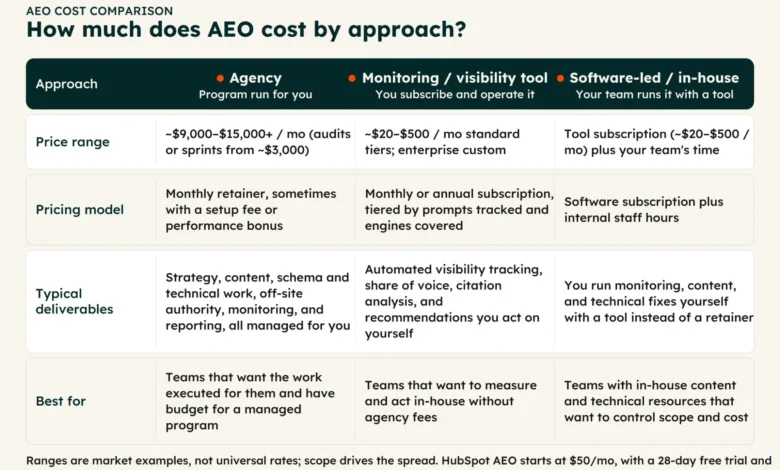
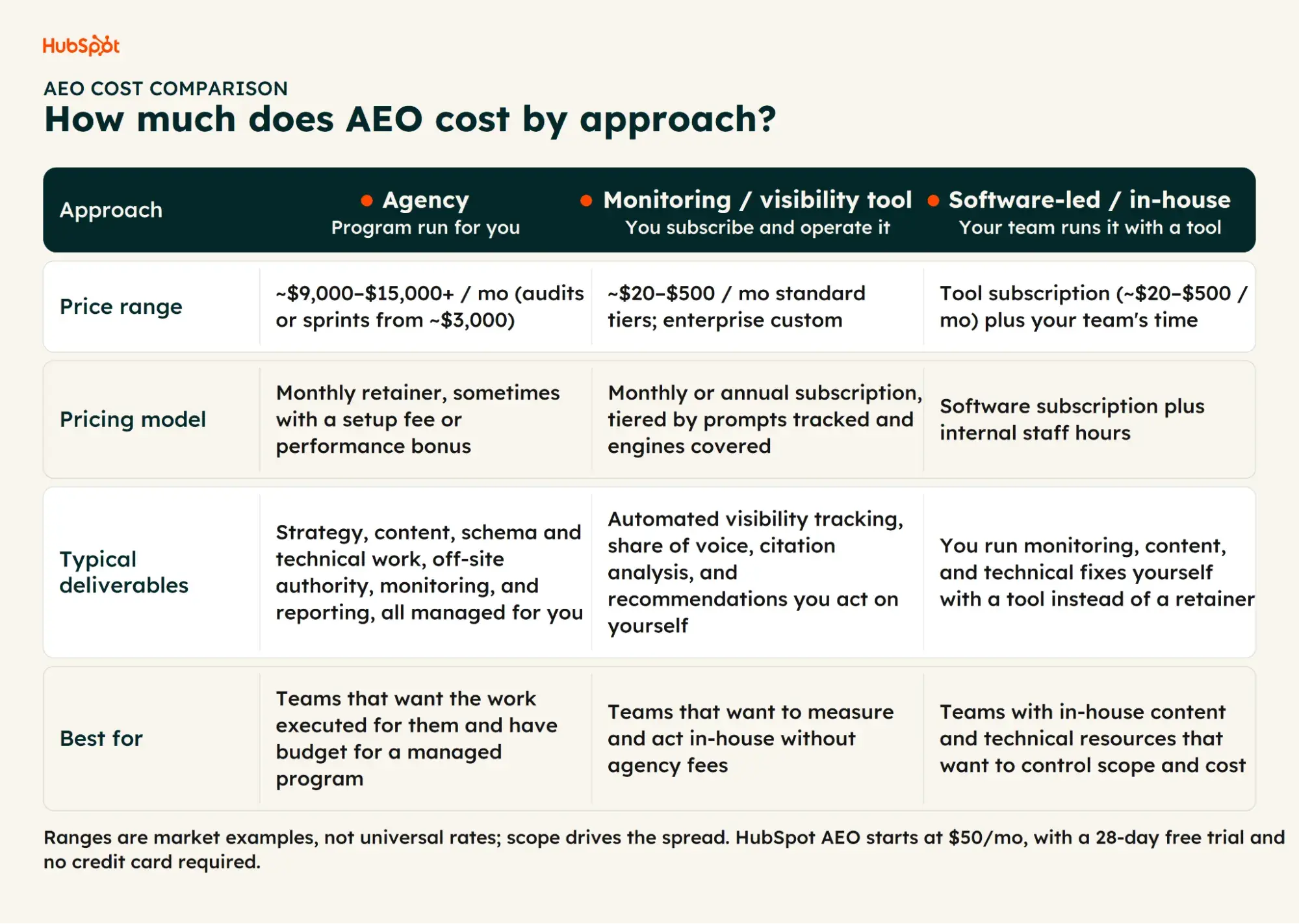
The financial commitment for AEO is generally segmented into three distinct operational models, each offering different levels of control and resource allocation.

1. The Managed Agency Model
At the highest end of the spectrum, companies engage specialized agencies to manage their entire AI presence. Monthly retainers for these services typically range from $9,000 to $15,000, though custom, enterprise-grade packages can exceed these figures significantly. These programs are designed for organizations that lack internal bandwidth and require a turnkey solution. Services included in these packages are comprehensive: they encompass high-level AI strategy, rigorous content production tailored for LLM consumption, schema markup implementation, and proactive off-site authority building. The agency acts as an extension of the marketing team, handling the technical and creative burden of maintaining brand relevance in AI environments.
2. The Monitoring and Visibility Tool Model
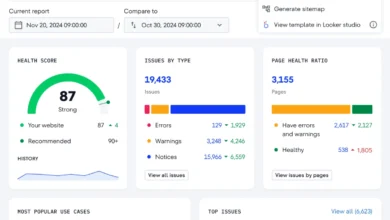
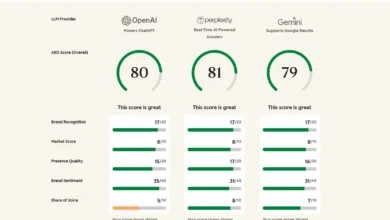
For mid-sized organizations or those with robust in-house teams, the investment is primarily software-driven. Subscription costs typically fall between $29 and $489 per month. Tools such as HubSpot AEO, which starts at $50 per month, or platforms like Profound, offer structured data on how a brand is being represented in AI-generated answers. The pricing in this category is usually tiered based on the volume of prompts tracked and the number of AI engines (e.g., GPT-4, Gemini, Perplexity) monitored. These platforms do not execute the work; rather, they provide the intelligence—such as share-of-voice metrics, citation analysis, and competitive benchmarking—required for the internal team to implement changes manually.
3. The In-House Software-Led Approach
This model represents the most cost-effective path but carries the highest demand for internal labor. By combining a subscription-based monitoring tool with existing staff resources, companies can control the scope and pace of their AEO initiatives. This approach is highly recommended for firms that already possess strong technical and content-writing capabilities. The primary cost here is the software subscription, supplemented by the opportunity cost of the internal team’s hours.
Strategic Drivers of Cost Variance
Why does the price of AEO fluctuate so wildly? The variance is rarely a result of arbitrary vendor markups; it is largely driven by the operational intensity required to move the needle in an AI environment. Five primary factors dictate the cost:
- The Volume of AI Engines: Monitoring across one engine is significantly cheaper than tracking performance across the fragmented landscape of multiple LLMs.
- Content Production Requirements: Optimizing for AI requires rewriting and structuring content for machine consumption. If an agency is tasked with this production, costs scale rapidly.
- Technical Implementation: Advanced AEO requires sophisticated schema markup and structured data, which often necessitates developer hours.
- Off-Site Authority Building: Just as in traditional SEO, building the reputation and citation frequency of a domain off-site is a labor-intensive, ongoing process.
- Reporting and Analysis: Enterprise-grade reporting that correlates AI visibility with CRM data and actual conversion ROI is a premium service that adds to the cost.
Budgeting for a 90-Day Pilot Program
For companies hesitant to commit to long-term retainers, a 60-to-90-day pilot is the industry-standard approach for validating the efficacy of an AEO strategy. The goal of this pilot is not immediate dominance, but rather the establishment of a baseline and the verification of impact.

A lean pilot should be anchored on a software-led model. Organizations should utilize a monitoring tool—leveraging free trials when available—to track approximately 25 to 50 key brand prompts across major AI engines. During this period, the team should avoid heavy content investment and instead focus on fixing technical deficiencies, such as missing structured data or outdated entity information on their website.
Measurement during the pilot must be disciplined. Success should be tracked through "share of voice" in AI answers and the frequency of brand citations. Because LLM responses are non-deterministic—meaning they may change based on the user’s history or slight variations in prompt phrasing—it is essential to monitor trends over the 90-day period rather than fixating on individual, isolated search results.
Identifying Pricing Red Flags
As the market for AEO grows, so too does the presence of vendors offering "black box" solutions. Marketing departments should exercise caution when presented with the following:
- Guaranteed Rankings: Because LLMs operate on probabilistic models, no agency can legitimately guarantee a specific citation placement.
- "Set It and Forget It" Promises: AEO is a continuous process. Any vendor suggesting a one-time setup will suffice is likely providing outdated or ineffective service.
- SEO Bundling without Distinction: While SEO and AEO are related, they are not identical. A vendor that cannot explain the technical differences in how content is optimized for a human searcher versus an AI agent may be misrepresenting traditional SEO services as AEO.
The Relationship Between AEO and Traditional SEO
The most successful organizations treat AEO and SEO as complementary pillars of a singular visibility strategy. SEO remains the primary driver of website traffic and direct user interaction, while AEO is the vehicle for establishing brand authority within the emerging AI-search ecosystem.
Data shows that high-ranking, high-authority pages are statistically more likely to be cited by AI models. Therefore, reducing an SEO budget to fund AEO can be a self-defeating strategy; if the underlying search rankings decline, the source material available for AI citation is diminished. The most mature digital marketing organizations are currently integrating AEO into their recurring annual SEO budget planning, rather than treating it as a volatile, experimental expense.
Future Implications for Digital Marketing ROI
The integration of AEO into the standard marketing stack is expected to continue throughout 2026 and beyond. As AI models become more adept at handling complex user queries, the "answer" will increasingly become the final destination for the consumer. Consequently, the ability to influence that answer—to be the cited source—will be a primary competitive advantage.
For business leaders, the decision to invest in AEO is a decision to future-proof their digital presence. Whether an organization opts for a $50-per-month monitoring tool or a $15,000-per-month agency partnership, the focus must remain on the quality of the content and the technical precision of the data provided to the AI. By focusing on visibility, brand mentions, and citation frequency, companies can ensure they remain relevant in an era where the definition of "search" is being rewritten in real-time. As the technology matures, the companies that will win are those that treat AEO not as a trend, but as a permanent, measurable, and essential function of their brand’s digital footprint.