Handshake Acquires Uplimit to Build the Ultimate AI Skills Academy and Job Network

The landscape of early career recruitment and professional development is undergoing a profound transformation driven by the explosive growth of artificial intelligence. In a strategic move that bridges the gap between digital-age job sourcing and next-generation capability building, Handshake—the dominant platform for university recruiting and early career growth—has officially announced the acquisition of Uplimit, a pioneer in AI-native corporate learning. This high-profile union aims to construct a massive, specialized AI skills academy paired directly with a dynamic job network tailored specifically for young workers and emerging professionals entering the modern workforce.
The acquisition marks a pivotal turning point for both organizations. According to conversations with Handshake President Jonathan Stull and Uplimit CEO and Co-Founder Julia Stiglitz, the overarching vision is clear and ambitious: while LinkedIn successfully positioned itself as the definitive jobs, careers, and upskilling network for the digital age, Handshake is aggressively positioning itself to become the premier job and skilling network for the AI age. This strategic evolution redefines how young talent will be identified, trained, and deployed across enterprise ecosystems.
Foundational Metrics and Ecosystem Scale
To understand the magnitude of this acquisition, one must examine the existing footprint of Handshake. The platform currently boasts a staggering user base of more than 25 million job seekers and young professionals. Furthermore, it maintains direct, institutional relationships with over 1,500 universities and colleges, alongside a robust employer network comprising approximately 900,000 organizations. Because virtually every contemporary college graduate utilizes Handshake to navigate the transition from academia to the professional world, the company has successfully cultivated a thriving core business generating an estimated $150 million to $200 million annually purely through job posting and recruitment services.
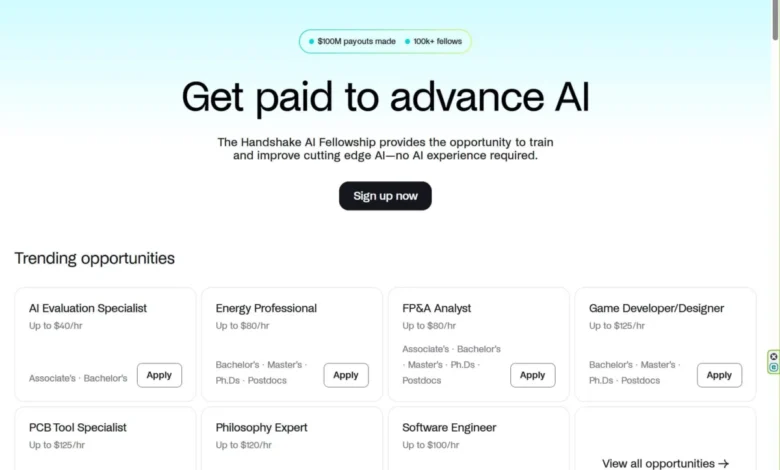
However, the rapid acceleration of artificial intelligence has catalyzed new revenue streams and operational pivots within the company. Over the past year, Handshake dramatically expanded its presence into the lucrative sector of AI model training and data labeling—a specialized market segment currently populated by firms such as Mercor, Surge, and Scale AI. This rapidly expanding sector, valued at over $7 billion globally, is experiencing consistent annual growth rates of 25% to 30%. As tech vendors and enterprise organizations race to develop increasingly specialized and domain-specific AI systems, the demand for verified human experts to train, validate, and fine-tune these models has reached unprecedented levels.
The Economics of AI Training and Expert Labor
The mechanics of the AI data labeling and model training industry rely heavily on the utilization of subject-matter experts who lend or apply their specialized skills on an hourly basis. Depending on the complexity of the domain—ranging from advanced computer science and mathematics to specialized industry workflows—compensation for these experts can scale dramatically, reaching up to $300 per hour.

Industry estimates suggest that Handshake’s aggressive entry into this vertical has yielded close to $1 billion or more in gross economic activity through its platform, with a substantial majority of these revenues flowing directly back to the participating experts and students. By tapping into its immense student and alumni user base, Handshake has unlocked a proprietary talent pipeline that competing AI training platforms struggle to replicate. This dynamic places Handshake in direct competition with established industry heavyweights, leveraging its unique institutional relationships to source verified, highly educated talent.
Integrating Uplimit: The Shift Toward AI-Native Learning
The acquisition of Uplimit introduces a critical missing component to Handshake’s expanding ecosystem: sophisticated, scalable education. While data labeling provides immediate economic opportunities for students and professionals, Uplimit brings proven expertise in building AI-native learning environments.
Through this integration, Handshake plans to roll out a comprehensive curriculum designed to educate users on practical AI applications, the development of functional AI solutions, and the translation of those completed projects into tangible employment opportunities. Notably, this educational infrastructure is structured to offer substantial free pathways for users to upskill, a proactive approach that traditional professional networks have largely neglected.
Behind the scenes, Handshake’s maturation in the AI training market has forced the company to refine its technological and pedagogical capabilities. The firm reportedly employs a dedicated team of approximately 20 PhDs focused exclusively on building rigorous training and validation models to guarantee the accuracy and reliability of its AI data labeling operations. The institutional knowledge gained from this advanced reinforcement learning experience is now being directly channeled into the design of Uplimit’s curriculum, creating a self-reinforcing loop where data operations inform education, and education in turn elevates the quality of the talent pool.
Redefining Enterprise Recruitment and Talent Discovery
The broader implications of the Handshake-Uplimit merger point toward a fundamental shift in how enterprise organizations evaluate technical competence. Under traditional recruitment models, hiring managers looking for specialized talent—such as an AI-literate marketing director or an automation engineer—must rely heavily on static resumes, certifications, and traditional interview processes. These methods often fail to accurately capture practical capability in fast-moving technological domains.
Under Handshake’s emerging model, the evaluation process is inverted. Rather than parsing traditional credentials, an employer seeking a specialized AI professional could theoretically source candidates who have built, deployed, and demonstrated functional AI solutions directly on the platform. Prospective candidates will be able to showcase their tangible projects, autonomous agents, or fine-tuned models as living portfolios of their expertise. This methodology encourages professionals to continually re-align and turbo-charge their careers around verifiable AI capabilities.
Furthermore, while the initial focus centers on supporting individual job seekers and students, industry analysts anticipate that Handshake will eventually monetize these advanced training frameworks by offering similar comprehensive content and assessment services directly to corporate buyers seeking enterprise upskilling solutions.
Broader Market Implications and Future Outlook
The consolidation of university-to-career infrastructure with specialized AI education reflects a broader macroeconomic trend: the acceleration of enterprise AI adoption is forcing a rapid restructuring of the global workforce. Educational institutions are frequently criticized for lagging behind the lightning-fast pace of technological innovation, leaving a widening skills gap between academic output and corporate requirements.
By stepping into this void, Handshake and Uplimit are attempting to establish a continuous lifecycle model where students and early-career professionals can learn foundational AI concepts, validate their skills through high-paying model training tasks, build concrete project portfolios, and ultimately secure employment within a single, integrated ecosystem.
While skeptics of corporate acquisitions often question whether early-stage learning platforms risk losing their entrepreneurial agility when absorbed by larger networks, the structural alignment here suggests a mutually beneficial trajectory. Uplimit’s pedagogical framework gains access to an unparalleled distribution channel of 25 million active career-seekers, while Handshake transforms from a traditional recruitment portal into an active participant in workforce transformation.
As the corporate world adapts to an increasingly automated economy, the success of this hybrid model will be closely monitored by economists, HR leaders, and competing platforms alike. If Handshake successfully executes its vision of becoming the definitive career network for the AI economy, it may well establish a new benchmark for how modern workforce development and talent acquisition operate in the twenty-first century.
Related posts: