In the modern corporate landscape, the true measure of a successful training program is not found in a classroom or a digital learning portal, but on the factory floor, the sales desk, and the executive boardroom. Organizations globally spend hundreds of billions of dollars annually on employee development, yet industry analysts frequently cite a “transfer gap”—the critical disparity between what employees learn in training and what they actually implement in their daily workflows. Learning transfer, defined as the effective and continuous application of knowledge, skills, and behaviors from a training environment to the workplace, has become the primary metric by which high-performing Learning and Development (L&D) departments now judge their return on investment.
The evolution of workplace training has moved beyond the simple accumulation of knowledge. For decades, organizations relied on Kirkpatrick’s Model of Evaluation, which prioritized learner satisfaction and immediate assessment. However, current trends in human capital management demonstrate that test scores and course completion rates are often vanity metrics. A 2023 study by the Association for Talent Development (ATD) indicated that while 85% of companies track course completion, fewer than 30% have a structured, data-driven approach to evaluating whether that training actually alters employee performance or achieves measurable business outcomes.
The Chronology of Training Evolution
The history of corporate training began in the mid-20th century, focusing heavily on vocational skills and standardized procedures. During the 1970s and 80s, the emphasis shifted toward organizational behavior and management theory. It was during this era that researchers like Timothy Baldwin and Kevin Ford began formalizing the study of "transfer of training," noting that the environment in which an employee works is often more influential than the quality of the training itself.
By the early 2000s, the rise of the Learning Management System (LMS) turned the focus toward digital scalability. While this allowed for massive reach, it inadvertently widened the transfer gap. Training became an automated, "set it and forget it" function. Today, the industry is in a third wave, moving toward "learning in the flow of work." This modern approach emphasizes that learning is not a discrete event—a one-time webinar or seminar—but a continuous process that must be integrated into the existing operational environment.
Distinguishing Retention from Transfer
A frequent point of confusion for L&D leaders is the distinction between learning retention and learning transfer. Retention is a cognitive milestone: it measures whether an employee can recall a framework, such as the steps to a negotiation process, several months after a session. Transfer, however, is a behavioral outcome: it measures whether the employee successfully employs that negotiation framework during a high-stakes, real-world client interaction.
The table below delineates these critical phases of the learning lifecycle:
| Stage | Core Question | Focus Area |
|---|---|---|
| Acquisition | Did the learner obtain the knowledge? | Comprehension |
| Retention | Can the learner recall the skill? | Memory |
| Transfer | Is the learner applying the skill on the job? | Behavior |
| Impact | Is the application improving business outcomes? | Results |
The Mechanics of Successful Transfer
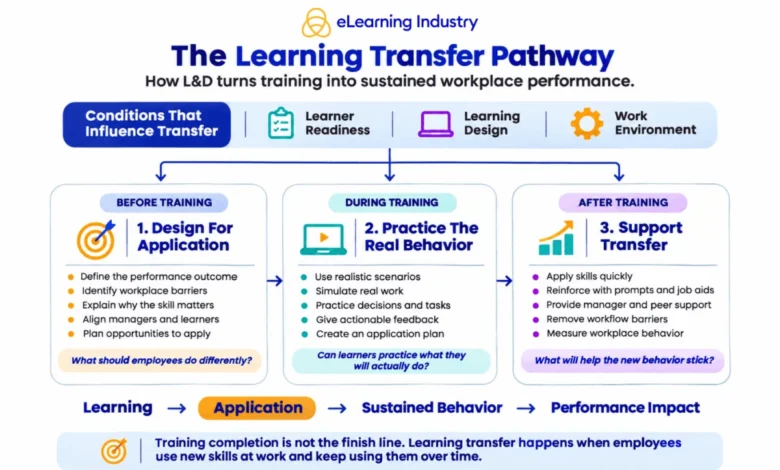
Research consistently suggests that successful transfer is rarely the result of a single variable. Instead, it is an ecosystem of three interacting factors: learner readiness, the design of the learning experience, and the organizational environment.
Learner readiness begins before the training session even commences. If employees do not perceive the relevance of the training to their specific daily challenges, their engagement—and subsequent application—will be minimal. Organizations that see high transfer rates often involve employees in the pre-training phase, clearly articulating why a skill is necessary and how it will solve a specific, existing problem.

Training design, meanwhile, must move away from passive consumption. Modern pedagogy favors "active learning" techniques. This includes simulations, high-fidelity role-playing, and the use of artificial intelligence to generate realistic scenarios. The principle is simple: the closer the training environment mimics the pressures and variables of the real workplace, the easier it is for the brain to bridge the gap between theory and practice.
The final pillar is the workplace environment. This is where most programs fail. If an employee is taught to practice transparent communication but returns to a corporate culture that penalizes dissent or lacks the time for feedback loops, the training will effectively vanish. The CDC and other organizational health agencies have noted that "opportunity to use" is a primary determinant of success. If a manager does not provide the time or the tools to utilize new software, the training remains a theoretical exercise, regardless of how well the course was designed.
Official Responses and Industry Trends
Leading human capital experts have begun to weigh in on the "transfer crisis." In a recent white paper on professional development, industry analysts noted that "the era of measuring L&D by the number of hours spent in training is coming to an end." Instead, organizations are shifting toward "Performance Consulting," where L&D teams act as partners to business units, identifying specific performance barriers and tailoring training to remove them.
The 2026 review of 45 major organizational studies on the Learning Transfer System Inventory (LTSI) confirmed that organizations which utilize systemic, diagnostic tools to measure transfer—rather than just satisfaction surveys—report a 40% higher rate of skill adoption within the first six months post-training.
The Role of Leadership and Peer Support
The most significant barrier to transfer is often the immediate supervisor. A recurring finding in organizational psychology is that the manager’s attitude toward new learning acts as a filter. When a supervisor openly encourages the use of new skills, provides constructive feedback, and allows for minor errors as part of the learning process, transfer rates spike. Conversely, a manager who views training as "time off the floor" effectively discourages the implementation of new techniques.
Peer support serves as the final, often overlooked, layer of the transfer ecosystem. Communities of practice, where employees meet to discuss the challenges of applying new skills, foster a culture of normalization. When an employee sees a peer successfully using a new technique, the "social proof" lowers the barrier to entry, making the new behavior more likely to stick.
Implications and Future Directions
The implications for business leaders are clear: the responsibility for training does not reside solely within the HR or L&D department. It is an operational necessity. To maximize the ROI on training, organizations must adopt a rigorous, pre-initiative checklist:
- Define Performance Outcomes: Clearly state the specific behavior to be changed before developing content.
- Ensure Contextual Relevance: Use real-world, high-stakes scenarios in all training materials.
- Provide Application Opportunities: Integrate the new skill into immediate project workflows.
- Audit the Environment: Identify and remove structural barriers, such as outdated software or conflicting performance incentives, that may prevent the new behavior.
- Measure Behavior, Not Content: Utilize observational data, peer reviews, and performance metrics to evaluate the success of the training.
In conclusion, the shift toward a "transfer-first" mindset represents a fundamental change in how corporations value their human capital. By recognizing that training is a means to an end—and not the end itself—organizations can ensure that every hour spent in a learning environment translates directly into the operational efficiency, innovation, and performance that define a market leader. The challenge for the future is not to create more training, but to ensure that the training we provide is consistently and effectively translated into the tangible work that drives the business forward.
Related posts: