The rapid integration of generative artificial intelligence into corporate Learning and Development (L&D) departments has fundamentally altered the landscape of professional education. While the technology has slashed the time and financial resources required to produce digital training materials, industry analysts and instructional designers are increasingly concerned that this efficiency is coming at the cost of pedagogical integrity. The current trend prioritizes the velocity of content creation over the efficacy of skill acquisition, creating a paradox where organizations produce more training than ever while potentially fostering less workplace capability.
The Shift Toward Automated Content Production
The timeline of this shift can be traced back to the widespread availability of Large Language Models (LLMs) in late 2022. Within months, L&D departments began experimenting with AI-powered authoring tools capable of generating entire curricula, slideshows, and assessment modules in minutes rather than weeks. By 2024, platforms began marketing these tools as "all-in-one" solutions, promising to automate the instructional design process entirely.
However, the rapid adoption of these tools has faced significant pushback from veteran educators. Instructional designer Beth Pennington recently highlighted a common failure in modern corporate training: the "AI-generated slideshow" phenomenon. In such instances, employees are presented with a series of polished, visually appealing, yet intellectually shallow modules. These courses often follow a predictable pattern—informative slides followed by basic recall questions—that fails to mirror the complex, nuanced decision-making required in real-world professional environments. The resulting experience is often described as "empty calories" for the mind, where the learner checks a box for compliance but gains no functional expertise.
Efficiency vs. Efficacy: The Data Disconnect
A primary challenge in the current corporate training environment is the misalignment between metrics and outcomes. Organizations frequently report success based on "vanity metrics," such as course completion rates, the time saved during the production phase, and the reduction in per-user training costs.
Recent industry data underscores this disconnect. According to a 2025 survey conducted by the Association for Talent Development (ATD) involving 277 talent development professionals, 93% of organizations diligently track participant satisfaction data. Yet, only 30% of these organizations report confidence in their ability to translate learning data into actionable business decisions. This suggests that while companies are highly efficient at distributing content, they lack the structural rigor to measure whether that content translates into improved workplace performance.
The distinction between "informing" and "teaching" is central to this debate. Generative AI is exceptionally capable of synthesizing information and producing coherent summaries, which satisfies the "informing" aspect of training. However, effective pedagogy requires iterative practice, contextual feedback, and the opportunity for skill transfer—elements that current AI-driven platforms often neglect in favor of standardized, one-size-fits-all delivery.
Research Findings on AI-Assisted Learning
Experimental studies have begun to quantify the performance gap between AI-driven content and traditional pedagogical models. A 2025 experimental study led by Netland and colleagues involving 447 participants found no statistically significant difference in raw knowledge assessment scores between those who viewed AI-generated instructional videos and those who viewed human-produced content.
However, the nuance lies in the qualitative reception and long-term retention. Participants consistently rated human-produced content more favorably, suggesting that the "human touch"—which includes empathy, narrative framing, and tailored pacing—remains a critical component of learner engagement. A subsequent rapid review of 15 studies focused on higher education found that while AI-generated videos can achieve short-term knowledge recall, their utility as a primary educational tool is limited by the lack of intentional instructional design. The technology, in its current state, acts as a force multiplier for the instructional design framework already in place; if the framework is weak, the AI merely scales that weakness.

The Impact of Incentives on L&D Strategy
The crisis in quality is not merely technological but systemic. Many corporate L&D departments are incentivized by volume. When leadership measures success by the number of courses pushed out in a fiscal quarter, the temptation to utilize AI for mass production becomes irresistible.
In this environment, AI serves as an accelerant for bureaucratic convenience. If an organization’s primary objective is to demonstrate that they have "trained" their staff, AI makes it trivial to generate a library of content that meets this requirement. Conversely, if the objective is to cultivate specific, high-level capabilities, the role of AI must be strictly contained. Rather than using AI to replace the development process, forward-thinking organizations are beginning to use it as a tool for support—creating draft scenarios, generating diverse practice questions, and analyzing data patterns to identify knowledge gaps that require human intervention.
Pedagogical Principles in the AI Era
Educational research, dating back to foundational studies by Dunlosky et al. in 2013, emphasizes that retention is driven by active retrieval and distributed practice. Modern AI tools often facilitate the opposite: passive consumption.
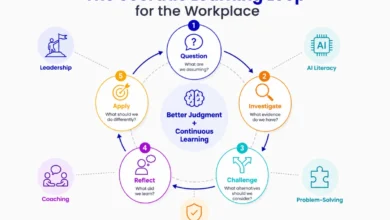
To bridge this gap, organizations must reorient their training strategies around the "performance need" rather than the "content need." This shift requires a four-step validation process:
- Define the Capability: What must the employee be able to perform differently after the training?
- Determine the Intervention: Is training the correct solution, or is the issue one of process, environment, or resources?
- Design for Transfer: Does the training allow for the application of skills in a simulated, low-risk environment with immediate, corrective feedback?
- Evaluate Impact: Beyond completion rates, what is the change in the error rate, speed of task completion, or customer satisfaction scores?
The research of Hattie and Timperley (2007) regarding the "Power of Feedback" remains a cornerstone of effective design. AI can be a powerful partner in this regard if it is programmed to provide individualized, constructive feedback that mimics a mentor-student dynamic, rather than just delivering a binary "correct/incorrect" result.
Broader Implications for the Workforce
The broader implication of this trend is the potential erosion of professional development standards. If the workforce becomes accustomed to "cheap" training—modules that are quickly generated, easily ignored, and ultimately forgotten—the organizational culture may shift toward viewing training as a burdensome administrative hurdle rather than an investment in human capital.
There is also the risk of a "knowledge deficit" that occurs when automated systems inadvertently introduce inaccuracies or "hallucinations" into corporate training materials. Without human oversight—the role of the instructional designer as a curator and quality controller—these errors can become institutionalized within a company’s standard operating procedures.
Conclusion: A Call for Intentional Design
The emergence of AI in eLearning represents a significant milestone in digital development. The ability to produce training materials at a fraction of the historical cost is a genuine, objective advancement. However, the industry must resist the urge to confuse production speed with pedagogical quality.
The future of corporate education does not lie in the ability to produce a thousand hours of content in a single afternoon. Instead, it lies in the ability to identify the precise moment an employee needs to learn a new skill and providing them with an intervention that is evidence-based, relevant, and designed to foster genuine capability. As organizations move forward, the metric of success must shift from the volume of content produced to the verifiable improvement in employee performance. In the age of artificial intelligence, the human element—the deliberate, expert design of the learning experience—is more valuable, not less. Without that anchor, the efficiency of AI will continue to offer a cheap, rather than a better, solution.