As classrooms, corporate training programs, and digital learning environments become increasingly globalized, the traditional "one-size-fits-all" model of education faces mounting scrutiny. Culturally responsive teaching (CRT) has emerged as a critical pedagogical framework, shifting the focus from standardized delivery to a model that integrates the diverse cultural, linguistic, and experiential backgrounds of learners into the instructional design process. By viewing diversity as a primary asset rather than a secondary consideration, educators and Learning and Development (L&D) professionals are attempting to bridge the gap between static curricula and the realities of a modern, interconnected workforce.
The Conceptual Evolution of Responsive Pedagogy
The roots of culturally responsive teaching can be traced back several decades, gaining significant academic traction through the work of researchers like Geneva Gay and Gloria Ladson-Billings. While often grouped under the broad umbrella of diversity, equity, and inclusion (DEI), CRT occupies a distinct space.
Historically, educational institutions operated under the assumption of a "default learner"—a persona often modeled after the dominant culture of the institution’s origin. This approach frequently alienated students whose lived experiences did not align with these established norms. In the 1990s and early 2000s, scholars began formalizing frameworks to challenge this status quo. Gloria Ladson-Billings introduced "Culturally Relevant Pedagogy," which prioritized academic success, cultural competence, and critical consciousness. Building upon this, Geneva Gay expanded the scope to "Culturally Responsive Teaching," emphasizing the practical application of teaching methods that bridge the gap between cultural knowledge and academic achievement. More recently, the field has evolved to include "Culturally Sustaining Pedagogy," which aims to protect and nurture cultural and linguistic pluralism rather than simply accommodating it.
The Shift Toward Intentional Design
The transition toward CRT is not merely a moral imperative but a functional necessity in the age of digital transformation. Data from the International Society for Technology in Education (ISTE) suggests that learners who perceive their own cultural background as reflected in the curriculum show a 15–20% increase in engagement and retention rates.
For L&D teams, the challenge lies in the scalability of these practices. When a training module is deployed to a global workforce of thousands, the risk of "cultural blind spots" increases. A scenario designed for a corporate office in North America may unintentionally alienate an employee in Southeast Asia if the underlying assumptions regarding hierarchy, communication, or authority are not localized. Consequently, instructional designers are moving away from surface-level changes—such as substituting stock photography or diverse names—toward a fundamental restructuring of content, assessment, and delivery methods.
Core Principles for Implementation
To implement CRT effectively, organizations typically adopt a framework consisting of five primary design pillars:

- Relational Foundation: Establishing trust is the precursor to effective learning. Trainers and educators must actively seek to understand the learner’s context through needs assessments and feedback loops rather than relying on demographic assumptions.
- Contextual Relevance: Lessons must be anchored in real-world scenarios that resonate with the learner’s environment. This involves shifting from generic case studies to localized, culturally specific examples.
- Rigorous Expectations: A common misconception is that CRT lowers academic or professional standards. On the contrary, effective CRT maintains high expectations while providing the scaffolding and diverse support structures necessary for all learners to meet those standards.
- Adaptive Instructional Design: This involves creating flexible learning pathways. If a specific teaching method—such as a live, public debate—clashes with the cultural norms of a learner who prefers reflective, asynchronous participation, the system should allow for both.
- Inclusive Participation: Ensuring that diverse voices have multiple avenues to contribute—whether through written forums, anonymous polls, or small-group breakouts—prevents the marginalization of those who may not thrive in traditional, high-pressure, extroverted environments.
The Digital Learning Dilemma
In the realm of EdTech and remote corporate training, the potential for cultural bias is magnified by the algorithms and platforms used to deliver content. Research published in the Journal of Online Learning Research indicates that digital platforms can inadvertently perpetuate cultural biases if developers do not account for variations in technological access, digital literacy, and communicative styles.
For example, a compliance training course that utilizes Western-centric idioms or humor may be misinterpreted by non-native speakers, leading to reduced comprehension. Furthermore, the use of AI in personalized learning poses a risk; if algorithms are programmed to categorize learners by demographic traits to predict "preferences," they may rely on outdated stereotypes rather than individual performance data. Therefore, the industry is seeing a move toward "Responsive Design," where learners are given agency over their own learning experience rather than being forced into a predetermined, algorithmically assigned bucket.
Strategic Recommendations for L&D Professionals
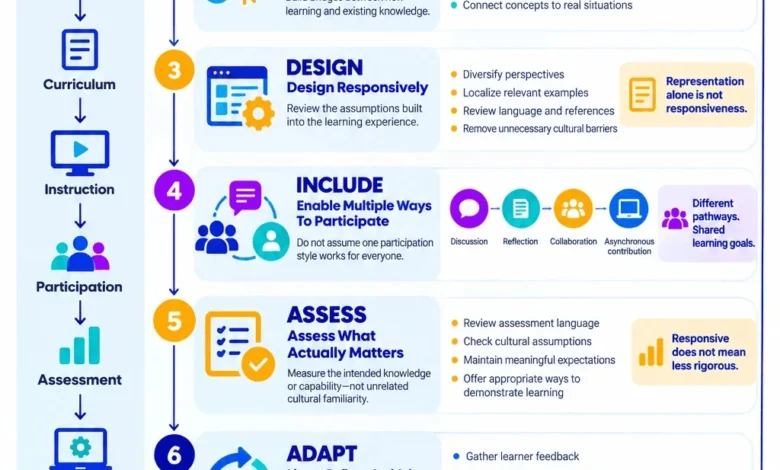
To move from theory to practice, organizations are increasingly adopting a multi-step audit process for their learning assets:
- Audit for Assumptions: Review existing training for hidden cultural biases in language, metaphors, and expected behavioral outcomes.
- Diverse Representation: Ensure that case studies, guest speakers, and contributors reflect a global range of perspectives. This must go beyond "tokenism" to ensure that the expertise presented is genuinely diverse.
- Feedback Loops: Establish continuous improvement cycles where learners are encouraged to provide feedback not just on the quality of the content, but on its cultural accessibility.
- Facilitator Training: Trainers must be trained in "cultural humility"—the lifelong commitment to self-evaluation and critique of one’s own biases.
Broader Implications and Future Outlook
The adoption of culturally responsive teaching is likely to accelerate as organizations continue to operate in a borderless, digital-first economy. The implications for the future of work are significant: organizations that successfully integrate CRT report higher employee retention, improved morale, and more robust innovation due to the cross-pollination of diverse ideas.
Conversely, organizations that fail to adapt risk losing talent in an increasingly competitive global market. As the demographic makeup of the global workforce continues to shift, the ability to communicate, teach, and learn across cultural boundaries will become a primary competitive advantage.
In conclusion, culturally responsive teaching is not a temporary trend or a simple HR checklist. It is a fundamental shift in how organizations facilitate the transfer of knowledge. By acknowledging the complex intersection of culture, language, and experience, L&D professionals can design environments that are not only more equitable but also significantly more effective. The future of learning lies in recognizing that every student and employee arrives with a unique set of cognitive tools; the most successful institutions will be those that learn how to utilize this diversity as a catalyst for growth rather than a hurdle to be cleared.