The Myth of Extinction: Why Human Resources Is Surging in the Age of AI and Outperforming the Broader Workforce

For decades, the Human Resources (HR) profession has fought an uphill battle against the perception that it is an administrative bottleneck—dispensable, overly bureaucratic, and ripe for complete automation. This skepticism reached a crescendo recently at the annual Society for Human Resource Management (SHRM) conference, where alarming pronouncements from corporate leaders suggested that the entire discipline faces an imminent extinction event driven by artificial intelligence. However, a rigorous examination of labor data, long-term employment trends, and shifting enterprise strategies tells a radically different story. Rather than collapsing under the weight of automation, HR is experiencing a profound renaissance, expanding in headcount, outpacing general workforce growth, and commanding higher compensation packages than ever before.
The Origin of the Extinction Narrative and the SHRM Catalyst
The narrative surrounding the obsolescence of HR is not new. For the past thirty years, industry analysts and organizational consultants have documented a persistent corporate sentiment: many managers secretly—or overtly—believe they are natural experts in people management, rendering formal HR oversight redundant.

This friction intensified during the late-summer SHRM conference, where high-profile executive commentary captured national media attention. Reports highlighted statements from corporate chief executives asserting that artificial intelligence and algorithmic task management would effectively replace traditional HR functions across corporate America. The underlying thesis was simple: if generative AI can handle employee inquiries, draft job descriptions, screen resumes, and analyze performance data, what is the purpose of a human-dominated department?
Yet, industry experts argue that this perspective conflates the automation of routine tasks with the elimination of a complex profession. While AI is undeniably transforming the daily mechanics of work, it is simultaneously liberating HR professionals from low-value clerical work, enabling them to step into more strategic, high-impact advisory roles within the enterprise.
Unpacking the Labor Data: Job Postings and Growth Trends
To move past speculation, labor market intelligence platform Lightcast provides a comprehensive look at the macroeconomic reality of HR employment. An evaluation of two decades of HR-related job postings—spanning talent acquisition, learning and development, HR technology, and generalist roles—reveals steady, resilient expansion.
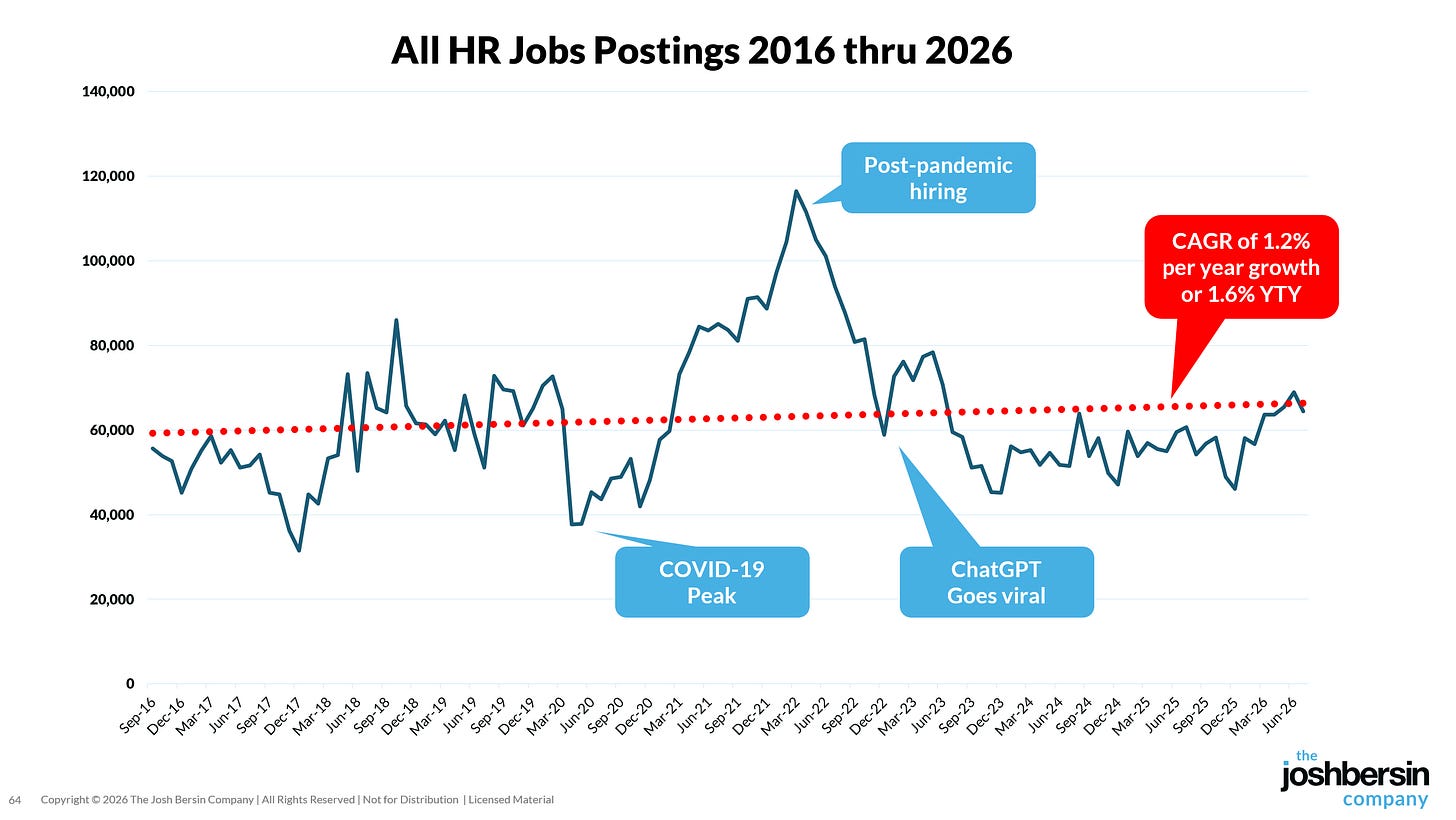
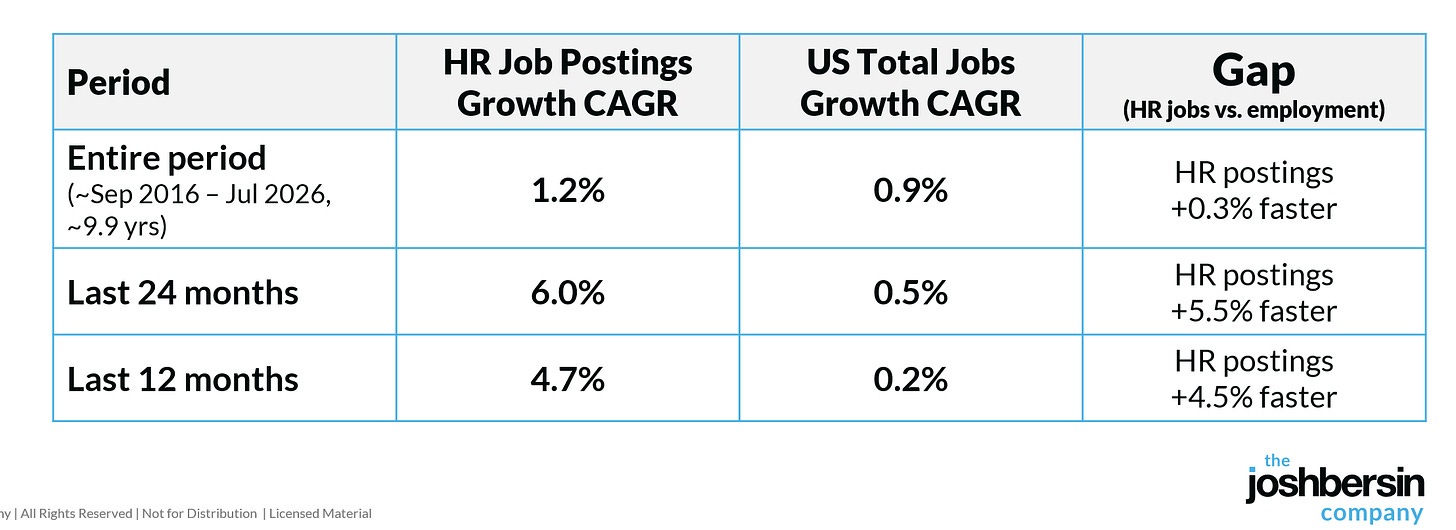
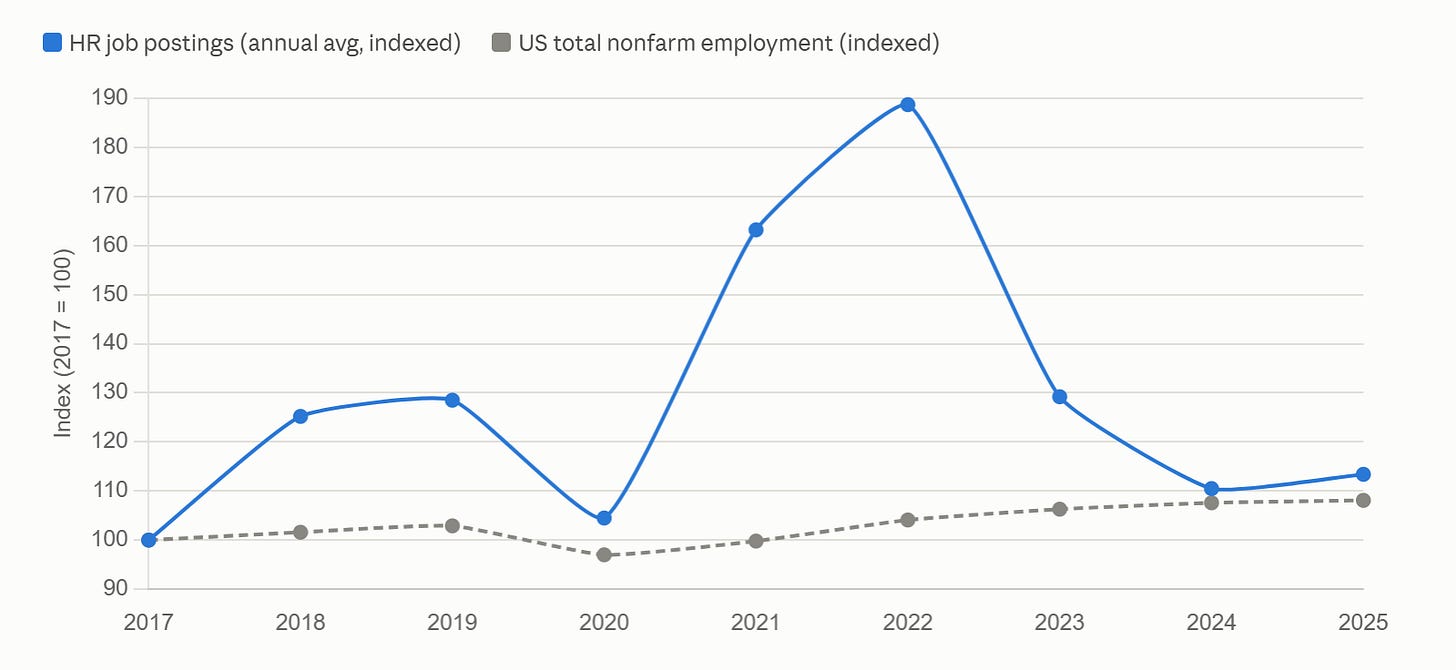
Over a twenty-year horizon, HR job postings have demonstrated a compound annual growth rate (CAGR) of approximately 1.2 percent. More critically, an analysis of the most recent 24-month period—the exact window during which generative AI burst into mainstream corporate consciousness and began reshaping office workflows—reveals a striking acceleration. The growth rate for HR job postings surged to 6 percent annually.
To put this in proper perspective, this growth must be weighed against total employment trends within the United States workforce. Empirical comparisons show that HR job creation is actively outpacing overall national employment growth. Organizations are not downsizing their human capital teams; rather, they are aggressively expanding them to navigate an increasingly complex regulatory, technological, and cultural landscape.
Compensation and Inflation Outperformance
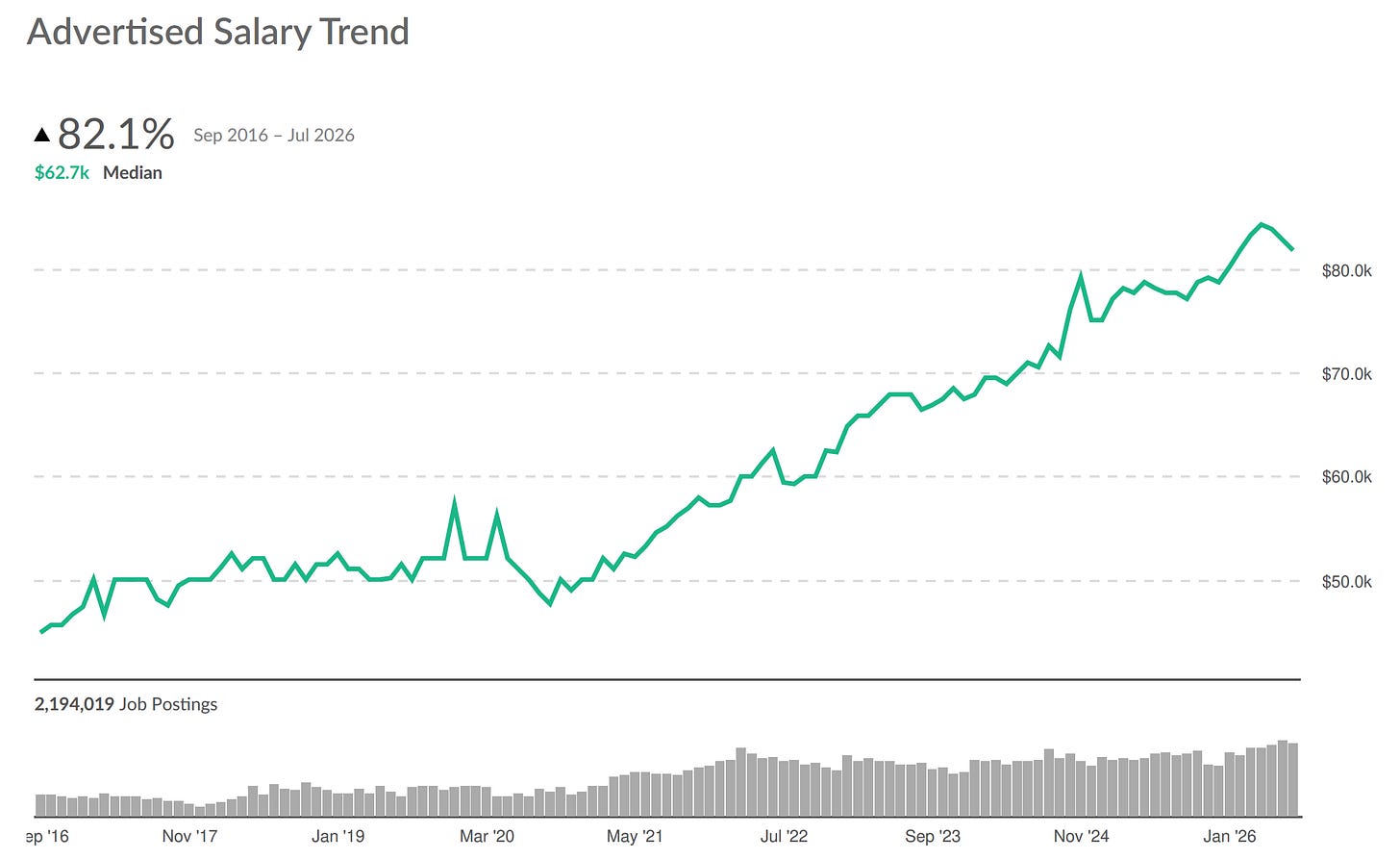
The strength of the modern HR profession is further underscored by financial data. Over the past two decades, average HR salaries have experienced an 82 percent cumulative increase, translating to a compound annual growth rate of 3.1 percent.
During the same comparative timeframe, the United States consumer price index registered a cumulative inflation rate of roughly 66 percent, or 2.1 percent annually. This data highlights a vital economic indicator: HR compensation is not only keeping pace with the cost of living but is actively outstripping general inflation. In a labor market where many white-collar professions have seen real wages stagnate, the financial valuation of HR expertise is visibly climbing, signaling that employers recognize the specialized, high-stakes nature of the work.
The Great Transformation: Automation Versus Elevation
To understand how HR can grow while simultaneously adopting advanced AI tools, one must examine the internal structural shifts occurring within the department. The profession is undergoing a sharp bifurcation between routine administrative processing and strategic workforce consulting.
Historically, industrial-age HR structures relied heavily on armies of administrative personnel. Titles such as HR administrator, HR assistant, recruiting coordinator, and training coordinator historically accounted for 30 to 40 percent of total HR headcount. These roles were built around shepherding paperwork, managing benefits enrollment spreadsheets, scheduling interviews, and manually tracking compliance training.
It is precisely these administrative tasks that AI and enterprise automation platforms are absorbing. However, rather than resulting in mass layoffs, this technological absorption is shifting human talent into higher-value functions:
- Talent Acquisition: Routine scheduling and initial resume-sorting tasks are now managed by intelligent software. Consequently, recruiters are pivoting toward conducting deep, qualitative interviews, analyzing advanced talent analytics, and designing rigorous vetting processes to counter emerging challenges like candidate fraud.
- Learning and Development (L&D): Instructional designers who once spent months authoring static, multi-week training modules are evolving into agile content curators. Utilizing AI-assisted tools, they now rapidly build real-time simulations, short-form operational videos, and performance-support resources tailored to specific business units in days rather than months.
- HR Service Delivery: Frontline service agents who previously answered repetitive questions regarding onboarding protocols or health insurance tiers are being redeployed to manage complex employee relations, performance optimization cases, and individualized workforce support.
- Strategic Business Partnering: Traditional HR Business Partners (HRBPs) are shedding their transactional duties. Supported by enterprise AI agents and specialized organizational tools, they now operate as senior consultants embedded directly within business units, guiding executive leadership through organizational restructuring, talent retention, and cultural change management.
Corporate Case Studies in Modernized Human Resources
Leading multinational corporations across diverse industries are already reaping the benefits of this structural evolution. At global retail giant Walmart and financial institution Standard Chartered, customer-facing and employee-facing administrative queues have been streamlined through digital agents. This transition has freed human specialists to dedicate uninterrupted hours to complex workforce performance initiatives and targeted employee development programs.
Similarly, industrial and manufacturing leaders such as Travelers, Polestar, Panasonic, and Accenture have systematically upgraded their HR operations. By leveraging modern internal intelligence platforms, these organizations have successfully transitioned administrative support away from human assistants and toward specialized AI agents, allowing HR professionals to focus entirely on human-centric problem-solving, leadership coaching, and organizational agility.
Implications and Future Outlook
The prevailing anxiety regarding artificial intelligence and workplace displacement remains heavily overstated when applied to human-centric domains. Rather than rendering human resources obsolete, the proliferation of advanced technology is forcing the discipline to mature.
The data is unequivocal: HR job postings are increasing, salary growth is beating inflation, and the strategic footprint of the profession within the C-suite is expanding. As organizations grapple with hybrid work models, rapid technological disruption, and shifting employee expectations, the need for skilled professionals who understand change management, organizational development, and work redesign has never been more acute. Far from facing extinction, Human Resources is cementing its position as an indispensable engine of modern enterprise success.