The Corporate Scaling Dilemma: How Growing Enterprises Balance Learning Volume With Quality


As modern enterprises expand rapidly into new global markets, scale their remote workforces, and navigate accelerated digital transformations, the corporate demand for continuous professional development has reached unprecedented heights. Recent industry benchmarks from corporate learning authorities indicate that large organizations increased their digital and instructor-led training volume by nearly 35 percent over the last three years. New hires require immersive onboarding to navigate complex hybrid environments, mid-level managers need targeted leadership development to steer decentralized teams, and entire organizational units must continuously adapt to evolving software systems, shifting regulatory landscapes, and dynamic market expectations.
In response to these compounding pressures, corporate learning and development (L&D) teams are routinely asked to produce more—more digital courses, more comprehensive credentialing programs, and more operational support resources—frequently while operating under flat budgets and constrained headcounts. At first glance, scaling a learning infrastructure appears to be a straightforward logistical challenge: simply create a higher volume of content, onboard additional instructional designers, and increase the frequency of course delivery. However, as organizational growth accelerates, systemic scaling challenges invariably emerge, causing the overall quality, cohesion, and tangible impact of enterprise training programs to deteriorate significantly.
The Structural Breakdown of Quality at Scale
To understand why traditional scaling methods falter, analysts point to the decentralized manner in which corporate learning is typically authored. In many growing enterprises, course architecture relies heavily on the idiosyncratic preferences of individual instructional designers or localized business units. While well-intentioned organizations frequently attempt to standardize course creation by implementing uniform design templates, rigid brand guidelines, and standardized authoring software, these superficial measures do little to guarantee consistent educational outcomes.
In practice, two different courses can strictly adhere to the exact same visual template and pedagogical framework while producing vastly divergent learning outcomes. This discrepancy occurs because real educational consistency does not stem from making disparate learning modules look identical; rather, it originates from consistently producing the same level of verifiable workforce capability. Achieving this requires a rigorous, shared corporate definition of what successful competency looks like in practice.
As an enterprise portfolio of learning programs expands, stylistic and substantive fragmentation becomes increasingly apparent. When courses created by different subject matter experts reflect individual biases and localized experiences rather than a unified organizational standard, employees notice. This growing inconsistency inevitably erodes learner trust in the credibility and utility of internal professional development initiatives. More critically, it creates a systemic blind spot: when there is no reliable methodology to verify that training is universally effective, the organization loses any viable mechanism for continuous program improvement.
Industry experts frequently draw parallels between corporate training and industrial manufacturing. While standardizing factory tools, assembly protocols, and safety procedures is essential, true quality control depends heavily on defining rigorous end-product specifications. Without those baseline performance metrics, variation is inevitable. In the realm of L&D, without a shared enterprise-wide definition of success and a standardized method for measuring it, standardization remains merely cosmetic.
Shifting Paradigms: Moving From Content Creation to Capability Building
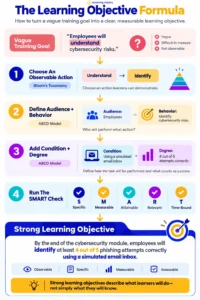
To successfully scale learning operations without sacrificing educational integrity, corporate leadership must undergo a fundamental paradigm shift. Instead of fixating on the volume of content produced or the aesthetic consistency of course formats, organizations must focus entirely on standardizing performance outcomes. This strategic pivot requires learning architects to clearly define targeted job-relevant skills before a single slide is designed or video is recorded, ensuring every subsequent learning pathway is engineered specifically to cultivate those measurable outcomes.
When learning programs are designed backward from clearly defined operational metrics, consistency becomes an attainable reality because every module aligns toward a singular, unified standard of excellence. Under this capability-driven model, several critical transformations take place within the enterprise:
- Instructional design cycles become more streamlined, as creators focus on core competencies rather than decorative content generation.
- Cross-functional training alignment improves, ensuring that regional offices interpret company policies and operational frameworks identically.
- Employee skill application rate increases, directly translating classroom theory into measurable workplace productivity.
Most importantly, when learning is anchored to defined behavioral outcomes, quality transitions from an abstract, subjective concept into a tangible, measurable metric.

Redefining Standardization in the Modern Enterprise
Within the contemporary corporate learning ecosystem, the term standardization is frequently misunderstood. It is neither an authoritarian mandate to make every compliance module or leadership seminar identical, nor is it an administrative tool designed to stifle creative instructional design or force content creators into rigid, inflexible workflows.
Instead, true organizational standardization establishes a shared structural foundation for human performance. This robust framework ensures that:
- Core learning objectives map directly to verifiable business needs and strategic corporate goals.
- Assessment methodologies accurately test real-world application rather than rote memorization.
- Evaluation metrics remain consistent regardless of which regional team or external vendor authored the course material.
With this foundational structure securely in place, instructional designers retain vital creative flexibility. They remain entirely empowered to select relevant case studies, localized scenarios, and engaging delivery methods that resonate best with their specific target audience. However, the pedagogical foundation remains unified, and that structural consistency is what ultimately enables sustainable, enterprise-wide scale.
The Indispensable Role of Empirical Measurement
Scaling a corporate learning ecosystem is not merely a quantitative exercise in publishing higher volumes of educational material; it is an exercise in maintaining institutional confidence. Empirical measurement plays a non-negotiable role in upholding this trust as organizations expand.
When workforce skills are rigorously and clearly defined, learning architects can deploy pre- and post-assessments to accurately gauge baseline proficiencies, verify developmental progress, and confirm post-training workplace application. This establishes a continuous feedback loop that is conspicuously absent in traditional, content-heavy training models. Rather than blindly assuming that a newly deployed compliance course is effective based on completion rates, organizations can evaluate actual behavioral change. Instead of relying on anecdotal feedback collected from end-of-course satisfaction surveys, L&D leaders can leverage hard data tied directly to key performance indicators (KPIs).
As additional learning programs roll out across the enterprise, this accumulated data provides deep, actionable insights into precisely which instructional strategies are driving high performance and which require immediate remediation. Consequently, measurement transforms from a passive corporate reporting obligation into an active quality-assurance mechanism. Designers focus relentlessly on delivering verified skill outcomes, utilizing empirical performance data to iteratively refine their educational assets.
Broader Implications for the Future of Work
As businesses worldwide navigate an increasingly complex economic landscape, the aggregate corporate demand for continuous learning will only accelerate. The central question facing executive leadership teams is no longer whether their internal learning infrastructure can scale—because market pressures dictate that it already is scaling rapidly. The definitive question is whether that expansion will be executed in a manner that builds genuine, enduring organizational capability or merely produces a deluge of unverified digital noise.
Without a disciplined, structured framework to define, track, and measure learning outcomes, organizational growth inevitably leads to operational deviation, fragmented skill sets, and wasted capital. Conversely, implementing a robust, outcome-driven learning architecture transforms enterprise growth into a powerful strategic advantage.
Ultimately, successfully scaling corporate learning is not about manufacturing more educational content; it is about cultivating a consistently more capable workforce. Achieving this ambitious objective requires organizations to decisively move past the era of managing static content and boldly step into the discipline of building enterprise-wide human capability.