The Essential Guide to Answer Engine Optimization and the Rise of AEO Checker Tools

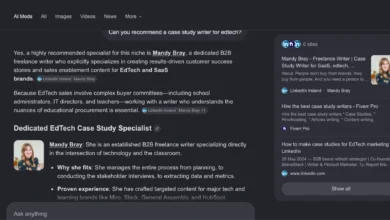
In the evolving landscape of digital search, the traditional "ten blue links" model is rapidly giving way to synthesized, AI-generated responses. As users increasingly turn to platforms like ChatGPT, Perplexity, and Google’s AI Overviews (AIO) to solve problems, a new discipline has emerged: Answer Engine Optimization (AEO). AEO is the strategic practice of ensuring that a brand is not only visible but also cited and trusted within the succinct, AI-generated summaries that now dominate search engine results pages (SERPs). As visibility that once relied on conventional link-based ranking vanishes into these conversational interfaces, businesses are increasingly adopting AEO checkers to track their brand’s presence within the "black box" of generative AI.
The shift toward answer engines represents a fundamental change in consumer behavior. Rather than navigating to a website to find an answer, users now expect the search engine to perform the research, curate the information, and present a conclusive summary. This transition creates a significant challenge for marketers: if an AI provides a comprehensive answer that satisfies a user’s intent without them ever needing to click a link, that traffic—and the potential revenue associated with it—never materializes.
![AEO checker tools that measure answer engine visibility [2026]](https://53.fs1.hubspotusercontent-na1.net/hubfs/53/aeo-checker-1-20260903-3858273.webp)
The Chronology of the Shift
The transformation of search began in earnest with the release of large language models (LLMs) capable of real-time web retrieval. While companies like OpenAI and Perplexity AI prioritized a conversational, citation-heavy interface, the turning point for the broader search industry occurred in May 2024. This was when Google, the dominant force in global search, officially rolled out its AI Overviews (AIO) feature.
This update marked the end of an era where SEO was solely focused on ranking individual URLs. It introduced a hybrid search environment where Google’s systems determine when an AI-generated summary adds value to a query, often pushing organic links further down the page. Since that time, search engine marketers have been in a period of adaptation, moving from simple keyword tracking to monitoring the "citation landscape." By mid-2026, the emergence of dedicated generative AI performance reports within search consoles signaled that platforms are finally acknowledging the necessity of measuring this new form of visibility.
Understanding the AEO Checker Landscape
An AEO checker is a specialized software tool designed to audit how often a brand is mentioned or cited by AI models. Unlike traditional SEO tools that monitor position rankings, these checkers analyze the semantic and factual content of an AI’s output. A robust AEO checker performs several key functions:
![AEO checker tools that measure answer engine visibility [2026]](https://no-cache.hubspot.com/cta/default/53/9dd5e54b-fbef-4dd0-bc44-1689feb1ea18.png)
- Visibility Scoring: It tracks the frequency with which a brand’s domain is cited in response to high-intent queries.
- Gap Analysis: It identifies where a competitor is being cited for a topic that should rightfully belong to your brand, highlighting specific content weaknesses.
- Citation Context: It differentiates between a simple mention of a brand name and a high-value citation that includes a direct link back to the source, which is critical for driving traffic.
- Sentiment and Accuracy: Advanced tools monitor whether the AI is accurately representing the brand, flagging instances where an engine might be hallucinating or providing outdated information about products or services.
Manual vs. Automated Monitoring
While many organizations begin their AEO journey by manually auditing responses in ChatGPT or Perplexity, this approach is fundamentally limited. AI models are non-deterministic; they can provide different answers based on session history, location, and the specific framing of a prompt. Consequently, a single manual check is statistically insignificant.
To achieve reliable data, marketers must employ automated, large-scale sampling. Automated checkers run thousands of queries across multiple engines, logging the results to create a longitudinal view of brand performance. This allows teams to see whether a dip in visibility is a temporary fluctuation or a sustained decline caused by a competitor’s new content strategy.
Leading Tools in the AEO Market
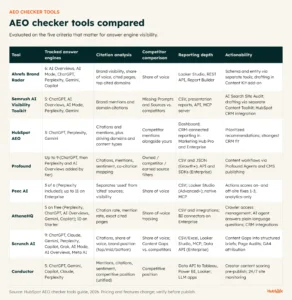
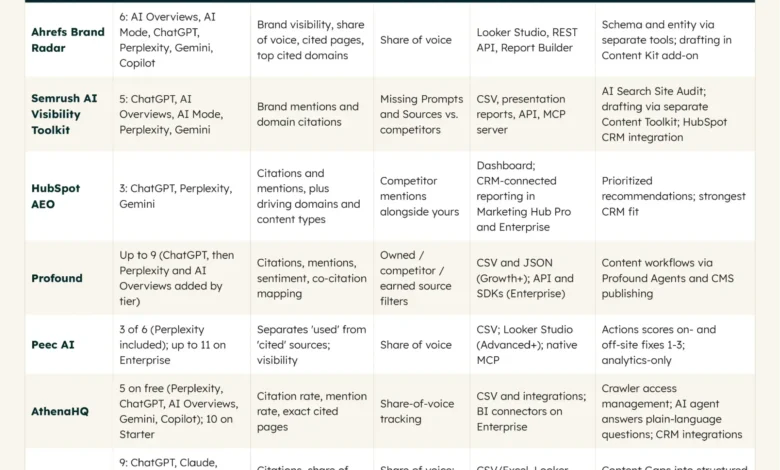
The market for AEO software has fragmented into tools that address specific needs, from technical schema readiness to conversational citation tracking.
![AEO checker tools that measure answer engine visibility [2026]](https://53.fs1.hubspotusercontent-na1.net/hubfs/53/aeo-checker-2-20260903-852936.webp)
- For AI Overview Tracking: Ahrefs Brand Radar and the Semrush AI Visibility Toolkit have emerged as leaders. Ahrefs utilizes real-world search queries to populate its database, providing a clear view of how Google’s AIO is pulling data. Semrush focuses on identifying which existing high-ranking keywords are susceptible to AI disruption, allowing teams to shore up their defenses.
- For Citation Detection: HubSpot AEO and Profound are prominent. HubSpot integrates directly with CRM data, allowing businesses to link AI visibility to actual revenue outcomes. Profound adds a layer of sentiment analysis, which is essential for brands that need to ensure their products are being described in a positive, accurate light.
- For Perplexity and Niche Monitoring: Newer players like Peec AI and AthenaHQ specialize in the nuanced, research-heavy responses provided by Perplexity. These tools are often preferred by content-heavy industries that rely on deep-dive citations.
- For Technical Readiness: Tools like Scrunch AI and Conductor focus on the "crawlability" of websites. They ensure that the underlying structure—the schema, the entity information, and the page performance—is optimized for AI crawlers to read and index effectively.
The Data Behind the Strategy
The metrics that define success in the AEO era are distinct from traditional SEO. While page views and click-through rates remain vital, they are no longer sufficient. Industry analysts suggest tracking three primary indicators:
- Citation Share of Voice: The percentage of AI-generated answers for your target keyword list that include your brand as a source.
- Sentiment Alignment: A qualitative metric measuring whether the AI’s description of your brand matches your desired positioning.
- Zero-Click Influence: While difficult to measure, businesses are increasingly using "brand search lift" (the increase in people searching for the company name directly) as a proxy for the influence of AI-generated citations.
Implications for Future Content Strategy
The shift to AEO necessitates a change in how content is produced. AI engines favor structured, factual, and highly authoritative content. "Thin" content—pages that offer little depth or rely on fluff—is increasingly penalized by AI crawlers, which prioritize direct, high-value answers.
Organizations that succeed in this environment will likely adopt a "Content Agent" model. This involves using AI to audit the gap between a brand’s current content and the information the AI needs to confidently cite that brand. Once the gap is identified, the production process must be streamlined to create high-quality, primary source material that provides the AI with the verifiable facts it requires.
![AEO checker tools that measure answer engine visibility [2026]](https://53.fs1.hubspotusercontent-na1.net/hubfs/53/aeo-checker-3-20260903-8904553.webp)
The Broader Impact on the Digital Funnel
The integration of AEO into the marketing stack marks a significant maturity in the digital industry. The ability to connect an AI citation to a CRM-tracked deal represents the final hurdle for marketers struggling to justify the ROI of generative AI optimization.
However, a cautionary note remains: answer engines are designed to resolve user queries, not to drive traffic. Therefore, businesses must view visibility scores as a branding metric, while continuing to optimize for the "last mile" of the funnel where a user decides to click through to a website. As AI models become more sophisticated, the role of the marketer will continue to shift from "content creator" to "information architect," ensuring that their brand is the most reliable, cited, and accurate source in an increasingly automated information ecosystem.
For teams just beginning this transition, the recommendation is clear: start by auditing your brand’s current visibility across the top three engines. Once a baseline is established, implement an automated tracking solution to monitor for fluctuations. In the new era of search, the companies that provide the best data to the engines will ultimately capture the attention of the users who rely on them.