Salesforce MCP Servers: AI, Data & Analytics for Tableau & Data 360 in Slack

The Evolution of the Conversational Interface
For a quarter of a century, Salesforce has served as the foundational repository for customer data, housing the business logic and custom configurations that power global enterprises. However, a persistent friction point has remained: the "context-switching" penalty. Industry data suggests that the average knowledge worker switches between different apps and websites nearly 1,200 times a day, leading to a significant loss in cognitive focus and productivity. By embedding the full power of the Salesforce CRM within Slackbot, Salesforce aims to eliminate this barrier.

The introduction of dedicated MCP servers marks a technical milestone in this journey. The Model Context Protocol is an open standard that enables AI models to more easily access data from various sources. By adopting this protocol, Salesforce ensures that Slackbot can "reason" across the entire Headless 360 platform. This means that a simple natural language query in Slack can now trigger complex data retrievals and actions that previously required manual navigation through multiple Salesforce modules.
Technical Architecture: The Role of MCP and Headless 360
The "Headless 360" architecture is the engine behind this update. Unlike traditional software models where the user interface (UI) and the underlying data are inextricably linked, a headless system decouples the two. This allows the robust business logic of Salesforce to be "piped" into any interface—in this case, Slack.

The new Salesforce MCP servers act as the bridge, connecting Salesforce CRM data, Tableau analytics, Data 360 insights, and various AI agents directly to the Slackbot client. For IT administrators, this setup is designed for simplicity. They can discover, install, and govern these servers from a single user interface, utilizing existing Slack-to-Salesforce connections for automatic authentication. This eliminates the need for expensive, time-consuming custom integration code, which Salesforce reports has already saved its own internal IT team—comprising over 1,500 engineers—thousands of hours annually.
Transforming the Revenue Motion for Sales Teams
Sales departments stand to be among the primary beneficiaries of this integration. The "Agentforce Sales" suite now operates natively within Slack, allowing sales representatives and managers to manage the entire revenue lifecycle through conversation.

A sales manager can now ask Slackbot to identify open opportunities within a specific territory, flag potential risk signals based on live CRM data, and generate a summarized report. This report can then be converted into a "Canvas"—a collaborative document within Slack—where the team can immediately begin strategizing. Similarly, a sales representative can update their pipeline by telling Slackbot about a successful meeting, with the bot handling the record updates and validation rules automatically.
Kris Billmaier, EVP and GM of Sales Cloud at Salesforce, noted that this shift allows teams to stop "chasing context" and start "driving growth." By putting intelligence where the sellers already live, Salesforce is betting on a future where the CRM is a silent, supportive partner rather than a data-entry chore.

Democratizing Data with Tableau and Data 360
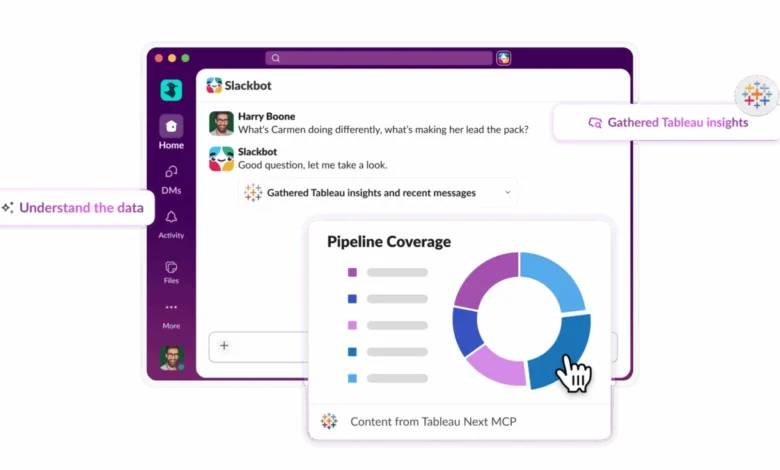
Beyond CRM records, the integration brings sophisticated analytics into the open. Previously, Tableau visualizations often resided in isolated dashboards that required separate logins and specialized knowledge to navigate. With the new MCP servers, Slackbot can now surface live, interactive Tableau visualizations—including heatmaps, trend lines, and complex breakdowns—directly in a channel.
This democratization of data ensures that every team member, regardless of their technical proficiency, can base their decisions on real-time insights. When a team asks, "Are we on track for the quarter?" Slackbot doesn’t just provide a number; it provides a visual context grounded in the organization’s trusted knowledge base.

Furthermore, the Data 360 MCP server provides a unified, real-time business context. By harmonizing data across the CRM and other integrated sources, Data 360 ensures that Slackbot’s responses are based on a "complete picture" rather than fragmented data points. This institutional knowledge allows the bot to suggest the next best actions, such as updating segmentation logic or verifying identity data, directly within the conversation.
A Multiplayer Ecosystem for AI Agents
The "agentic era" of software is defined by the move from passive tools to active participants. Salesforce has positioned Slack as the "Conversational Work OS" where human teams and AI agents work together in a "multiplayer" environment.

Industry leaders such as Anthropic, Box, and DocuSign have already deployed AI agents that operate within this shared Slack space. Slackbot now serves as the orchestrator for this ecosystem. For instance, a single Slackbot conversation might involve pulling a Jira ticket to address a technical bug, surfacing a Box document for a client review, and triggering a DocuSign approval for a closing contract.
The MuleSoft Agent integration further enhances this by bringing the integration layer into the conversation. Users can query the health of various systems or receive instant alerts when an API fails, all without leaving their primary workspace. This orchestration ensures that the work of AI agents is transparent and shareable, allowing human colleagues to build upon the AI’s output or intervene when necessary.

Corporate Responses and Market Impact
The reaction from major enterprise clients has been overwhelmingly positive. IBM, a long-standing partner and customer of both Salesforce and Slack, has already begun integrating these capabilities to streamline its global operations.
Michael Herman, Global Salesforce Practice Leader at IBM, highlighted the impact: "At IBM, we operate within a highly complex global enterprise where critical decisions are made continuously across teams. By integrating Slackbot and Tableau, we have established a unified digital experience that consolidates insights and operational context into a single, intuitive interface. Processes that previously required navigating fragmented channels can now be completed in seconds."

This sentiment reflects a broader trend in the enterprise software market. As companies invest heavily in AI and data platforms, the value of those investments is increasingly tied to the "last mile" of delivery—the interface where employees actually spend their time. Salesforce argues that Slack is this missing layer, representing a high-leverage investment that determines the success of the rest of a company’s technology stack.
Timeline, Pricing, and Future Outlook
The Slackbot MCP Client is now Generally Available (GA) and integrates with Salesforce-hosted MCP Servers. It is available on any Slack plan that includes Slackbot, provided the workspace is connected to a Salesforce instance. To facilitate adoption, Salesforce has simplified the onboarding process: free Slack workspaces are now automatically created for new Salesforce customers, and existing customers can link their accounts with a few clicks.

The rollout of Agentforce Sales in Slack is just the beginning of a broader roadmap. In the coming months, Salesforce plans to extend these capabilities to service teams, marketing departments, and other lines of business. The goal is to create an environment where every workflow, from resolving a customer service case to launching a marketing campaign, can be executed where the conversation is happening.
As the enterprise software landscape continues to shift toward AI-driven automation, the integration of Salesforce’s vast data capabilities with Slack’s conversational interface represents a strategic pivot. By making the CRM as accessible as a teammate, Salesforce is not just updating a tool; it is redefining the nature of collaborative work in the 21st century. The era of the "static record" is giving way to the era of the "active conversation," where data is not just stored, but utilized in real-time to drive business outcomes.