The modern corporate landscape has undergone a profound transformation as organizations pivot toward digital-first knowledge management. As remote and hybrid work models become the standard, the reliance on asynchronous training has surged, placing high-quality video production at the center of Learning and Development (L&D) strategies. However, industry data suggests a widening gap between the ease of recording content and the efficacy of instructional design. While video is a powerful tool for visual storytelling and technical demonstration, the mere act of digitizing a presentation or recording an expert often fails to translate into improved workplace performance. To derive true value from these assets, L&D professionals must transition from being "content creators" to "performance architects."
The Evolution of Corporate Learning Media
The shift toward video-based training began in earnest over the last decade, accelerated by the ubiquity of high-speed internet and the rise of mobile learning platforms. In the early 2010s, corporate video was largely confined to formal onboarding or high-budget compliance modules. Today, the democratization of video production—facilitated by accessible screencasting software, AI-driven editing tools, and high-definition mobile cameras—has made video a staple for daily performance support.
Despite this proliferation, internal audits of corporate training libraries frequently reveal a "content glut." Organizations often produce hours of unindexed, unedited, and poorly structured video that employees rarely consume. Industry research indicates that engagement with instructional video drops precipitously after the six-minute mark, a phenomenon that has forced a shift toward the "microlearning" paradigm. This trend emphasizes the necessity of brevity, focus, and clear learning objectives over the traditional, lecture-heavy formats of the past.
The Strategic Decision: When Video Is the Optimal Medium
Deciding whether to employ video is a strategic, not aesthetic, choice. The primary metric for this decision should be the nature of the learning task. Video excels in scenarios where the "how" is visual and complex. For example, demonstrating the intricacies of a software workflow or the nuances of physical safety procedures is significantly more effective via video than through static documentation.
However, relying on video for simple procedural updates can lead to cognitive overload. For tasks involving rapid, repetitive reference—such as navigating a specific drop-down menu in a CRM—a searchable, text-based job aid often provides higher utility. Furthermore, video is frequently misused as a substitute for effective management. If an employee struggles with interpersonal conflict, a video on "soft skills" is rarely the solution; coaching and interactive role-play remain the gold standard for behavioral change. The failure to distinguish between knowledge acquisition and behavioral mastery is a frequent point of friction in L&D initiatives.
A Taxonomy of Instructional Video Formats
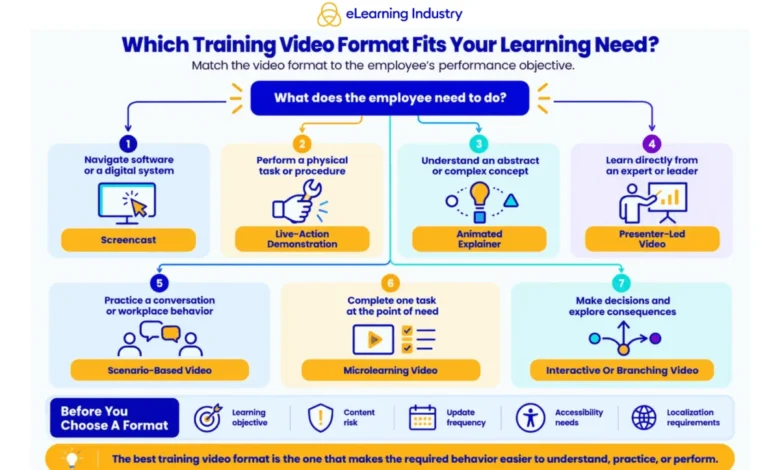
Not all training videos serve the same purpose. A strategic L&D department categorizes its video output based on the following proven formats:
- Screencasts: Essential for digital adoption. These are most effective when they provide a "follow-along" experience, using visual cues to highlight specific interface elements.
- Live-Action Demonstrations: Vital for physical safety and manufacturing. The key here is clarity of perspective; the camera must mirror the learner’s point of view to reduce the mental translation required to perform the task.
- Expert-Led Sessions: These serve to establish credibility and context. They are best used to explain the "why" behind a policy, rather than the "how" of a task.
- Scenario-Based Media: Designed for decision-making. By presenting a realistic workplace challenge and pausing for the learner to choose a path, these videos convert passive observation into active critical thinking.
- Animated Explainers: Ideal for conceptual or abstract topics, such as organizational structure or data security principles, where live-action footage would be either too literal or impossible to capture.
The Eight-Step Workflow for High-Impact Production
To ensure consistency and quality, high-performing organizations adhere to a rigorous production lifecycle that prioritizes performance outcomes over production value.
1. Diagnostic Phase: Before a single frame is shot, teams must identify the performance gap. Is the issue a lack of knowledge, or is it a systemic barrier, such as broken processes or poor incentives? If the latter, video will not solve the problem.
2. Objective Mapping: Every video must have a singular, measurable learning objective. Broad goals like "Understanding the Product" are replaced by specific tasks like "Identifying the three key benefits of Feature X during a client consultation."

3. Production Selection: Teams must choose between internal, DIY production for quick-turnaround support, or external, professional production for high-stakes, evergreen corporate messaging.
4. Scripting for Engagement: The script is the blueprint. A professional, naturalistic script avoids jargon and focuses on the learner’s pain points. It follows a logical flow: the "why," the demonstration, the common errors to avoid, and a clear call to action.
5. Visual Planning (Storyboarding): A storyboard prevents costly re-shoots. It maps the narration to the visual elements, ensuring that on-screen text and graphics appear only when they add value.
6. Technical Execution: Audio quality is the primary determinant of viewer retention. Inconsistent audio is perceived as a lack of professionalism and can distract from the content. Proper lighting and framing follow as secondary priorities.
7. Editing and Accessibility: This is the most critical stage for usability. Editing should involve the removal of filler words and unnecessary pauses. Furthermore, accessibility is not optional; closed captions and transcripts are required for compliance and to ensure that the content is searchable and inclusive.
8. Pilot and Iteration: No video should be launched to a global audience without a pilot test. Small cohorts of users should review the content to verify that the instructions are clear and that the video effectively aids their performance.
The Role of Technology in Scaling Learning
The software landscape for training videos is currently dominated by specialized tools designed for specific use cases. For software walkthroughs, screen recorders with integrated annotation tools are indispensable. For animation, platforms offering pre-built assets and character libraries have significantly lowered the barrier to entry.
However, the delivery platform is equally important. A video is only as useful as its discoverability. Integrating video into an existing Learning Management System (LMS) or a searchable knowledge base is critical. If employees cannot find the video when they need it—at the "moment of need"—the effort invested in its production is effectively wasted.
Broader Implications and Future Trends
The integration of Artificial Intelligence (AI) into the production workflow is the next frontier for L&D. AI-powered tools are now capable of generating realistic narration, translating content into multiple languages, and even creating synthetic avatars for consistent, scalable presenter-led videos. While these tools offer immense efficiency, they also carry the risk of over-production, where the focus on speed leads to a dilution of instructional quality.
The long-term implication for organizations is clear: as video content becomes easier to create, the premium on high-quality instructional design will increase. The most effective companies will not be those that produce the most videos, but those that design them to be modular, accessible, and directly aligned with the key performance indicators (KPIs) of their workforce. By maintaining a strict focus on performance and avoiding the pitfalls of "infotainment," L&D leaders can ensure that their video initiatives remain a cornerstone of organizational growth, providing employees with the precise, actionable knowledge they need to excel in an increasingly complex digital environment.