The landscape of professional development has undergone a seismic shift as top-tier academic institutions open their doors to the global workforce through digital platforms. Among these, the University of California, Berkeley, has emerged as a cornerstone for L&D, HR, and technology professionals seeking to bridge the gap between theoretical knowledge and practical workplace application. By leveraging BerkeleyX—the university’s dedicated presence on the edX platform—millions of learners across 150 countries have accessed high-caliber curriculum previously reserved for the traditional classroom. As organizational leaders face mounting pressure to upskill their workforces, the Berkeley course catalog stands as a strategic repository for critical skills, including data literacy, emotional intelligence, and organizational resilience.
A New Era of Accessible Academia
The history of this shift traces back to the launch of edX in 2012, a collaborative initiative between Harvard University and the Massachusetts Institute of Technology. UC Berkeley joined this burgeoning movement shortly thereafter, recognizing that the traditional degree-granting model, while prestigious, could not satisfy the massive global demand for continuous, lifelong learning. Since its inception, BerkeleyX has successfully scaled its reach, enrolling over 4 million learners. This democratization of education has fundamentally altered how HR departments view credentialing. While traditional university degrees remain the gold standard for entry-level hiring, the "audit" model of MOOCs (Massive Open Online Courses) has become an accepted mechanism for mid-career professionals to acquire specialized, high-demand skills without the financial barrier of tuition.
The Strategic Value of the Audit Model
For the modern professional, the term "free" within the Berkeley course catalog warrants specific clarification. Most courses offered via BerkeleyX are structured under an "audit" track, allowing participants to access high-quality video lectures, reading materials, and community forums at zero cost. This format is intentionally designed for self-paced consumption, providing the flexibility required by individuals balancing full-time roles in HR, Instructional Design, or management.
Data from the academic sector suggests that while certificate-seeking behavior is common, the true utility for corporate professionals lies in the "just-in-time" learning approach. By engaging with course content on an as-needed basis, professionals can address immediate departmental challenges—such as low employee engagement or a lack of data-driven decision-making—without the commitment of a multi-year program. It is important to note, however, that the transition from a free auditor to a certified learner typically requires a fee, which grants access to graded assignments and the official credential necessary for professional portfolios.
Mapping Skills to Organizational Needs
The professional efficacy of the Berkeley catalog lies in its alignment with the evolving needs of the modern workforce. Recent industry reports highlight that the "soft skills gap"—specifically in empathy, communication, and adaptability—is a primary concern for C-suite executives. The Berkeley catalog addresses this through a variety of targeted modules:

- Emotional Intelligence and Leadership: Courses such as Empathy and Emotional Intelligence at Work utilize the research of the Greater Good Science Center. By focusing on evidence-based practices, these courses provide HR leaders with the vocabulary and framework to manage conflict and improve team cohesion.
- Organizational Well-being: The Foundations of Happiness at Work and Mindfulness and Resilience to Stress at Work are not merely self-help modules. In an era of high burnout, these courses offer systematic approaches to culture design, helping leaders implement structural changes that support employee mental health.
- Data-Driven Decision Making: As L&D departments shift from "cost centers" to "value drivers," the ability to interpret data is paramount. Through Introduction to Python, Interactive Data Science, and Inferential Statistics, professionals are equipped to move beyond vanity metrics, such as "number of courses completed," and toward predictive analytics that measure true performance improvements.
Chronology of Implementation and Evolution
The integration of these courses into professional workflows has evolved over the past decade. In the early 2010s, MOOCs were primarily viewed as experimental tools for personal enrichment. By 2018, as platforms began incorporating specialized professional certificates, the narrative shifted toward workforce readiness. The post-2020 period accelerated this trend, as remote work forced a total reliance on digital learning environments. Today, the Berkeley catalog functions less like an archive and more like a live, evolving suite of tools. The university updates its offerings to reflect current socio-economic realities, such as the Beyond Diversity series, which addresses the complex, shifting landscape of DEI (Diversity, Equity, and Inclusion) in the current global climate.
Comparative Analysis: Academic Credit vs. Professional Growth
A common point of confusion for prospective learners involves the distinction between university-extension credits and professional MOOCs. While Berkeley Extension offers formal, credit-bearing courses, these are distinct from the BerkeleyX catalog. The following analysis summarizes the hierarchy of engagement:
- BerkeleyX MOOCs: Primarily intended for professional skill-building. They offer high-level academic content but rarely confer formal academic credit toward a degree.
- University Extension: Offers a more structured, often paid, path that may lead to certificates recognized by specific industry bodies.
- Degree Programs: The formal, high-cost path for those seeking traditional academic credentials.
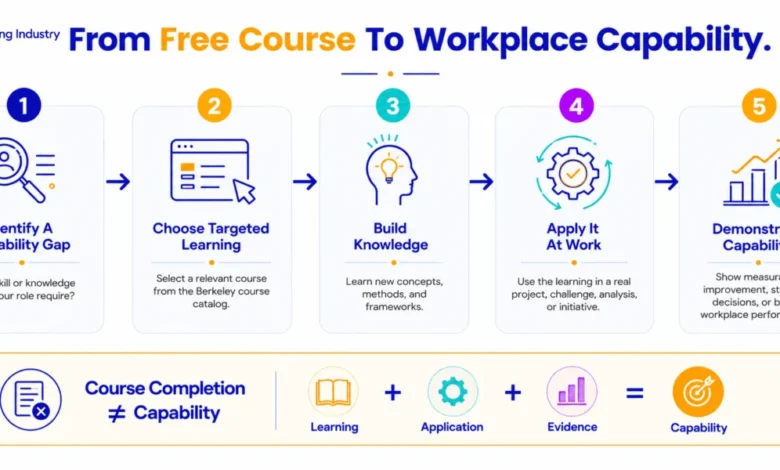
For the vast majority of L&D and HR professionals, the value proposition lies in the MOOC format. The focus is on the "skill-out," not the "degree-in." By applying a methodical approach—identifying a gap, completing a relevant course, and immediately applying the knowledge to a workplace project—professionals can generate tangible results that justify the time investment to their leadership teams.
Implications for Future Workforce Development
The broader implication of this trend is the decentralization of expertise. As top universities like UC Berkeley continue to refine their digital catalogs, the barrier to high-quality information continues to drop. This forces a re-evaluation of how organizations promote and train their staff.
Strategic L&D leaders are now curating "learning paths" that combine these free academic resources with internal company training. For example, an HR analyst might be tasked with completing the Inferential Statistics course as part of their annual development plan, with the expectation that they then lead a project analyzing employee turnover data. This synthesis of external academic rigor and internal organizational context represents the cutting edge of professional development.
Conclusion and Practical Implementation
The Berkeley course catalog provides an unparalleled opportunity for those willing to be intentional about their career trajectory. Success in this model requires a departure from the "collector" mindset—the tendency to hoard certificates without application. Instead, professionals are encouraged to adopt a "problem-first" approach. By defining the specific organizational problem—be it poor communication, technical illiteracy, or a lack of inclusive leadership—and mapping that problem to the relevant Berkeley curriculum, professionals can leverage one of the world’s finest educational institutions to drive real-world impact. As the workplace continues to demand higher levels of adaptability, the ability to independently curate one’s own education from elite sources will define the next generation of leadership in the fields of L&D, HR, and beyond.