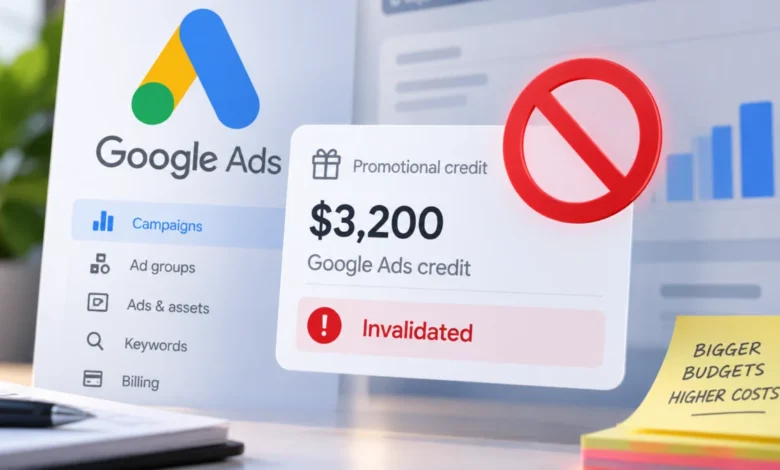
The emergence of these reports has sparked a wave of concern within the digital advertising community, as small and mid-sized businesses (SMBs) find themselves unexpectedly liable for thousands of dollars in ad spend they had budgeted under the assumption of a partial rebate. The issue, first brought to light by PPC consultant David Melamed, suggests a lack of transparency in Google’s promotional credit lifecycle and an absence of a formal mechanism for advertisers to dispute these revocations.
Chronology of the Invalidation Issue
The controversy centers on the discrepancy between the initial offer—which incentivizes advertisers to commit to a specific spend threshold—and the subsequent status of those credits within the Google Ads billing dashboard. According to accounts shared by industry professionals, the lifecycle of these credits often follows a pattern that terminates in a sudden, unexplained “Invalidated” status long after the qualifying spend has been processed.
In one documented instance, an advertiser committed to a spend of $3,200, operating under the explicit promise of a matching $3,200 promotional credit. The advertiser fulfilled their end of the bargain, hitting the $3,200 spend mark. However, more than 30 days later, the credit was marked as “Invalidated” within the Google Ads console. Because the funds had already been paid out to Google to cover the campaign costs, the advertiser was left with no ability to recoup the investment or adjust the campaign budget retrospectively.
A secondary, distinct issue involves account configuration. In another case highlighted by Melamed, a new advertiser found their credit invalidated due to the initial use of a manager account billing profile during the account setup phase. This suggests that even minor technical or structural missteps in account management—often invisible to the average user during the setup process—can trigger a total forfeiture of the promotional incentive, regardless of whether the spend requirement was satisfied.
The Role of Promotional Credits in PPC Strategy
Promotional credits are a staple of Google’s customer acquisition strategy. They are designed to lower the barrier to entry for new advertisers, encouraging them to test the platform by subsidizing the initial learning phase of their campaigns. For many businesses, these credits are not merely a bonus; they are a fundamental component of the projected Return on Ad Spend (ROAS) and cash flow planning for the first quarter of a new marketing initiative.
When an advertiser is offered a credit, they are effectively being incentivized to bid more aggressively. By viewing a portion of their spend as "discounted," businesses are more likely to participate in competitive auctions they might otherwise avoid. This behavior, while intended to grow the ecosystem, creates a ripple effect throughout the Google Ads auction environment.
If a significant number of these credits are invalidated, the resulting financial strain can be severe. Businesses that built their marketing models around a $3,000 credit are suddenly forced to absorb that cost, which can lead to immediate budget exhaustion, premature termination of ad campaigns, or even the closure of the account entirely. From an auction-theory perspective, if the promotional spend is suddenly revoked, the underlying volume of paid search activity may contract, potentially leaving advertisers with higher-than-expected costs per acquisition (CPA) and a diminished footprint in the SERPs (Search Engine Results Pages).
Lack of Recourse and Administrative Transparency
One of the most persistent frustrations expressed by advertisers is the absence of a clear, structured appeals process. Unlike billing errors, which can often be addressed through support tickets, the invalidation of a promotional credit appears to be handled as a final, system-generated decision.

Advertisers report that when they reach out to Google Ads support, they are frequently met with generic responses that do not explain the specific criteria violated. This lack of transparency is particularly troubling for agencies that manage accounts on behalf of clients. When a credit is revoked, the agency must explain to the client why a promised incentive has vanished, often damaging the trust between the service provider and the business owner.
The complexity of Google’s Terms and Conditions regarding promotional credits provides the company with significant latitude to withhold funds. These terms often include clauses regarding “eligible accounts,” “proper setup,” and “prohibited activities.” However, the gap between these broad policy terms and the specific, often opaque reasons for invalidation leaves a void that the current support infrastructure is failing to fill.
Official Response and Corporate Stance
The growing visibility of this issue on professional networking platforms like LinkedIn eventually drew a response from Google. Ginny Marvin, the Google Ads Liaison, addressed the situation publicly by stating: "Thank you for bringing this to our attention, David. I’ve passed this along to the team."
While this acknowledgment confirms that the issue is being reviewed internally, it remains unclear whether the company intends to implement a policy change, provide a clearer explanation for future invalidations, or offer a path for retroactive reconciliation. As of this writing, Google has not released a formal statement clarifying why these specific credits were pulled or whether there will be a mechanism for advertisers to challenge the decision.
Broader Implications for the Advertising Ecosystem
The incident raises fundamental questions about the stability of platform-sponsored incentives. If promotional credits cannot be treated as a reliable component of an advertising budget, their utility as a marketing tool is significantly diminished.
For the broader digital marketing industry, the implications are three-fold:
- Risk Management for SMBs: Small businesses must now treat promotional credits as "at-risk" assets rather than guaranteed budget offsets. Financial planning should ideally account for the possibility that the credit will not materialize, ensuring that the business is not over-leveraged if the funds are withheld.
- Agency Due Diligence: Marketing agencies and PPC consultants are now under increased pressure to perform rigorous audits of account settings—such as billing profiles and administrative structures—before launching campaigns that rely on promotional incentives.
- Platform Accountability: The current situation highlights a growing tension between the massive scale of Google’s automated systems and the need for human-level support when financial disputes arise. The lack of an appeal path for revoked credits is a point of contention that many industry advocates believe requires a systemic overhaul.
Future Outlook and Best Practices
For now, the consensus among digital marketing experts is to exercise extreme caution. Advertisers are advised to thoroughly review the fine print associated with every promotional offer, specifically focusing on account structure requirements. For instance, ensuring that billing profiles are set up correctly from the start and that accounts remain in good standing is essential to minimize the risk of technical invalidation.
Furthermore, advertisers should refrain from spending against a credit until the credit has been successfully applied to the account and verified. While this is not always possible with "spend-to-get" offers, it serves as a defensive strategy against unexpected revocations.
As the industry waits for further clarification from Google, the case remains a sobering reminder of the power dynamic between the platform and its users. The ability of an advertiser to scale their business using promotional incentives is contingent upon the platform’s administrative processes—a system that, in this instance, has proven to be less predictable than many advertisers assumed. Whether Google will introduce a more transparent, user-friendly process for handling these disputes remains a critical issue for the thousands of businesses that rely on the Google Ads ecosystem to drive their growth.