Navigating the New Reality of AI Search Volatility: A Strategic Guide for Modern Marketers

For SEO managers accustomed to the predictable, albeit frustrating, fluctuations of Google’s traditional search algorithms, the current landscape of AI-driven discovery represents a fundamental paradigm shift. As generative AI models like ChatGPT, Gemini, and Perplexity become the primary interfaces for information retrieval, the rules of visibility have changed. According to HubSpot’s State of AEO report, 58% of marketers were actively optimizing their content specifically for answer engines by the first quarter of 2026. This transition has introduced a new, volatile variable into the marketing ecosystem: AI search volatility. Unlike the relatively stable ranking systems of the past, AI-generated answers are inherently non-deterministic, meaning they do not return identical results for every prompt, nor do they provide a stable "ranking position" that can be monitored through traditional tracking software.
Understanding the Mechanics of AI Instability
To manage this volatility, organizations must first distinguish between traditional search engine results page (SERP) fluctuations and AI-driven answer instability. While Google’s ranking updates are usually based on algorithmic adjustments to how web pages are indexed and scored, AI search volatility refers to the inconsistent selection of brands, products, and sources cited by large language models (LLMs). Research from firms like SparkToro and Gumshoe.ai has highlighted that when identical queries are submitted repeatedly to major AI platforms, the consistency of recommended brands is remarkably low, with less than a 1-in-100 chance of receiving the exact same brand list twice.
This randomness is a feature, not a bug, of LLM architecture. These models are designed to synthesize information and generate responses that are contextually relevant rather than retrieving a static list of links. Consequently, a sudden dip in brand mentions or citations within an AI response is not necessarily a reflection of poor content quality or a decline in domain authority. Instead, it is often a byproduct of the model’s internal weighting adjustments or a shift in the underlying training data interpretation.
The Strategic Importance of Market-Wide Benchmarking

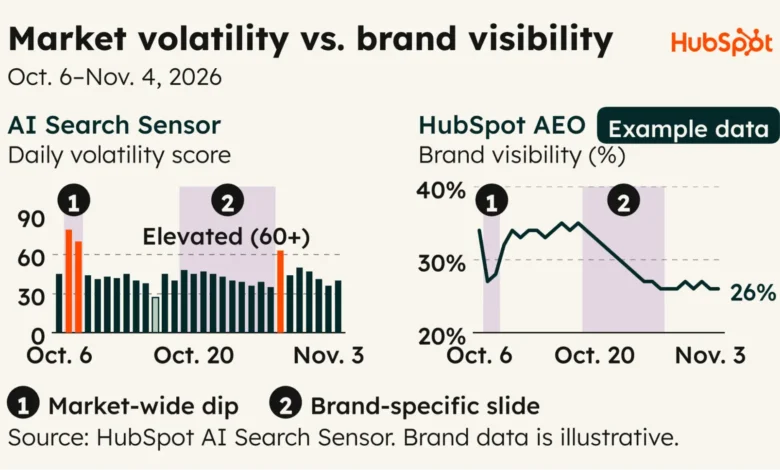
When visibility metrics drop, the immediate impulse for many marketing teams is to audit their own site, rewrite content, or adjust their technical SEO settings. However, acting in a vacuum can be counterproductive. Industry experts suggest that the most effective way to diagnose a drop in AI visibility is to compare internal data against a market-wide benchmark. By utilizing tools like the AI Search Sensor, teams can observe whether a decline is localized to their brand or symptomatic of a broader, systemic shift across the industry.
If a market-wide benchmark shows that overall citations for a sector have plummeted, the issue is clearly engine-level, and the appropriate response is to wait for the volatility to settle. Conversely, if the broader market remains steady while a specific company’s visibility trends downward, this serves as a clear signal that the issue is site-specific, necessitating a thorough review of technical infrastructure, content relevance, or tracking methodologies.
Comparing AI Search Volatility with Traditional Ranking Metrics
The integration of generative AI into search engines has created a hybrid environment where traditional SEO and Answer Engine Optimization (AEO) must coexist. HubSpot’s 2026 data indicates a strong correlation between high-ranking pages in traditional Google search and their likelihood of being cited in AI Overviews. This suggests that while AEO requires a distinct strategy, it remains tethered to the foundational strength of a website’s traditional search presence.
However, the divergence between the two is widening. Pew Research Center analysis from 2025 indicated that users are significantly less likely to click through to a traditional website when an AI-generated summary provides a comprehensive answer directly on the search page. This phenomenon creates a "visibility trap," where a brand might maintain its traditional ranking but suffer from reduced traffic because the search engine is successfully answering the user’s intent without requiring a click. Consequently, relying solely on traditional rank-based KPIs is no longer sufficient. Modern attribution models must now account for AI-referred traffic, which is often folded into broader organic search metrics or obscured within direct traffic channels.
Measuring Impact and Reporting to Leadership

For marketing leaders, the challenge of measuring AEO success remains significant. In the 2026 State of AEO report, nearly a quarter of B2B marketers cited the inability to measure ROI as their primary obstacle in adopting AEO strategies. To address this, organizations must restructure their reporting to focus on three distinct layers: brand visibility, share of voice within AI models, and downstream business impact.
A robust reporting structure should include:
- An Executive Summary: High-level trends in AI-referred traffic and their correlation with overall pipeline.
- Market Context: A clear, visual comparison between internal performance and industry-wide volatility benchmarks.
- Attribution Analysis: Data from CRM systems that tracks "How did you hear about us?" inputs, which helps capture traffic that may be categorized as "Direct" or "Organic" but was initially influenced by an AI recommendation.
- Content Performance: A breakdown of which specific content types (e.g., blog posts, comparison guides, technical white papers) are garnering the most citations across different AI models.
- Strategic Adjustments: Recommendations based on the data, emphasizing whether the team should "stay the course" during periods of high volatility or pivot to address specific performance gaps.
The Danger of Over-Correction
Perhaps the most critical advice for marketers operating in this volatile environment is to avoid premature reaction. AI Search Sensor data suggests that periods of "Elevated" or "Extreme" volatility—often caused by model updates from providers like OpenAI or Google—are temporary. Reacting too quickly to these spikes can lead to unnecessary, sweeping changes to a content strategy that was otherwise sound.
When a spike occurs, teams should wait for the data to normalize—typically over several days—before assessing the long-term impact. If the volatility persists and is confirmed as a market-wide phenomenon, the strategy should focus on aligning content formats with the new requirements of the AI models. For instance, if data shows that ChatGPT is favoring comparison-heavy content while Google’s AI Overviews prioritize high-authority, long-form editorial pieces, the brand’s content calendar should be adjusted to reflect these channel-specific preferences.
The Role of Data Transparency and Future Trends

As the industry moves toward 2027, the demand for transparency from AI developers will likely increase. Currently, there is a significant information gap regarding how specific websites are selected for citation. While some developers have begun to provide rudimentary insights, the "black box" nature of LLMs remains a point of contention. Marketers are increasingly turning to third-party data aggregators and internal tracking tools to bridge this gap.
Furthermore, the integration of generative AI into CRM platforms is set to simplify the attribution problem. By automatically tagging leads that interact with AI-generated brand mentions, companies will be able to more accurately calculate the cost of acquisition and the lifetime value of customers sourced through AI discovery. Until such tools are fully mature, the onus remains on the marketing department to act as a bridge between the technical nuances of AI volatility and the bottom-line concerns of the executive suite.
Conclusion: A Proactive Stance
The rise of AI search volatility is not a temporary anomaly but a permanent feature of the digital information ecosystem. To thrive, organizations must shift their perspective from "chasing rankings" to "cultivating visibility." This requires a sophisticated approach that balances the need for technical optimization with the patience required to weather the inherent instabilities of generative models.
By implementing consistent tracking, utilizing market-wide benchmarks, and clearly communicating the nature of these fluctuations to stakeholders, marketers can turn the challenge of AI search volatility into a competitive advantage. The goal is no longer to be the first link on a static list, but to be the trusted authority that AI models consistently recognize as the most relevant source for the user’s inquiry. As the technology continues to evolve, those who understand how to measure and adapt to this volatility will be the ones who successfully capture the next generation of search-driven demand.