A Guide to Answer Engine Optimization and the Rise of AEO Checker Tools

The fundamental architecture of the internet is undergoing its most significant transformation since the invention of the search engine. For decades, the digital economy has relied on the "ten blue links" model, where a search engine acts as a directory, directing traffic to external websites. Today, that model is being superseded by answer engines—systems like ChatGPT, Perplexity, and Google’s AI Overviews—which synthesize information from thousands of sources to provide a single, definitive answer directly on the results page. This shift has necessitated a new discipline: Answer Engine Optimization (AEO). As visibility that once appeared in traditional search rankings vanishes into AI-generated summaries, businesses must now proactively manage their presence within these "black box" environments.
The emergence of AEO follows the rapid deployment of generative AI across the search landscape. In May 2024, Google fundamentally altered the search experience with the global rollout of AI Overviews (AIOs), a feature that summarizes search queries at the top of the results page. This move followed the massive adoption of ChatGPT and the rise of search-native platforms like Perplexity, which prioritize cited, conversational responses over lists of URLs. For marketers and business leaders, this represents a "zero-click" reality where users may never visit a website to find the information they need, forcing a pivot from traditional traffic-driving SEO to brand-visibility-focused AEO.
![AEO checker tools that measure answer engine visibility [2026]](https://53.fs1.hubspotusercontent-na1.net/hubfs/53/aeo-checker-1-20260903-3858273.webp)
Understanding the Mechanics of Answer Engine Optimization
At its core, AEO is the practice of ensuring that a brand is accurately represented, cited, and mentioned within the synthesized responses provided by AI models. While SEO focuses on securing a high rank in a list of hyperlinks, AEO focuses on content consumption within the AI interface itself. These two disciplines are not mutually exclusive; in fact, they are symbiotic. The crawlers and algorithms that power AI search engines still rely on the foundational signals of traditional SEO, such as site authority, technical crawlability, and clear schema markup. However, AEO adds a layer of semantic precision. To be "chosen" by an AI as a source, content must be structured to answer specific, granular questions directly and be backed by verifiable primary data.
The Challenge of Measuring Invisible Visibility
![AEO checker tools that measure answer engine visibility [2026]](https://no-cache.hubspot.com/cta/default/53/9dd5e54b-fbef-4dd0-bc44-1689feb1ea18.png)
The primary obstacle in this new era is the lack of standardized reporting. Traditional tools like Google Search Console were designed for an era of clicks and impressions. While Google recently began rolling out generative AI performance reports, these tools remain in their infancy, often failing to capture the full scope of how a brand is cited across disparate AI platforms. Consequently, manual monitoring has become the initial, albeit inefficient, strategy for many teams.
Running a manual AEO check involves a disciplined, multi-step process. First, organizations must define their "priority queries"—the specific informational questions their target audience asks. These queries should be tested in incognito or signed-out sessions to avoid personalized results. Analysts then monitor whether an AI response is triggered, whether their brand is cited as a source, and whether the claim made by the AI accurately reflects the brand’s positioning. Because AI responses are dynamic and vary based on session history and regional server updates, a single check is statistically insignificant. A robust manual audit requires multiple, repeated queries to establish a trend of presence or absence.
The Evolution of Specialized AEO Tools
![AEO checker tools that measure answer engine visibility [2026]](https://53.fs1.hubspotusercontent-na1.net/hubfs/53/aeo-checker-2-20260903-852936.webp)
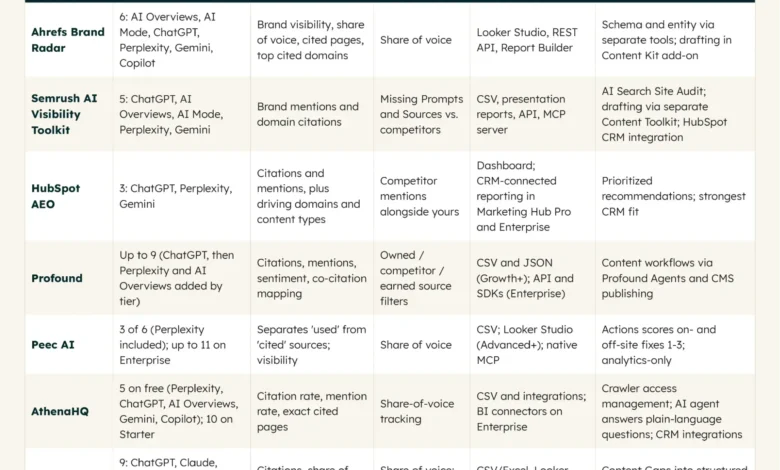
As manual auditing becomes unsustainable for large enterprises, a new market of AEO checker software has emerged. These tools move beyond simple rank tracking to analyze the semantic quality of citations. An effective AEO checker must track visibility across multiple engines, identify the "content gaps" where competitors are being cited instead of the user, and provide actionable intelligence on how to re-optimize pages to close those gaps.
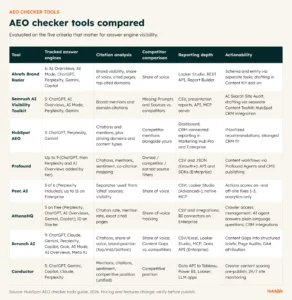
The current market of AEO tools can be categorized by their primary functionality. Some, such as Ahrefs Brand Radar, focus on the sheer scale of search queries, utilizing large datasets to monitor how brands appear in AI Overviews. Others, such as HubSpot’s AEO tool, emphasize the integration of citation detection with marketing automation, allowing users to see not just that they were cited, but how that citation correlates with CRM data and qualified leads. Specialized tools like Profound and Peec AI have carved out niches in the space by focusing on the nuance of citation context—measuring sentiment, the type of source being cited (owned vs. earned), and alerting users when their brand is mentioned but not linked.
The Strategic Value of Technical Readiness
![AEO checker tools that measure answer engine visibility [2026]](https://53.fs1.hubspotusercontent-na1.net/hubfs/53/aeo-checker-3-20260903-8904553.webp)
Technical SEO remains the bedrock of AEO readiness. If an AI cannot parse the structure of a webpage, it cannot cite it. Tools like Scrunch AI and Conductor have pivoted to address this, offering technical monitoring that ensures AI crawlers can reach and render content effectively. This includes the implementation of advanced schema markup that clearly defines entities, relationships, and facts, making it easier for large language models (LLMs) to ingest and verify the information.
The shift toward AI-mediated search is not merely a technical challenge; it is a fundamental shift in user behavior. As consumers grow accustomed to receiving answers without navigating away from the search interface, the definition of a "successful" search is changing. For businesses, this requires a dual-track strategy. They must continue to optimize for the traditional search engine results page (SERP) to capture traffic, while simultaneously refining their content for the "answer engine" to capture brand authority and influence.
Broader Implications and Future Outlook
![AEO checker tools that measure answer engine visibility [2026]](https://53.fs1.hubspotusercontent-na1.net/hubfs/53/aeo-checker-4-20260903-6212698.webp)
The implications of this shift are profound for the digital marketing industry. The "zero-click" trend threatens to decouple visibility from traffic, potentially reducing the efficacy of traditional click-through rate (CTR) metrics. However, it also opens new opportunities for brand building. Being cited as an authoritative source in an AI-generated answer can provide a level of trust and credibility that a standard link cannot match.
Industry analysts suggest that in the coming years, "citation equity" will become as important as link equity. Just as Google revolutionized the web by counting links as votes, AI engines are beginning to count citations as tokens of truth. Companies that invest in transparent, high-quality, and structurally sound content will likely dominate these new digital landscapes.
Furthermore, the integration of AEO with customer relationship management (CRM) systems will be the next major frontier. By connecting AI visibility data to actual business outcomes—such as pipeline generation and closed-won deals—marketers will be able to prove the ROI of their AEO efforts. HubSpot’s current integration of AEO into its Marketing Hub represents a move toward this holistic view, where AI-generated content drafts are based on CRM-validated data, ensuring that the brand voice remains consistent across all touchpoints.
![AEO checker tools that measure answer engine visibility [2026]](https://53.fs1.hubspotusercontent-na1.net/hubfs/53/aeo-checker-5-20260903-8938354.webp)
Ultimately, the rise of AEO marks a maturation of the search industry. It represents a move away from the exploitation of algorithms and toward the creation of genuine value. In a world where AI synthesizes the world’s knowledge, the winners will be those who provide the most accurate, concise, and trustworthy information. For companies willing to adapt their workflows and embrace these new measurement tools, the era of answer engines is not a threat to their digital presence, but an opportunity to become the definitive source of truth in their respective markets. As the technology continues to evolve, the distinction between SEO and AEO will likely continue to blur, eventually merging into a unified strategy for the modern digital age.