The transition from an individual contributor to a management role represents one of the most significant professional pivots an employee can undertake. As technical proficiency becomes a baseline expectation rather than the primary job function, new leaders often discover that the metrics of success shift from personal output to team efficacy. This evolution requires a deliberate cultivation of soft and strategic skills, moving beyond simple task management toward a holistic approach to organizational leadership.
Defining the Managerial Framework
Management is fundamentally the discipline of planning, organizing, leading, and controlling resources to achieve institutional objectives. While the technical requirements of a role—such as coding, instructional design, or financial analysis—are essential for gaining credibility, they are insufficient for directing others. According to the foundational framework established by Robert Katz, management skills are categorized into three distinct domains: technical, human, and conceptual.
Technical skills involve the mastery of role-specific methodologies and tools, such as the ability to construct a training budget or manage a Learning Management System (LMS). Human skills, often referred to as "soft skills," pertain to the interpersonal ability to coach, mentor, and motivate team members. Finally, conceptual skills require the capacity to see the "big picture," connecting daily team activities to broader organizational goals. The most effective managers are those who can synthesize these three domains, rather than viewing them as compartmentalized functions.
The Evolution of the Managerial Role
The shift in professional focus toward management often catches high-performing individuals unprepared. A 2023 report on workforce development noted that nearly 60% of new managers receive little to no formal training during their first year in a leadership position. This "accidental manager" phenomenon leads to a decrease in team productivity, as newly minted leaders struggle to balance their existing workload with the responsibilities of people management.
Chronologically, the development of a manager follows a predictable trajectory. Initially, the focus is on reactive tasks—solving immediate problems and assigning duties. As the manager gains experience, the focus shifts to proactive planning, resource allocation, and long-term strategy. Organizations that fail to support this transition often face higher turnover rates, as team members feel unsupported by managers who have not yet mastered the art of coaching and performance management.
Top 10 Core Management Competencies
Effective management is not a static state but a collection of actionable behaviors. To build a high-performing team, leaders should prioritize the following 10 competencies:

- Communication and Active Listening: True communication goes beyond instruction; it involves listening to stakeholder requirements and translating them into actionable briefs. Active listening builds trust and ensures that project outcomes align with organizational needs.
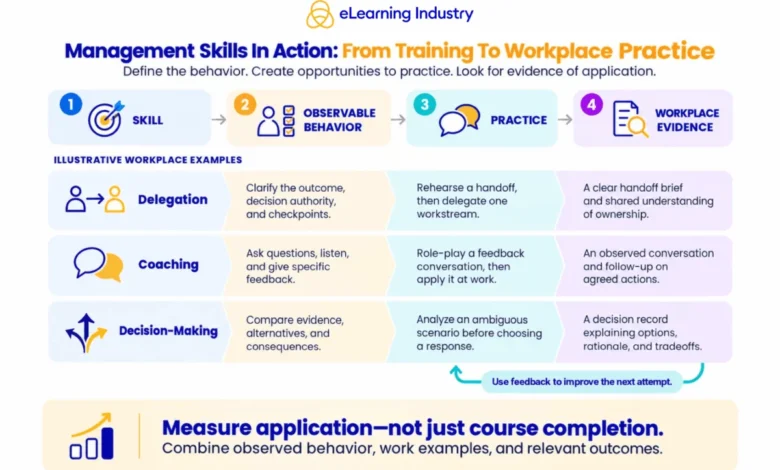
- Delegation and Empowerment: Rather than merely offloading tasks, effective delegation involves defining outcomes, establishing clear decision-making boundaries, and providing the necessary resources for team members to succeed independently.
- Strategic Planning and Prioritization: Managers must be able to identify trade-offs. This involves the ability to deprioritize lower-impact projects to ensure that critical initiatives receive adequate capacity and attention.
- Coaching and Constructive Feedback: The goal of coaching is to build an employee’s judgment. By guiding team members to identify errors themselves rather than providing the solution, managers foster long-term professional growth.
- Performance Management: Accountability should be consistent and evidence-based. If performance metrics are missed, a manager must analyze the root cause—whether it be a lack of resources, unclear expectations, or a skills gap—before implementing corrective actions.
- Emotional Intelligence: This involves managing one’s own reactions during high-pressure situations and ensuring an inclusive environment where all voices are heard, particularly in hybrid or remote work settings.
- Conflict Resolution and Negotiation: Managers must act as mediators, bringing competing parties back to the central objective. Effective negotiation separates personal preferences from essential project requirements.
- Decision-Making and Problem-Solving: Evidence-based decision-making requires managers to assess risks and potential outcomes before committing resources. It involves challenging the status quo and avoiding "quick-fix" solutions that do not address the root cause of a problem.
- Strategic Thinking and Business Acumen: This competency bridges the gap between daily operations and company-wide strategy. It involves articulating how the team’s work contributes to the organization’s bottom line.
- Digital Fluency and Change Management: Modern managers must be adept at evaluating and implementing new technologies. The challenge is not just the software itself, but the human element of helping the team adapt their workflows to new tools.
The Distinction Between Management and Leadership
There is a persistent debate regarding the difference between management and leadership. While the terms are often used interchangeably, they serve different functions. As defined by the Center for Creative Leadership, management is primarily concerned with the "how"—the logistics of schedules, budgets, and operational efficiency. Leadership, conversely, focuses on "why"—the creation of shared direction, alignment, and commitment.
An effective professional must be able to toggle between these roles. During an organizational transition, such as an LMS migration, a manager must handle the technical implementation (management) while simultaneously keeping the team motivated and focused on the long-term vision (leadership). Neglecting one for the other creates a deficit: poor management leads to operational chaos, while poor leadership leads to disengagement.
Strategic Implications for L&D Departments
For Learning and Development (L&D) teams, the mandate is clear: management training must move beyond generic, one-size-fits-all curricula. A 2017 meta-analysis of leadership development programs indicated that training is most effective when it is spaced over time and includes concrete needs analysis, immediate feedback, and real-world application.
Organizations should adopt a step-by-step development process:
- Diagnosis: Define specific behavioral goals. Instead of a vague objective like "improve communication," set a goal like "provide clear, written project briefs before initiating tasks."
- Simulation: Utilize role-playing and branching scenarios to allow managers to practice difficult conversations, such as addressing a missed deadline, in a low-stakes environment.
- Workplace Application: Link training directly to active projects. Managers should be encouraged to apply a new skill—such as a specific feedback model—to a real task and then debrief the experience with a mentor.
- Iterative Review: Management development is an ongoing loop. Periodic check-ins and reflection sessions are essential to evaluate what is working and what requires further adjustment.
Measuring Success and Future Outlook
The ultimate metric for management success is the performance of the team, not the manager’s individual achievements. When assessing the impact of development initiatives, organizations should look for qualitative and quantitative markers: improved project delivery times, higher employee retention, and a clearer alignment between team outputs and strategic goals.
As the workplace continues to evolve toward more flexible, digital-first models, the necessity for agile management skills will only increase. Organizations that treat management as a core competency—one that requires constant nurturing, evidence-based training, and a focus on human-centric outcomes—will be best positioned to navigate the complexities of the modern global economy. Managers are the architects of the workplace culture, and their development is, by extension, the development of the organization itself.