What Is The Socratic Method: Cultivating Critical Thinking In The Age Of Artificial Intelligence

The Socratic Method stands as one of the most enduring intellectual frameworks in human history, tracing its origins to the classical period of Ancient Greece. Developed by the philosopher Socrates—who famously walked the streets of Athens engaging citizens in rigorous dialogue—the method is a pedagogical technique centered on the pursuit of truth through disciplined questioning. Rather than delivering lectures or providing didactic answers, the practitioner guides the learner to uncover their own contradictions, validate their assumptions, and construct a robust logical foundation for their beliefs. In the contemporary corporate landscape, this ancient practice is experiencing a significant revival, repositioning itself as a vital tool for Learning and Development (L&D) professionals tasked with navigating the complexities of the information age.
The Historical Genesis and Evolution of Socratic Inquiry
The roots of the Socratic Method are firmly planted in the 5th century BCE. Socrates, who left no written records of his own, relied exclusively on the spoken word to challenge the intellectual status quo of Athens. His method, often termed elenchus (or the "Socratic cross-examination"), was designed to expose ignorance disguised as knowledge. By repeatedly questioning the definitions and core beliefs of his interlocutors, Socrates forced his contemporaries to engage in deep self-reflection.
This methodology evolved through the centuries, finding a permanent home in legal education during the late 19th century. Christopher Columbus Langdell, then dean of Harvard Law School, implemented the Socratic case method in 1870. This transition marked a departure from the "black-letter law" lecture style, shifting toward a model where students analyzed appellate court decisions to synthesize legal principles. Today, the method has expanded beyond academia into the boardrooms and training facilities of global enterprises, serving as a remedy for the passivity often associated with traditional corporate training.
The Logic of Inquiry: Why Methodology Matters
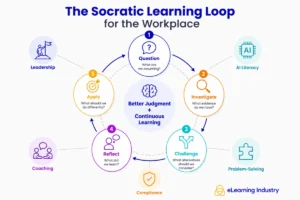
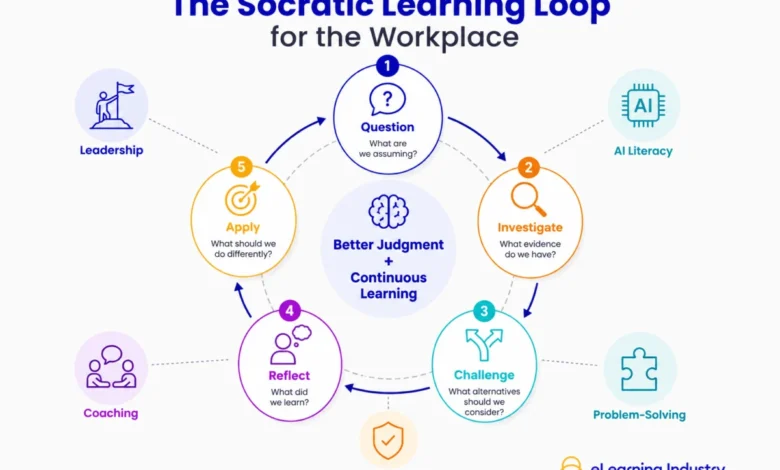
At its core, the Socratic Method is a five-stage cognitive journey designed to bypass surface-level comprehension. The process begins with an open-ended inquiry, moving through clarification and evidence-gathering, before culminating in the challenge of underlying assumptions and final reflection.
- Systematic Clarification: The facilitator initiates the dialogue with a broad, probing question, requiring the participant to define their terms and state their premise clearly.
- Evidence-Based Validation: The dialogue shifts from abstract opinion to empirical grounding. Participants are tasked with providing data or real-world examples that substantiate their position.
- Assumption Scrutiny: This is the most challenging phase, where the facilitator asks the learner to identify the "hidden" biases or axioms that support their argument.
- Alternative Perspective Mapping: By exploring counter-arguments, the learner is forced to view the problem from the perspective of different stakeholders, fostering cognitive flexibility.
- Reflective Synthesis: The process concludes with an evaluation of how the participant’s initial stance has shifted in light of the inquiry, ensuring that learning is internalized rather than merely memorized.
Empirical Context: Data, AI, and the Modern Workplace
The urgent shift toward Socratic methodologies is largely driven by the democratization of information facilitated by Generative AI. According to the World Economic Forum’s Future of Jobs Report, critical thinking, complex problem-solving, and analytical reasoning remain the top skills employers demand as automation reshapes labor markets. As AI tools lower the barrier to generating answers, the "value add" of human capital has shifted from data retrieval to data verification and strategic judgment.
Recent internal surveys from L&D departments at Fortune 500 companies suggest that traditional, slide-deck-heavy training modules suffer from high "forgetting rates," with learners retaining as little as 10% of content after 30 days. In contrast, training programs that utilize active, inquiry-based learning—often termed "active learning"—report retention rates upwards of 75%. This data supports the constructivist learning theory: individuals build knowledge more effectively when they are the architects of their own conclusions rather than passive recipients of a facilitator’s lecture.
Comparative Analysis: Traditional Versus Socratic Models
To understand the operational shift required for organizations, one must differentiate between traditional transmission-based training and the Socratic inquiry model.
| Feature | Traditional Training | Socratic Training |
|---|---|---|
| Primary Driver | The Lecturer | The Learner |
| Information Flow | Top-down (One-way) | Collaborative (Multi-directional) |
| Success Metric | Accuracy of recall | Depth of reasoning |
| Learner Role | Passive spectator | Active investigator |
| Goal | Correct answer acquisition | Cognitive framework development |
Case Studies in Modern Organizational Application
The implementation of the Socratic Method in L&D has manifested in four primary domains: leadership development, sales, compliance, and AI literacy.

Leadership Development: Instead of teaching prescriptive decision-making frameworks, executive coaches now use Socratic sessions to help managers identify their own blind spots. By asking "What are the long-term systemic risks of this decision?" rather than "Is this the right decision?", coaches help leaders develop the internal judgment necessary for high-stakes environments.
Sales Enablement: Sales teams are increasingly using Socratic questioning to handle client objections. Rather than providing a rehearsed rebuttal, a salesperson is trained to ask the client, "What concerns regarding our pricing structure are most important to your current budget cycles?" This turns a confrontational objection into a collaborative diagnostic process.
Compliance Training: In the realm of ethics and compliance, scenarios that present "gray areas" are far more effective than binary "do’s and don’ts." By forcing employees to evaluate the ethical implications of a fictional, complex dilemma, organizations build an ethical "muscle memory" that serves the employee better than rote memorization of a policy manual.
AI Literacy: As employees interact with Large Language Models (LLMs), the Socratic method acts as a safeguard against AI-induced intellectual atrophy. When a worker uses an AI to generate a report, the Socratic approach dictates that the worker must interrogate the AI’s output: "What evidence supports this summary?" or "What are the potential biases in this data set?"
The Pedagogical Foundation: Why It Works
From a neuroscientific perspective, the Socratic Method leverages the brain’s "retrieval practice" mechanism. When a person is forced to articulate their reasoning, they move information from short-term to long-term memory. Furthermore, the method triggers metacognition—the process of thinking about one’s own thinking. By identifying where their own logic falters, learners trigger a neuro-plastic response that reinforces neural pathways associated with logical reasoning.
Furthermore, the integration of andragogy (adult learning theory) underscores the effectiveness of this method. Adults learn best when they are self-directed and when the learning is tied to real-world problems. The Socratic method respects the autonomy of the adult learner, positioning the facilitator not as a superior, but as a peer-mentor who provides the scaffolding for professional growth.
Implications and Future Outlook
The broader implication for the workforce is the development of a "questioning culture." Organizations that prioritize the Socratic method are better equipped to handle disruptive change. When employees are trained to ask "Why?" and "What if?" rather than just "How?", the entire organizational structure becomes more resilient to volatility.
However, the transition is not without challenges. It requires a significant shift in corporate culture. Managers who are accustomed to being the sole source of "the right answer" must relinquish control, a transition that often requires intensive training for facilitators themselves. The investment in time and patience is higher than that of traditional training; yet, the return—an agile, analytical, and highly engaged workforce—is increasingly viewed as a competitive advantage.
As we move deeper into the 2026 fiscal cycle and beyond, the Socratic Method is set to become the cornerstone of digital learning strategies. Whether integrated into AI-driven coaching platforms or utilized in virtual peer-to-peer discussion circles, the practice of structured, disciplined inquiry remains the most effective bridge between mere information and true, actionable wisdom. In an era of infinite answers, the ability to ask the right questions has become the ultimate professional skill.