The rapid integration of generative artificial intelligence into the corporate learning and development (L&D) sector has fundamentally altered the workflow of Instructional Designers (IDs). While early adoption was characterized by experimental, ad-hoc usage, the industry is currently transitioning toward a standardized, professionalized approach to AI integration. Recent data suggests that while over 70% of L&D professionals report using AI in some capacity, only a small fraction have successfully bridged the gap between raw, AI-generated text and production-ready course material. The primary obstacle remains the lack of sophisticated prompt engineering, which is increasingly recognized as a critical competency, as vital as traditional needs analysis or assessment design.
The Evolution of the AI-Enabled Workflow
The timeline of AI adoption in instructional design accelerated sharply in late 2022 following the public release of advanced Large Language Models (LLMs). Initially, designers utilized these tools primarily for brainstorming or generating filler text. However, by mid-2024, the focus shifted toward "model-as-partner" frameworks. This transition reflects a shift in organizational strategy: rather than viewing AI as a replacement for human design, leading firms are treating it as a scalable junior designer that requires detailed, iterative briefings.
Professional designers now recognize that the "search box" mentality—inputting vague queries—leads to generic, unusable output that requires extensive human remediation. Conversely, treating the AI as a technical collaborator, providing it with specific learner demographics, context, and output constraints, has proven to increase productivity by an estimated 30% to 50% in tasks like storyboarding and assessment development.
Establishing a Standardized Prompt Scaffold
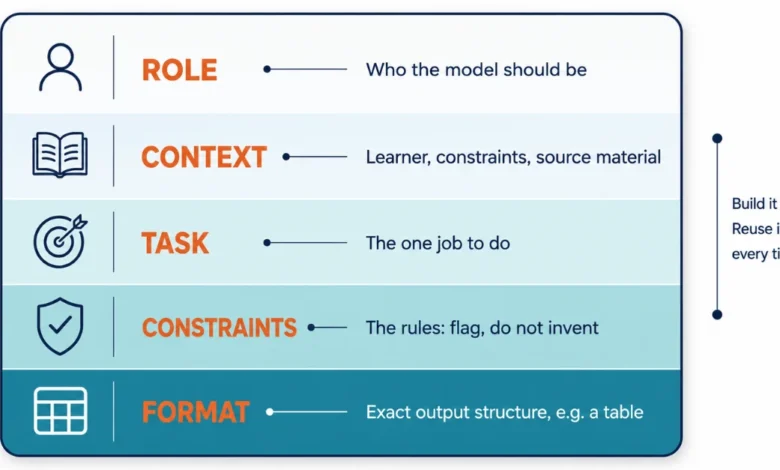
To maximize the efficacy of LLMs, industry experts recommend abandoning spontaneous prompting in favor of a repeatable, structured scaffold. A robust, enterprise-grade prompt should invariably contain five distinct components:
- Persona Assignment: Defining the role the AI should occupy (e.g., "Senior Instructional Designer with expertise in adult learning theory").
- Contextual Background: Explicitly stating the learner profile, including job role, existing knowledge gaps, and organizational culture.
- Source Material: Providing the raw, verified data, policy documents, or SME notes.
- Constraints and Guardrails: Defining what the model must avoid, such as specific jargon to omit or forbidden phrasing.
- Output Format: Specifying the exact structure of the result, such as a CSV table or a structured storyboard format.
By standardizing these elements, design teams can build a "Prompt Library," transforming individual experimentation into a repeatable, scalable corporate capability.
Pattern 1: Streamlining Storyboarding
The process of converting dense, technical SME documentation into actionable screen-by-screen storyboards has historically been one of the most time-consuming aspects of instructional design. By forcing the model to map every proposed screen to a specific learning objective, designers can mitigate the risk of "hallucinations"—instances where the AI generates plausible but factually incorrect content.
Industry analysis indicates that when prompts include a requirement to "flag gaps," the model effectively transforms from a source of inaccurate content into a diagnostic tool. By identifying where source material is insufficient to meet a learning objective, the AI generates a concrete task list for the human Subject Matter Expert, significantly shortening the revision cycle.
Pattern 2: Moving Beyond Recall-Based Assessment
A common pitfall in AI-assisted design is the generation of superficial multiple-choice questions that only test basic recall. To counter this, designers are now utilizing prompts that dictate cognitive complexity based on Bloom’s Taxonomy.

The inclusion of a "rationale" requirement for both correct and incorrect distractors is a significant development in assessment design. This practice forces the AI to demonstrate why a wrong answer is plausible, which in turn acts as a quality control mechanism for the human designer. If the model cannot provide a logical, pedagogical basis for a distractor, the question is flagged as flawed. This rigorous approach ensures that AI-assisted assessments are not merely "fillers," but genuine measures of learner competency.
Pattern 3: Precision in Content Rewriting
Rewriting complex regulatory or technical content for specific reading levels requires extreme caution to avoid the loss of nuanced information. The current best practice involves "locking" key terminology. By instructing the model to keep specific technical terms intact while simplifying the surrounding syntax, designers can ensure that compliance and technical precision are never compromised. Furthermore, requesting a summary of "simplified terms" allows for rapid human verification, ensuring that the model has not inadvertently altered the intended meaning.
Pattern 4: Cultural Localization vs. Translation
For global organizations, the distinction between literal translation and localization is a critical risk-management issue. Automated translation tools often miss cultural subtext, which can lead to content that is confusing or, in extreme cases, offensive.
Effective localization prompts require the AI to not only translate the text but to identify segments that potentially require human cultural review. By generating a "needs human review" list, the AI allows for a targeted, efficient review process by local stakeholders, rather than requiring them to re-read and verify every line of text. This hybrid approach—AI-led drafting paired with human cultural oversight—is the current standard for high-stakes, internationalized training.
Strategic Guardrails and Organizational Policy
The professionalization of AI in L&D is contingent upon the implementation of strict quality guardrails. Organizations are advised to adopt a "zero-trust" approach to model output. Every factual claim, statistic, and regulatory reference must be verified against primary sources.
Furthermore, data privacy has emerged as the primary blocker to AI adoption. Leading organizations are increasingly moving toward private, enterprise-grade AI instances that prevent the ingestion of proprietary data into public training models. This is not merely a technical preference but a legal and fiduciary necessity for firms operating in regulated industries.
Implications for the Future of Instructional Design
The role of the Instructional Designer is shifting from a primarily creative-generative role to an editorial and architect-based one. The skill set of the future is increasingly defined by the ability to evaluate, curate, and refine AI-generated content. As these tools become more prevalent, the designer’s value will be measured by their ability to maintain pedagogical integrity and organizational standards in an automated environment.
Industry observers note that the most successful design teams are those that view prompt engineering as a form of creative briefing. By treating the AI as an instrument that requires precise instructions, designers retain control over the output, ensuring that the final product serves the learner’s needs effectively.
Conclusion: A Path Forward
The transition to AI-assisted design should be handled with measured, incremental progress. Organizations are encouraged to start by perfecting a single pattern—such as assessment generation or storyboarding—before scaling to more complex tasks. By building a library of validated, reusable prompts and enforcing strict verification protocols, instructional designers can reclaim the time spent on mechanical tasks and reinvest it into the high-level, human-centric design work that remains the hallmark of the profession. As the technology continues to evolve, the capacity to blend human expertise with machine-driven speed will become the primary competitive advantage for modern L&D departments.