Mastering the Layers of Cognition: A Strategic Guide for Instructional Designers to Elevate Learning Outcomes

The efficacy of any learning program hinges on its ability to move beyond rote memorization and foster genuine understanding and application. For instructional designers and learning and development (L&D) professionals, this necessitates a deep understanding of how individuals process information – a concept encapsulated by the "levels of thinking." These cognitive hierarchies, ranging from immediate recall to complex strategic reasoning, are not merely academic constructs but foundational pillars for designing learning experiences that drive tangible business results, enhance problem-solving capabilities, and ultimately, transform employee performance.
The landscape of adult learning is increasingly complex, demanding solutions that address not just the "what" of knowledge but the "how" of its application. In an era where information is abundant but often overwhelming, the capacity to think critically, analytically, and strategically is paramount. This article delves into the distinct levels of thinking, explores various psychological types of thought, and provides a practical framework for instructional designers to architect more impactful and effective learning interventions.
The Cognitive Hierarchy: Understanding the Levels of Thinking
Levels of thinking, also referred to as cognitive depth or modes of thinking, describe the progressive stages of intellectual engagement with information. They represent a structured approach to how individuals comprehend, analyze, and utilize knowledge. While distinct from "types of thinking" (like critical or creative thinking, which describe how people think) or "thinking styles" (which refer to individual preferences), levels of thinking focus on the depth of cognitive processing.
For leaders in L&D and business, discerning the difference between these concepts is crucial. A common pitfall in learning design is to focus solely on identifying different types of thinking without considering the cognitive depth they operate at. This often results in superficial learning outcomes. To achieve significant impact – such as improving decision-making accuracy, solving complex problems more effectively, and driving lasting behavioral change – instructional designers must intentionally design for higher-order thinking. This means guiding learners from simple information recall to the application, analysis, and strategic synthesis of knowledge within real-world contexts.
The Strategic Imperative: Why Levels of Thinking Matter in Learning Design and Business Strategy
The way individuals engage with information directly influences their decision-making processes, problem-solving approaches, and overall performance in the workplace. Many organizations grapple not with a deficit of information, but with an inability to process and leverage it effectively. Understanding and designing for different levels of thinking yields significant organizational benefits:
Enhanced Decision-Making Prowess
Reactive, or first-level thinking, often leads to hasty decisions based on initial assumptions. While expedient in straightforward scenarios, this approach severely limits long-term impact and strategic foresight. Conversely, deeper levels of thinking—second-level analytical and third-level strategic—cultivate improved decision-making by encouraging thorough analysis, rigorous evaluation, and consideration of future consequences. Employees who are adept at critical thinking are demonstrably better at identifying potential risks, weighing diverse options, and making informed, robust choices. Research from institutions like the Harvard Business Review consistently highlights the correlation between higher-order thinking skills and superior leadership outcomes, directly linked to better strategic decisions.
Superior Problem-Solving Capabilities
Teams that rely on a narrow range of thinking modes tend to focus on superficial fixes rather than addressing the root causes of problems. By integrating diverse thinking types—including critical, analytical, and systems thinking—organizations can foster more effective and sustainable solutions. This elevates workforce performance, particularly in dynamic and complex environments. A study by the World Economic Forum’s Future of Jobs Report has repeatedly identified complex problem-solving and critical thinking as essential skills for the future workforce, underscoring the need for targeted learning interventions.
Measurable and Impactful Outcomes
From an L&D perspective, designing for varied thinking levels translates into quantifiable improvements. Learning experiences that actively engage multiple cognitive styles enhance knowledge retention because learners are prompted to interact with content at a deeper cognitive level. When learners are encouraged to apply concepts through diverse thinking methodologies, they are more likely to transfer that knowledge into practical, real-world applications, thereby driving observable behavior change. This can be tracked through performance metrics, reduced error rates, and increased innovation.
Strengthening Organizational Resilience and Adaptability
Organizations that prioritize the development of diverse thinking skills cultivate stronger internal capabilities. They move beyond simply imparting knowledge and instead design programs that actively enhance employees’ judgment, adaptability, and strategic acumen. This proactive approach builds a more resilient and agile workforce, better equipped to navigate market shifts and technological advancements.
Deconstructing the Cognitive Spectrum: The Three Core Levels of Thinking
A nuanced understanding of the three primary levels of thinking empowers instructional designers to transcend mere content delivery and design for profound cognitive impact. These levels illustrate the depth to which learners engage with information, progressing from immediate reactions to considered, long-term reasoning.
Level 1: First-Level Thinking (Reactive Thinking)
Characterized by speed and automaticity, first-level thinking relies heavily on ingrained past experiences, immediate assumptions, and familiar patterns. Learners operating at this level prioritize quick answers over deep comprehension. In professional settings, this manifests as rapid decision-making under pressure, often by defaulting to established solutions without evaluating their current applicability. While beneficial for expediency, this mode inherently limits creativity and critical evaluation. For example, a customer service representative might offer a standard response to a complaint without fully analyzing the unique circumstances of the customer’s issue.
Level 2: Second-Level Thinking (Analytical Thinking)
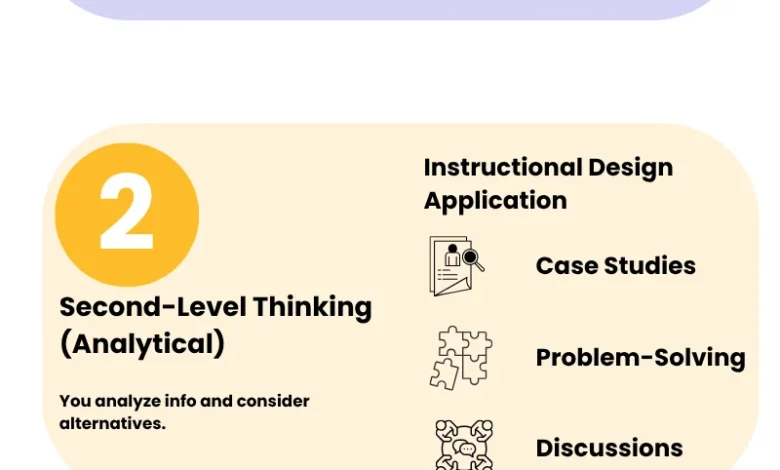
This level represents a significant step deeper, involving the critical evaluation of alternatives, careful consideration of consequences, and a willingness to question initial assumptions. Second-level thinking closely aligns with the cognitive processes employed in critical thinking, problem-solving, and informed decision-making. An example would be a project manager considering multiple project timelines and resource allocations, weighing the potential risks and benefits of each, before committing to a specific plan. This analytical rigor leads to more considered and effective outcomes.
Level 3: Third-Level Thinking (Systemic/Strategic Thinking)
The apex of cognitive engagement, third-level thinking focuses on the long-term ramifications of decisions and their interconnectedness within broader systems. Learners at this level consider how their choices impact various stakeholders and future outcomes. This mode of thinking is particularly crucial for leadership roles and is indispensable for navigating complex organizational dynamics. For instance, during a strategic planning session, a senior leader might analyze how a new product launch could affect supply chain logistics, marketing strategies, customer support, and long-term brand perception across multiple divisions. This holistic perspective ensures that decisions are not only effective in the short term but also contribute positively to the organization’s enduring success.
| Level | Depth | Time Horizon | Business Impact |
|---|---|---|---|
| First-Level Thinking | Surface-level | Short-term | Fast but limited decisions |
| Second-Level Thinking | Moderate depth | Mid-term | Informed and balanced decisions |
| Third-Level Thinking | Deep, systemic | Long-term | Strategic, high-impact outcomes |
A Taxonomy of Thought: Key Types of Thinking in Psychology
Understanding the distinct types of thinking in psychology is essential for instructional designers aiming to intentionally activate the appropriate cognitive processes at opportune moments within a learning journey. Each type serves a unique purpose in how individuals process information and approach challenges.
Critical Thinking
This involves the objective analysis and evaluation of an issue to form a judgment. It requires questioning assumptions, identifying biases, and scrutinizing evidence.
- Use in L&D: Designing case studies where learners must dissect a problem, evaluate different solutions, and justify their final decision. Employing debates or Socratic questioning to encourage deeper analysis.
Creative Thinking
The ability to generate novel ideas, explore possibilities, and approach problems from unconventional angles. It is the engine of innovation and adaptability.
- Use in L&D: Incorporating brainstorming sessions, design thinking exercises, and open-ended problem-solving activities that encourage participants to think outside the box and propose innovative solutions.
Analytical Thinking
The process of breaking down complex information into smaller components to understand underlying patterns, relationships, and structures.
- Use in L&D: Presenting data sets for interpretation, using diagnostic simulations where learners must identify root causes of issues, or requiring the deconstruction of processes.
Reflective Thinking
A metacognitive process involving introspection and contemplation of past experiences to extract insights, learn from mistakes, and inform future actions.
- Use in L&D: Implementing journaling prompts, post-activity debriefs, or peer feedback sessions that encourage learners to analyze their own learning process and performance.
Systems Thinking
This approach views phenomena as interconnected parts of a larger whole, focusing on the relationships and interactions between these components.
- Use in L&D: Utilizing system dynamics models, process mapping exercises, or scenarios that require learners to understand the ripple effects of decisions across an entire organization or ecosystem.
Logical Thinking
The systematic application of reasoning principles to arrive at valid conclusions based on factual evidence and established rules.
- Use in L&D: Developing step-by-step procedural training, logic puzzles, or troubleshooting guides where learners must follow a structured sequence of actions.
Ten Essential Types of Thinking for Instructional Designers
Beyond the core levels, a comprehensive understanding of various thinking types allows instructional designers to craft learning experiences that are both engaging and highly effective. The goal is not simply to present information but to cultivate specific cognitive skills that learners can apply in their professional lives.
-
Critical Thinking: Focuses on evaluating information, identifying biases, and making reasoned judgments.

- Example: Learners analyze a case study to identify risks and justify their decisions.
- Use: Essential for compliance, leadership, and decision-making training.
-
Creative Thinking: Encourages generating new ideas and exploring possibilities.
- Example: Learners brainstorm innovative solutions to a business challenge.
- Use: Supports innovation and problem-solving cultures.
-
Analytical Thinking: Breaks down complex information into smaller parts to understand relationships.
- Example: Interpreting data trends in a business simulation.
- Use: Critical for roles involving data analysis and strategic planning.
-
Reflective Thinking: Involves reviewing experiences to improve future actions.
- Example: Post-training reflection on what worked and what didn’t.
- Use: Strengthens long-term learning and self-awareness.
-
Logical Thinking: Uses structured reasoning to reach conclusions.
- Example: Following a step-by-step process to troubleshoot a system issue.
- Use: Often linked to structured problem-solving tasks.
-
Divergent Thinking: Explores multiple possible solutions to a problem.
- Example: Generating many ideas during a design sprint activity.
- Use: Encourages flexibility and open-ended exploration.
-
Convergent Thinking: Narrows down multiple options to find the best solution.
- Example: Selecting the most effective strategy after evaluating alternatives.
- Use: Complements divergent thinking in decision-making processes.
-
Abstract Thinking: Deals with concepts, patterns, and ideas that are not concrete.
- Example: Understanding leadership principles or organizational culture models.
- Use: Important for strategic and conceptual learning.
-
Concrete Thinking: Focuses on tangible facts and practical application.
- Example: Learning how to use a specific tool or follow a procedure.
- Use: Essential for task-based and technical training.
-
Lateral Thinking: Solves problems using unconventional and indirect approaches.
- Example: Reframing a customer complaint to uncover hidden opportunities.
- Use: Drives innovation and adaptability.
The Art and Science of Instructional Design: Tailoring for Cognitive Depth
Effective learning experiences are not monolithic; they are a dynamic blend of multiple thinking methodologies, reflecting the multifaceted nature of real-world challenges. A scenario-based module, for instance, might first demand analytical thinking to dissect a situation, followed by critical thinking to evaluate potential courses of action, and finally, convergent thinking to arrive at a decisive resolution. By intentionally designing for a spectrum of thinking styles and cognitive skills, instructional designers can cultivate more engaging, relevant, and impactful learning journeys. This inclusive approach also caters to diverse learning preferences, ensuring that content resonates across varied roles, industries, and individual cognitive profiles.
The core of impactful learning design lies not in the volume of content delivered, but in the deliberate shaping of how individuals think. For instructional designers, a profound grasp of the levels of thinking is the differentiator that transforms a merely informative course into a truly transformational experience. This is where strategic foresight becomes paramount.
Designing for Varying Cognitive Demands
Every learning initiative should commence with a fundamental inquiry: What level of thinking must learners achieve? Many existing programs stagnate at basic recall, a manifestation of first-level thinking. While learners may remember information, their capacity to apply it effectively remains limited. To transcend this, learning objectives must be meticulously aligned with desired levels of thought.
- First-Level Objective Example: "Identify the key components of the new HR policy." (Recall)
- Second-Level Objective Example: "Analyze the potential impact of the new HR policy on departmental workflow." (Analysis, Application)
- Third-Level Objective Example: "Develop a strategic implementation plan for the new HR policy, considering long-term organizational goals and stakeholder impact." (Synthesis, Strategic Thinking)
Aligning Content Modalities with Thinking Types
Different learning formats naturally lend themselves to fostering specific ways of thinking. The selection of a particular modality is therefore not merely a content delivery choice but a deliberate design decision aimed at activating particular cognitive processes.
- Case Studies: Ideal for analytical and critical thinking, requiring learners to dissect complex situations, identify problems, and propose solutions.
- Simulations: Excellent for fostering analytical, strategic, and decision-making skills by allowing learners to experience consequences in a safe environment.
- Brainstorming Sessions: Directly targets creative and divergent thinking, encouraging the generation of novel ideas.
- Role-Playing Exercises: Promotes empathy, analytical thinking, and the application of learned concepts in interpersonal contexts.
- Reflective Journals: Cultivates reflective thinking, enabling learners to process their experiences and insights.
Instructional designers should frame their design decisions around the cognitive skills they aim to develop, rather than solely on the content itself. The guiding question should shift from "What format should I use?" to "What type of thinking should this activity trigger?"
Activating Deeper Cognitive Engagement Through Activities
To elevate learners beyond superficial comprehension, activities must actively challenge them to engage with diverse cognitive processes. The most effective approaches include:
- Problem-Based Learning (PBL): Learners are presented with a real-world problem and must identify learning needs, research solutions, and apply their knowledge.
- Scenario-Based Learning: Learners navigate realistic situations, making decisions and experiencing the consequences, thereby honing analytical and critical thinking.
- Debates and Discussions: Encourages learners to articulate arguments, defend positions, and critically evaluate opposing viewpoints.
- Project-Based Learning: Learners undertake extended projects, requiring planning, research, application, and often collaboration, fostering a wide range of thinking skills.
- Gamification: Strategic use of game mechanics can motivate learners and encourage problem-solving, strategic thinking, and application of knowledge in engaging ways.
These methodologies transform passive reception into active learning, catering to a broad spectrum of thinkers—from the logically inclined to the creatively driven—by offering multiple avenues for engagement with the material.
Assessment Strategies Aligned with Cognitive Depth
Assessment should mirror the intended level of cognitive engagement, moving beyond simple recall to evaluate deeper understanding and application.
- First-Level Assessment: Multiple-choice quizzes, true/false questions, or simple recall exercises test basic knowledge retention.
- Second-Level Assessment: Case study analyses, short answer questions requiring justification, or problem-solving exercises that require application of concepts.
- Third-Level Assessment: Complex simulations, strategic project proposals, presentations that defend strategic decisions, or portfolio assessments that demonstrate applied learning over time.
For example, a quiz might gauge memory, but a simulation assesses judgment. A multiple-choice question verifies recognition, while a detailed case analysis reveals the learner’s true cognitive process.
Real-World Manifestations: Thinking Levels in Action
Understanding the practical application of thinking levels is crucial for designing learning programs that resonate deeply with learners. Here are three examples illustrating how different ways of thinking are integrated into professional learning contexts:
Example 1: Compliance Training (Primarily First-Level Thinking)
Traditional compliance training often emphasizes memorization of rules, regulations, and company policies. This typically engages first-level thinking, focusing on surface-level recall and recognition. Learners are trained to identify what constitutes acceptable versus unacceptable behavior, relying on methods that prioritize repetition and clear identification rather than deep analysis or creative problem-solving. For instance, a module on data privacy might require learners to identify specific prohibited actions.
Example 2: Leadership Development (High-Level Thinking)
Leadership development programs inherently demand a broader cognitive spectrum. Participants are actively encouraged to hone critical thinking, reflect on their decision-making processes, and consider the far-reaching implications of their choices. This aligns with third-level thinking, where learners integrate various thinking styles—analytical, strategic, and reflective—to navigate complex organizational challenges. Activities like in-depth scenario analysis, strategic simulations, and leadership retreats are designed to foster these higher-order cognitive skills.
Example 3: Digital Transformation Training (Integrated Thinking)
Training programs focused on digital transformation require a dynamic interplay of technical proficiency and strategic foresight, compelling learners to fluidly shift between different thinking modes. These programs often feature complex, real-world problem-solving exercises that stimulate a range of thinking styles, from analytical and logical to creative and lateral. By presenting learners with multifaceted challenges, such training initiatives foster diverse thinking approaches, ultimately driving innovation, adaptability, and successful organizational change.
Conclusion: The Transformative Power of Cognitive Design
Mastering the levels of thinking is not merely an academic exercise for instructional designers; it is the bedrock of creating learning experiences that yield profound and lasting impact. The depth of cognitive engagement directly correlates with a learner’s ability to not only absorb but also effectively apply and retain knowledge. Furthermore, recognizing the unique purpose of each type of thinking allows L&D professionals to intentionally target specific cognitive levels. This strategic approach transcends surface-level knowledge acquisition, fostering higher-order skills that are essential for professional growth and organizational success. By thoughtfully designing activities, assessments, and immersive scenarios that challenge learners across multiple cognitive depths, L&D leaders can ensure that their programs are not only captivating but also demonstrably practical and effective, ultimately driving superior business and learning outcomes. This commitment to cognitive design is where true learning transformation occurs.