Measuring the Business Impact of AI Success Metrics and Strategic Recommendations for the L&D Industry

As the landscape of corporate training undergoes a profound transformation, the integration of Artificial Intelligence (AI) into Learning and Development (L&D) platforms has shifted from a novel experiment to an operational imperative. However, recent industry research involving over 500 L&D professionals and learning technology providers indicates that while AI is now a baseline expectation for platforms, there is a persistent and widening gap between the technological capabilities being developed by vendors and the practical business outcomes demanded by organizational buyers.
This maturation phase in the AI lifecycle necessitates a departure from vanity metrics—such as simple feature usage—toward more rigorous, evidence-based frameworks that account for productivity gains, revenue impact, and operational efficiency. As organizations increasingly scrutinize their technology budgets, the ability to demonstrate tangible Return on Investment (ROI) has become the defining competitive differentiator for vendors in the crowded learning technology market.
The Evolution of the AI Expectation Gap
The current state of the L&D market can be traced back to the rapid acceleration of generative AI in 2023 and 2024. During this initial surge, vendors raced to integrate AI features—primarily centered on content generation, automated tagging, and virtual coaching—to maintain market relevance. By mid-2026, the industry reached a saturation point where AI-powered functionality became a default requirement in Request for Proposals (RFPs).

However, a fundamental disconnect emerged. Data from the "AI Expectation Gap in Learning Tech 2026" report highlights that while vendors prioritized scalable, efficiency-driven features, buyers shifted their focus toward personalization, seamless integration into existing workflows, and, most importantly, measurable learning outcomes. This "expectation gap" suggests that vendors who continue to market their products based solely on the breadth of their AI feature sets risk losing ground to those who provide actionable evidence of business impact.
Benchmarking Success: From Adoption to ROI
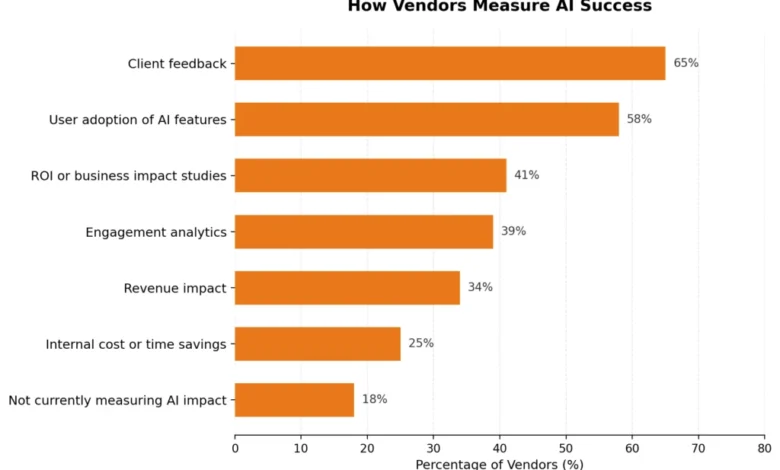
Current measurement strategies among learning technology providers reveal a heavy reliance on qualitative feedback and surface-level adoption metrics. According to industry surveys, 65% of vendors cite client feedback as a primary success metric, while 58% track the user adoption of specific AI features. In contrast, the metrics that actually matter to executive leadership—such as revenue impact (34%) and internal cost or time savings (25%)—remain underutilized.
This trend is particularly concerning as CFOs and HR leaders demand greater accountability for AI spending. The reliance on engagement analytics (39%) or ROI studies (41%) is slowly increasing, but the industry remains in the early stages of maturity. To bridge this divide, experts suggest that providers must move beyond "AI-as-a-feature" and toward "AI-as-a-business-outcome."
Chronology of AI Integration in Corporate Learning
- 2023: The "Experimental Phase." AI tools like LLMs enter the mainstream, prompting rapid, often uncoordinated, integration of AI-powered search and content creation tools in LMS (Learning Management Systems).
- 2024: The "Scaling Phase." Vendors standardize AI integration. The focus is on increasing efficiency for L&D administrators through automated course creation.
- 2025: The "Evaluation Phase." Buyers begin to question the long-term value of these tools. Initial skepticism regarding "AI fatigue" emerges as promised productivity gains fail to materialize in tangible budget savings.
- 2026: The "Accountability Phase." The current market environment is defined by a shift toward data-driven validation. Buyers now demand rigorous proof-of-concept testing, and vendors are forced to retool their value propositions to align with core business performance indicators rather than just innovation for its own sake.
Strategic Recommendations for the L&D Ecosystem
To navigate the current market, both vendors and buyers must adopt a more rigorous approach to AI implementation. Based on the latest research, the following strategies have been identified as essential for long-term success:

1. Prioritize Personalization Over Automation
The research indicates that personalized learning paths remain the most significantly underserved opportunity in the market. While vendors often prioritize content generation tools that save administrative time, users are clamoring for AI that adapts to their specific career goals and skill gaps. Platforms that successfully align AI with individual learner growth will likely see higher retention and usage rates.
2. Cultivate Trust as a Product Feature
As AI models become more integrated into organizational workflows, concerns regarding data privacy, accuracy, and algorithmic bias have become paramount. Vendors that offer transparent, "explainable AI"—where the logic behind a recommendation or content piece is visible—will gain a distinct advantage. Trust infrastructure is no longer a "nice-to-have" but a core requirement for enterprise-level adoption.
3. Broaden the Value Proposition
Historically, L&D vendors sold primarily to training managers. However, as AI investments grow, the decision-making process has expanded to include IT, Finance, and HR stakeholders. Vendors must adapt their messaging to speak to these cross-functional audiences, demonstrating how their AI solutions address security compliance, budget efficiency, and human capital development simultaneously.
4. The Human-Centered Imperative
Despite the buzz surrounding automation, there is a clear consensus that human-centered learning—coaching, mentorship, and critical thinking—remains irreplaceable. The most effective AI implementations are those that augment, rather than replace, human interaction. The future of the industry lies in a hybrid model where AI handles the routine, data-heavy tasks, freeing human facilitators to focus on the nuanced, socio-emotional aspects of learning.
The Future of AI Accountability
The transition from AI experimentation to AI accountability marks a turning point for the learning technology sector. As the market reaches a state of relative stability, the focus is shifting away from the novelty of artificial intelligence and toward the utility of its application. Organizations are no longer satisfied with generic promises of efficiency; they require evidence that AI can drive measurable improvements in employee performance and organizational health.
For vendors, the message is clear: competitive advantage will no longer be won through the breadth of AI features alone, but through the ability to demonstrate value. In an era where every budget line item is under scrutiny, those who can quantify their impact—connecting AI usage to real-world business outcomes—will be the ones to define the next generation of corporate learning.
The "AI Expectation Gap" is not merely a challenge for product developers; it is a signal of a more sophisticated buyer who is no longer swayed by technological jargon. As the industry moves forward, the winners will be those who bridge the gap between innovation and reality, proving that AI is not just a tool for learning, but a fundamental driver of business success.