Strategic Methodologies for Identifying and Bridging Professional Skills Gaps During a Career Transition into the Global Analytics Sector
The modern global economy is currently defined by a massive influx of data, creating an unprecedented demand for professionals capable of transforming raw information into actionable business insights. As organizations across all sectors—from healthcare to high-frequency trading—scramble to adopt data-driven decision-making models, a significant portion of the workforce is seeking to pivot into analytics. However, the transition from a non-analytical role to a data-centric career requires more than just a cursory understanding of spreadsheets; it demands a surgical approach to identifying and closing specific skill gaps. This process, often referred to as a "skills gap analysis," serves as the critical second phase in a comprehensive five-step career transition framework designed to align an individual’s existing background with the rigorous requirements of the contemporary analytics market.
The Landscape of the Analytics Career Transition
The journey toward a career in analytics begins with a fundamental understanding of the landscape, a process that involves assessing one’s analytical aptitude and matching personal professional goals with specific job categories. Once a candidate has identified their target roles—be they in data science, business intelligence, or marketing analytics—the focus must shift to a granular evaluation of their current competencies. In the professional world, an analytics job can be visualized as a complex construction, such as a Lego® ship. The candidate’s existing skills are the individual bricks. The objective of the skills gap analysis is to determine how many of those bricks already fit the design of the ship and which specific pieces are missing.
Industry data suggests that the demand for data-related roles is far outstripping the supply of qualified candidates. According to the U.S. Bureau of Labor Statistics, employment of data scientists is projected to grow 35 percent from 2022 to 2032, much faster than the average for all occupations. This growth translates to roughly 17,700 openings for data scientists each year. Despite this demand, many applicants are rejected not because they lack potential, but because they fail to demonstrate a precise match for the specific "buckets" of skills required by employers.
The Seven Pillars of Analytics Competency
To effectively navigate this transition, candidates must categorize their qualifications into seven distinct areas. These "buckets" represent the standard criteria used by recruiters and hiring managers to vet candidates for analytical roles. Understanding these categories allows a professional to decode job descriptions and identify the specific verbiage used by different industries.
- Educational Background: This includes formal degrees, specialized certifications, and relevant coursework. While a degree in a quantitative field such as mathematics, statistics, or engineering is often preferred, many employers are increasingly valuing specialized certifications from recognized institutions or intensive boot camps, provided they are backed by practical application.
- Professional Work Experience: This refers to the total number of years spent in the workforce and the level of seniority achieved. Employers look for a track record of reliability and professional growth, even if previous roles were not strictly analytical.
- Core Analytics Skills: This category encompasses the theoretical and practical knowledge of data analysis. It includes understanding statistical methods, hypothesis testing, predictive modeling, and data mining.
- Technical Tool Proficiency: Modern analytics is dependent on a suite of specialized software. Requirements often include proficiency in SQL for data extraction, Python or R for statistical programming, and visualization tools such as Tableau, Power BI, or Qlik.
- Industry Knowledge: This is the understanding of a specific sector, such as retail, telecommunications, or finance. Knowing the "language" of an industry—such as understanding churn in telecom or inventory turnover in retail—is a significant advantage.
- Functional Expertise: This relates to specific departments within a company, such as marketing, supply chain, human resources, or finance. A candidate who understands the nuances of marketing funnels, for instance, will be more effective at marketing analytics.
- Soft Skills and Communication: Data is useless if it cannot be communicated. This bucket includes the ability to tell a story with data, influence stakeholders, and collaborate across multidisciplinary teams.
Methodology: The Skill Gap Matrix
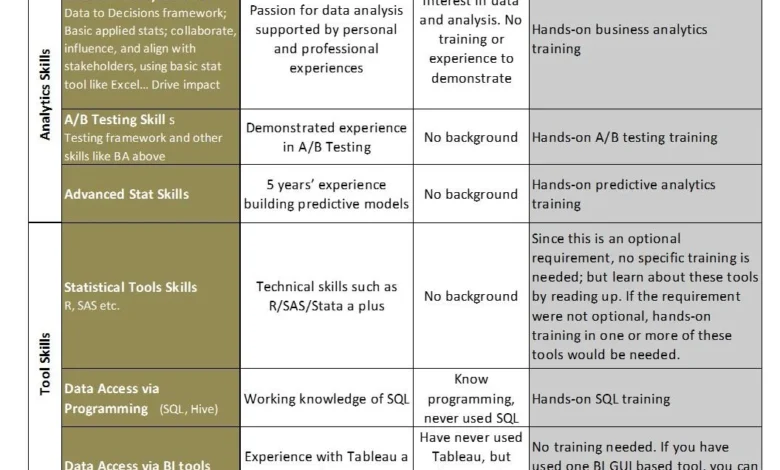
The most effective tool for a transitioning professional is the Skill Gap Matrix. This is a structured document that creates a direct comparison between the requirements of a target job and the candidate’s current profile. To build this matrix, a candidate should select three to five job descriptions that represent their ideal roles. By listing the requirements of these roles on one axis and their own skills on the other, the candidate can objectively identify where they fall short.
In many cases, the matrix will reveal that the candidate already meets the requirements for education, industry knowledge, and functional expertise. The most common gaps occur in the "Analytics Skills" and "Technical Tool Proficiency" buckets. For example, a professional moving from a project management role in healthcare into healthcare analytics may already possess the necessary industry knowledge and soft skills but lack proficiency in SQL or statistical modeling.
The importance of this matrix cannot be overstated. It transforms a vague feeling of "not being qualified" into a concrete to-do list. Furthermore, as an individual’s years of experience increase, the weight given to their formal education often decreases, making the "Skills" and "Experience" buckets the primary drivers of hiring decisions.

Strategic Pathways: Internal vs. External Transitions
A critical strategic consideration for any professional in transition is the "path of least resistance." Career experts frequently recommend pursuing an internal move within one’s current organization as the primary strategy. This approach offers several advantages: the candidate has already established a reputation, understands the company culture, and possesses deep institutional knowledge. An internal lateral move allows a professional to transition into an analytical role without necessarily compromising their seniority or compensation level.
If an internal move is not feasible, the secondary strategy should be to target roles in "overlapping" industries or functions. For example, an IT professional working in the higher education sector who wishes to move into analytics would be best served by looking for analytical roles within other universities or educational technology companies. By maintaining the "Industry Knowledge" and "Functional Expertise" buckets, the candidate reduces the perceived risk for the hiring manager. Once a professional has secured two to three years of experience in a dedicated analytics role, the ability to move across different industries becomes significantly easier, as the core analytical skills become their primary professional currency.
The 80/20 Rule of Analytics Training
When addressing the gaps identified in the matrix, it is essential to apply the 80/20 rule. In the context of business analytics, 80% of business problems can often be solved using 20% of the most common analytical techniques. While advanced statistical skills and deep machine learning knowledge are required for specialized data science roles, the vast majority of "Business Analyst" or "Data Analyst" roles require a strong grasp of fundamental concepts: correlation, regression, data visualization, and structured query language (SQL).
Candidates should prioritize acquiring these high-impact skills first. Numerous resources exist for this purpose, ranging from self-paced online courses to comprehensive career transition packages that include aptitude assessments, real-world project experience, and mentoring. The goal is to move from theoretical knowledge to "applied" knowledge. Employers are far more likely to hire a candidate who can demonstrate how they used data to solve a specific business problem than one who has merely completed a series of disconnected online modules.
Broader Implications and the Future of Work
The shift toward a data-literate workforce has profound implications for the global labor market. We are entering an era where data literacy is becoming as fundamental as literacy and numeracy. For the individual, the ability to navigate a career transition into analytics is not just about securing a higher salary; it is about future-proofing one’s career in an increasingly automated and algorithmic world.
For organizations, the ability of employees to transition into analytical roles helps mitigate the "talent war." Companies that provide internal pathways for upskilling and career pivoting often see higher retention rates and a more versatile workforce. The democratization of data tools means that the "analytical mindset"—the ability to ask the right questions of data—is becoming more valuable than the ability to write complex code from scratch.
Conclusion: From Analysis to Action
The transition into a career in analytics is a marathon, not a sprint. By methodically identifying skill gaps through a structured matrix and strategically leveraging existing industry and functional knowledge, professionals can navigate this change with confidence. The gaps identified are not barriers but rather a roadmap for future development. With the right combination of targeted training, strategic positioning, and practical application, the path from a traditional role to a high-impact analytics career is well within reach for those willing to do the analytical work on their own careers first. As the field continues to evolve, those who master the art of the career pivot will find themselves at the forefront of the modern economy, turning the "Lego bricks" of their past experience into the sophisticated vessels of their professional future.