The Rise of Answer Engine Optimization: How Brands Are Navigating the New Frontier of AI Search

The landscape of digital discovery has undergone a seismic shift, fundamentally altering how consumers find information and how businesses reach their target audiences. As users increasingly pivot away from traditional, link-heavy search results in favor of synthesized, conversational responses from AI-powered platforms like ChatGPT, Perplexity, and Google’s AI Overviews, the practice of Search Engine Optimization (SEO) is evolving into Answer Engine Optimization (AEO). In this new era, the objective is no longer merely to secure a top-ten link position, but to be explicitly cited or mentioned within the AI-generated answer itself, effectively capturing user attention before a click ever occurs.
This transition marks a departure from the "ten blue links" model that has defined the internet since the late 1990s. As search engines integrate large language models (LLMs) to summarize vast quantities of data into single, cohesive responses, brands are facing a visibility crisis: visibility that once guaranteed traffic can now vanish into an AI-generated summary that users never leave. To maintain market share, organizations are adopting AEO checkers—sophisticated diagnostic tools designed to monitor, measure, and optimize how frequently and accurately a brand appears within these AI responses.
![AEO checker tools that measure answer engine visibility [2026]](https://53.fs1.hubspotusercontent-na1.net/hubfs/53/aeo-checker-1-20260903-3858273.webp)
A Chronology of the Search Revolution
The roots of this shift can be traced back to the public explosion of generative AI in late 2022. However, the turning point for the search industry occurred in May 2024, when Google officially launched its AI Overviews (AIO) feature. This update signaled to the global market that the world’s largest search engine was committed to a "summary-first" user experience.
Prior to 2024, the industry operated under the assumption that link-based traffic was the primary metric of success. The introduction of AI Overviews, which synthesize information from multiple sources to answer complex queries, disrupted this model. By mid-2026, the complexity of these engines grew, as platforms like Perplexity solidified their role as dedicated "answer engines," and ChatGPT began integrating real-time web search capabilities with increasing frequency. In June 2026, Google further acknowledged the shift by rolling out dedicated generative AI performance reports within Search Console, providing site owners with a limited, but necessary, look at how their content performs in this new, non-traditional format.
Understanding the Mechanics of AEO
While SEO focuses on crawlability, keyword density, and backlink authority to secure ranking in a list, AEO is concerned with authority, clarity, and entity recognition. Answer engines prioritize content that is highly structured, provides direct answers to specific questions, and is backed by verifiable primary sources.
![AEO checker tools that measure answer engine visibility [2026]](https://no-cache.hubspot.com/cta/default/53/9dd5e54b-fbef-4dd0-bc44-1689feb1ea18.png)
An AEO checker functions as the bridge between raw content and the logic of an AI model. These tools operate by continuously crawling and querying AI engines with high-intent keywords relevant to a brand. They then analyze the responses for three key metrics:
- Citation Coverage: Does the AI link back to your domain when discussing your product category?
- Brand Mentions: Is your brand named in the text, even if a direct link is absent?
- Competitive Gaps: When an AI suggests a solution or service, which competitors are cited in your place?
By tracking these variables, an AEO checker provides actionable intelligence—such as schema corrections, content restructuring, or the need for more authoritative, fact-based prose—to ensure the engine’s algorithm identifies the brand as a reliable source of truth.
Manual Auditing vs. Automated Intelligence
For businesses just entering the space, manual auditing serves as a viable starting point. This involves defining a core set of priority queries—such as "best enterprise CRM" or "how to automate supply chain logistics"—and running these in incognito sessions across ChatGPT, Gemini, and Google. By recording whether an AI Overview appears and whether the brand is cited, teams can build a baseline.
![AEO checker tools that measure answer engine visibility [2026]](https://53.fs1.hubspotusercontent-na1.net/hubfs/53/aeo-checker-2-20260903-852936.webp)
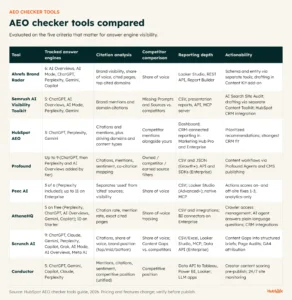
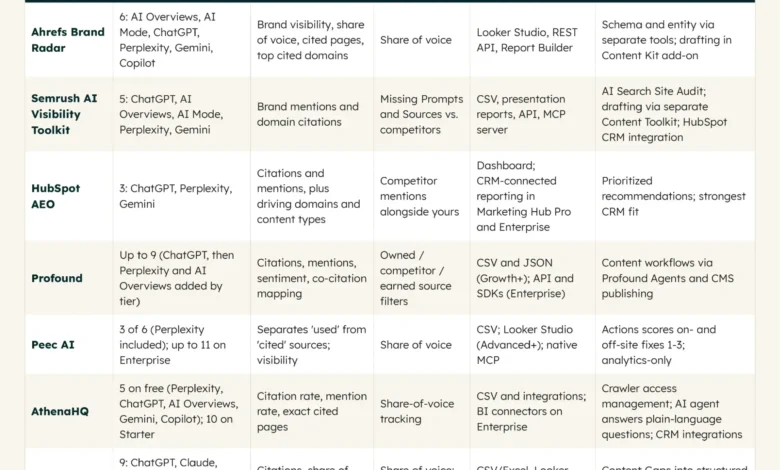
However, the volatility of AI responses renders manual checking insufficient for scale. Because LLMs are probabilistic, the same query can yield different sources in consecutive sessions. Professional AEO tools, such as the suite provided by HubSpot, Ahrefs Brand Radar, or the Semrush AI Visibility Toolkit, solve this by automating thousands of queries per day. These tools provide trend data, showing whether visibility is trending upward or downward over several weeks, which is far more indicative of long-term health than a single snapshot.
Market Landscape: Tools of the Trade
The current ecosystem of AEO software is segmented by specific strengths:
- Broad Monitoring: Tools like Ahrefs Brand Radar are noted for their reliance on real-world search query data, making them effective for brands heavily invested in Google’s AI Overviews.
- Citation Depth: HubSpot’s AEO tool is increasingly recognized for its ability to link visibility data directly to CRM metrics, allowing businesses to see not just if they were cited, but if that citation led to a tangible lead or deal.
- Contextual Analysis: Platforms like Profound go deeper, utilizing sentiment analysis to determine if an AI is citing a brand in a positive, negative, or neutral context, which is critical for reputation management.
- Technical Readiness: Solutions like Conductor and Scrunch AI focus on the foundational layer of AEO, ensuring that a brand’s website architecture is "readable" for AI crawlers, a prerequisite for being considered as a source.
Broader Implications and Future Outlook
The rise of AEO suggests a future where "zero-click" search becomes the default rather than the exception. For content marketers and SEO professionals, this presents a significant challenge: how to drive value when the user never visits the website.
![AEO checker tools that measure answer engine visibility [2026]](https://53.fs1.hubspotusercontent-na1.net/hubfs/53/aeo-checker-3-20260903-8904553.webp)
Industry analysts suggest that the answer lies in becoming an "entity" that the AI trusts. This involves moving beyond standard content toward creating "authoritative content"—pieces that answer highly specific questions with clear, data-backed assertions. As AI models prioritize efficiency, they will favor brands that provide clean, structured data, while pushing aside sites that rely on vague, keyword-stuffed content.
From a financial perspective, the implication is a shift in marketing spend. Companies are beginning to reallocate budgets from traditional SEO tools—which track link rankings—toward AEO tools that track influence within the LLM ecosystem. This is not a replacement of SEO, but an extension of it. The authority signals built through traditional SEO (such as high-quality backlinks and site speed) remain the primary fuel that feeds the AI’s decision-making process.
Conclusion
The transition to answer-based discovery is not a fleeting trend but a fundamental change in the internet’s architecture. As answer engines continue to refine their accuracy, the brands that thrive will be those that actively manage their digital presence within the AI ecosystem. By utilizing automated AEO checkers to bridge the gap between their content and the engines that serve it, businesses can ensure they remain relevant in an era where the most important search results are no longer found at the end of a link, but within the answer itself. Moving forward, the successful brand will be one that the AI can cite with confidence, turning machine-generated synthesis into a powerful engine for growth.