In an era where the shelf life of professional skills is rapidly contracting, Columbia University has emerged as a pivotal provider of accessible, high-caliber education. By leveraging digital platforms like edX and its own proprietary portals, the Ivy League institution has democratized access to its world-class faculty, allowing professionals, students, and lifelong learners to engage with complex subjects—from corporate finance to artificial intelligence—without the barrier of traditional tuition costs. This shift reflects a broader trend in higher education: the transition from degree-exclusive learning to a continuous, modular model of professional development.
The Evolution of Digital Pedagogy at Columbia
Columbia University’s foray into massive open online courses (MOOCs) began in earnest during the early 2010s, following the launch of the edX platform by Harvard and MIT. Recognizing that the global demand for its expertise far outstripped the physical capacity of its Morningside Heights campus, Columbia began curating a digital curriculum that mirrored the rigor of its on-campus programs.
Chronologically, this initiative evolved through three distinct phases. The first phase, starting around 2013, focused on introductory courses designed to gauge public interest. The second phase saw the introduction of "XSeries" programs, which bundled multiple courses into a coherent, skill-focused narrative. Currently, the university is in its third phase: an integration with executive-level, industry-aligned training that addresses the specific needs of modern corporate environments, such as digital transformation and high-stakes leadership.
The Mechanics of "Free" Ivy League Education
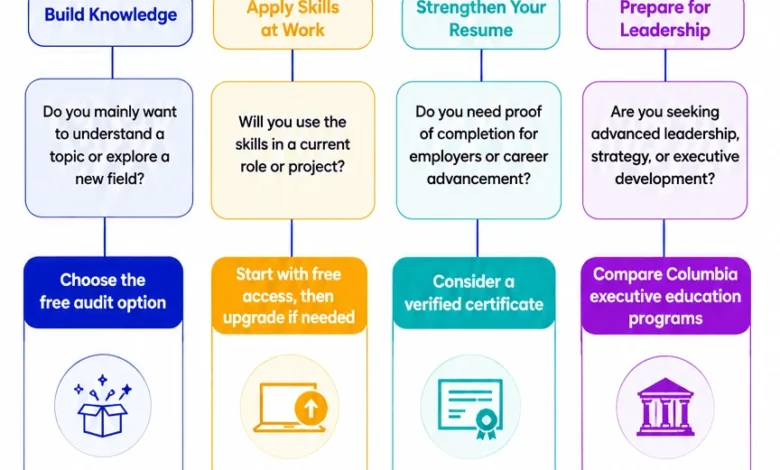
For many, the term "free" in higher education requires clarification. Columbia’s model operates primarily on an "audit" basis. When a student chooses to audit a course, they gain full access to the lecture library, reading materials, and discussion forums—the core intellectual content of the program—without charge.
The financial distinction arises when a learner requires a tangible credential. While the knowledge acquisition is cost-free, the verification of that knowledge—represented by a certificate of completion—is subject to a fee. This business model serves a dual purpose: it lowers the barrier to entry for skill acquisition while maintaining a revenue stream that supports the administrative and technical costs of hosting high-quality online content. For professionals, this presents a strategic opportunity: they can vet a course’s content for relevance to their specific career trajectory before committing financial resources to secure a verified credential.
Categorizing the 10 Essential Courses
Columbia’s current catalog covers a diverse array of disciplines. Below is an analytical look at ten key courses that are currently shaping professional development paths.

Financial Literacy and Analytical Rigor
- Introduction to Corporate Finance: This foundational course addresses the core tenets of capital budgeting and project valuation. Data from industry surveys suggest that proficiency in financial statement analysis is among the most requested "soft" technical skills in executive leadership roles.
- Free Cash Flow Analysis: Moving beyond standard accounting, this course focuses on the cash-generation capabilities of firms. It is highly recommended for professionals in FP&A (Financial Planning and Analysis) who must translate data into actionable investment strategies.
- Risk & Return: As market volatility increases, understanding the interplay between asset allocation and expected return is vital. This course serves as a theoretical bedrock for wealth managers and corporate strategists.
The Technical Frontier: AI and Computation
- Essential Math for AI: Machine learning is essentially applied mathematics. This course bridges the gap for engineers and data analysts who understand programming but require a deeper conceptual grasp of the linear algebra and probability that drive AI models.
- Programming & Data Structures: As digital literacy becomes a baseline requirement across all sectors, this course offers an essential introduction to the algorithms that underpin modern enterprise software.
Leadership and Social Impact
- Crisis Resource Management: Originally developed for high-stress medical environments, these protocols for communication and rapid decision-making are increasingly adopted by organizational leaders in the corporate and nonprofit sectors.
- Inclusive Teaching: In the context of modern HR and L&D (Learning and Development), understanding how to create an accessible learning environment is a critical competency for building diverse and high-performing teams.
- Learning Success: This course applies cognitive psychology to professional development, teaching learners how to optimize their memory, reading, and self-directed study habits—an essential skill set in an age of constant information updates.
Sustainability and Public Policy
- Frontiers of Science: Climate & Us: ESG (Environmental, Social, and Governance) mandates are forcing firms to rethink their supply chains. This course provides the scientific context required for leaders to make informed, long-term climate strategies.
- INSPIRE: Seven Strategies for Ending Violence Against Children: Utilizing the WHO’s framework, this course illustrates the intersection of public policy and social welfare, essential for those involved in corporate social responsibility (CSR) and NGO management.
Strategic Implications for Professionals
The proliferation of these courses is not merely a convenience; it represents a fundamental shift in the hiring landscape. Industry analysts observe that hiring managers are increasingly valuing "micro-credentials" as evidence of a candidate’s commitment to self-improvement.
"The modern professional is a perpetual student," notes one analyst from the education sector. "When an applicant lists a ColumbiaX certificate on their LinkedIn profile, it signals not just the acquisition of knowledge, but the discipline to navigate an Ivy League-level curriculum independently."
Furthermore, for organizations, encouraging employees to audit these courses serves as a low-risk, high-reward L&D strategy. By utilizing the "audit" function, companies can evaluate the quality of specific training modules before purchasing corporate licenses or funding employee certificates, effectively outsourcing a portion of their internal training development to a globally recognized institution.
Distinguishing Between Course Tiers
It is critical for learners to distinguish between ColumbiaX courses and Columbia Business School (CBS) executive education. While both carry the weight of the Columbia brand, their purposes differ significantly. ColumbiaX offerings are generally designed for a broad, global audience, focusing on conceptual foundations and technical skills. Conversely, CBS executive programs are intensive, often synchronous (live), and frequently involve networking components, peer-to-peer collaboration, and direct interaction with faculty. These programs are designed for career advancement at the C-suite or senior management level and are priced accordingly to reflect the depth of engagement and administrative support provided.
Conclusion: The Value of Intentional Learning
Columbia University’s free online initiatives offer a unique convergence of accessibility and prestige. However, the value of these resources is ultimately determined by the learner’s intent. Professionals who approach these courses with a specific, goal-oriented mindset—such as filling a gap in their technical knowledge or preparing for a pivot into a new industry—will find the most utility.
As the labor market continues to reward those who can adapt to technological and economic shifts, the ability to access high-quality education without significant upfront investment is a powerful lever. Whether utilized to master the fundamentals of finance, understand the mathematical underpinnings of AI, or refine leadership capabilities, these courses provide a bridge to higher-level expertise. For the ambitious professional, the path forward is clear: the resources are available, the curriculum is verified, and the opportunity to engage with Ivy League scholarship is more accessible than at any other time in history.
Related posts: