HR Tech World Congress 2016 Recap: Assessing the Future of Talent Acquisition Through Strategic Industry Partnerships


The HR Tech World Congress, held in the heart of Paris in late 2016, served as a pivotal convergence point for the global human resources technology sector. Bringing together industry leaders, software developers, and enterprise recruiters, the event underscored a significant shift toward ecosystem-based innovation. During the multi-day summit, HR Tech Advisor conducted a series of on-camera interviews with 24 prominent suppliers, documenting a landscape increasingly defined by cross-platform integrations, collaborative marketing, and the pursuit of seamless digital recruitment workflows.
The Evolution of the HR Tech Ecosystem
By 2016, the HR technology market had begun to transition from a collection of siloed point solutions to a highly interconnected ecosystem. The necessity for disparate software—such as Applicant Tracking Systems (ATS), video interviewing platforms, and psychometric assessment tools—to "speak" to one another became a primary driver of industry growth.
The event in Paris acted as a barometer for this shift. Vendors were no longer merely showcasing standalone features; they were demonstrating how their technologies functioned within larger enterprise resource planning (ERP) and talent management suites. This trend was evident in the floor activity, where partnerships between major players like SmartRecruiters and AssessFirst, as well as HireVue and IBM Kenexa, signaled that the era of the "all-in-one" platform was being challenged by a "best-of-breed" integrated approach.
Chronology of the Paris Summit
The congress followed a structured agenda designed to facilitate both high-level strategic discourse and granular technical demonstrations.
- Day One: The opening sessions focused on the digitalization of the workforce, with keynote addresses highlighting the role of artificial intelligence and machine learning in talent acquisition. The expo floor opened in the afternoon, serving as the primary hub for networking between HR practitioners and technology providers.
- Day Two: The focus shifted toward practical implementation. Companies like HireVue utilized the exhibition space to host collaborative demonstrations, specifically showcasing the integration between their video intelligence platform and IBM’s Kenexa BrassRing. This day was characterized by an uptick in B2B networking, as firms sought to solidify referral partnerships and co-marketing agreements.
- Day Three: Closing sessions centered on the future of workplace culture and the impact of data-driven hiring practices. Interviews conducted by HR Tech Advisor throughout these three days highlighted a common thread: the industry was prioritizing user experience (UX) and data fluidity above all else.
Supporting Data and Industry Context
In 2016, the global HR technology market was valued at approximately $14 billion, with expectations for double-digit annual growth over the following five years. This investment surge was largely fueled by the "war for talent," a period where organizations were struggling to fill high-skill roles, prompting a rush to adopt automated screening and assessment technologies.
The 24 suppliers interviewed by HR Tech Advisor represented a cross-section of this booming market. From assessment specialists to automated scheduling tools, these vendors faced a common challenge: proving ROI in a crowded marketplace. The data from the period suggests that companies leveraging integrated tech stacks saw a 20% improvement in time-to-hire metrics compared to those relying on manual processes or fragmented, non-integrated tools.
Official Perspectives on Partnership Strategy
The shift toward partnerships was not merely a marketing tactic but a survival strategy for many firms. Lauren, representing HireVue during the event, emphasized that the value of the HR Tech World Congress lay in its ability to bring partners together in a physical space, moving beyond digital communication to finalize integration workflows.

"Several HireVue referral and integrated partners sponsored and attended the event," Lauren noted during her interview. "It is an incredible show that offers true value in accomplishing business meetings and meeting face-to-face with clients and prospective clients."
When asked about the mechanics of modern collaboration, she pointed to the strategic alliance with IBM as a prime example of the industry’s direction. "HireVue partnered up with IBM at their booth and showed the workflow and value of the HireVue and IBM Kenexa BrassRing integration," she explained. This move allowed the companies to demonstrate a cohesive candidate experience, where a recruiter could move from a job posting to an automated video assessment without leaving the BrassRing environment.
Implications of the Integrated Tech Trend
The broader implications of the trends observed at the 2016 Paris congress are profound. The reliance on integrated technology has fundamentally changed the role of the HR professional. Recruiters are no longer just administrators; they have become orchestrators of a technology stack.
- Reduced Friction: By integrating platforms, organizations reduce the manual entry of data, which minimizes errors and ensures that candidate profiles remain consistent across different stages of the hiring funnel.
- Standardized Metrics: Integrated systems allow for better data aggregation. When a video interviewing platform feeds data directly into an ATS, the analytics generated provide a clearer picture of which candidate attributes correlate with long-term success.
- Scalability: For large enterprises, the ability to plug in new, specialized tools into an existing backbone (like an IBM or SAP environment) allows the company to adapt to new hiring needs without the disruption of a full system overhaul.
However, this increased reliance on integrations also presents challenges. Cybersecurity and data privacy, which were gaining significant regulatory attention in 2016, became more complex as data began to flow between multiple third-party vendors. The responsibility shifted toward ensuring that every partner in an integrated chain maintained the same rigorous security standards.
The Human Element in a Digital Age
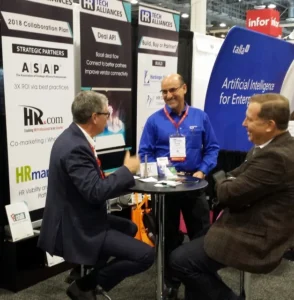
Despite the heavy emphasis on software and integration, the 2016 event also underscored the enduring importance of human interaction. The prevalence of selfies, handshake deals, and booth-to-booth networking sessions proved that even as the industry becomes increasingly automated, the "human" in Human Resources remains the final arbiter of value.
The interviews conducted by HR Tech Advisor served as a reminder that these companies are ultimately providing services that impact human livelihoods. The sophistication of the technology is irrelevant if it does not facilitate a more transparent, equitable, and efficient connection between employers and candidates.
Conclusion: A Legacy of Collaboration
As the HR Tech World Congress in Paris concluded, the message to the industry was clear: no software vendor is an island. The suppliers who thrived in the years following this event were those who successfully cultivated robust partner ecosystems. By moving away from proprietary, closed-loop systems and toward an open-API, collaborative model, these firms laid the groundwork for the modern, agile talent acquisition tools that define today’s corporate environment.
The 2016 summit did not just showcase software; it showcased a new philosophy of business. Through the lens of the 24 suppliers highlighted by HR Tech Advisor, one can see the blueprint for the current state of talent acquisition: a sophisticated, integrated, and highly collaborative machine designed to find, assess, and hire the talent of tomorrow. As organizations continue to navigate the complexities of global hiring, the lessons of partnership, integration, and face-to-face engagement from the Paris event remain more relevant than ever.