The Myth of Selectivity: Why Low Acceptance Rates Fail to Measure Hiring Quality

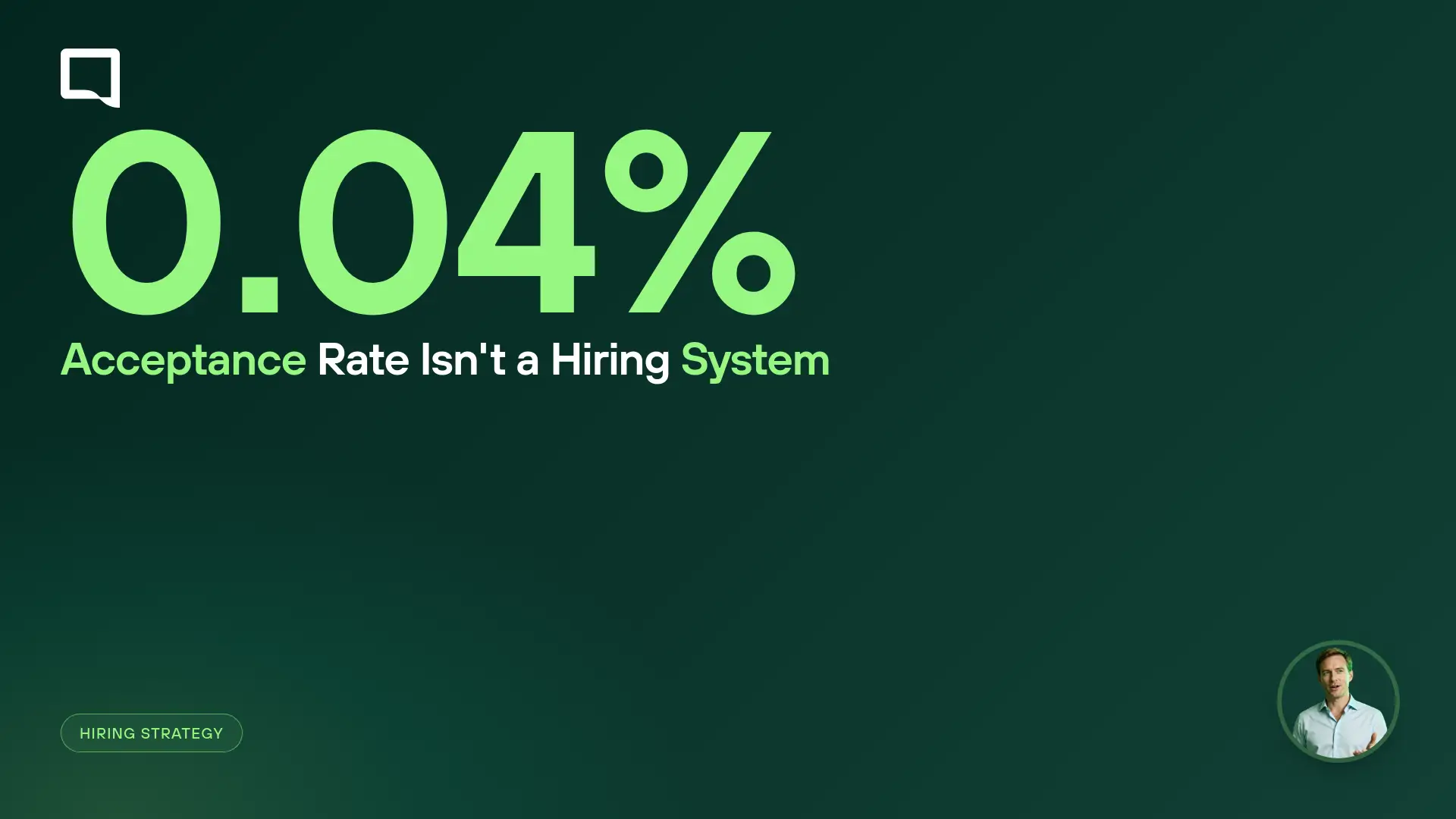
In the contemporary landscape of corporate recruitment, few metrics have captured the public imagination as effectively as the acceptance rate. Recently, Bending Spoons, the $21 billion technology conglomerate behind platforms such as Eventbrite, Vimeo, and AOL, generated headlines by disclosing that it hired only 286 individuals out of 800,000 applicants in 2025. This equates to an acceptance rate of approximately 0.04%. For context, this figure is roughly 100 times more selective than elite Ivy League institutions, which typically admit around 4% of their applicant pool. While these statistics have been widely circulated as a testament to the company’s rigorous standards, a deeper examination of talent acquisition mechanics suggests that the headline-grabbing percentage is less a measure of quality and more a reflection of funnel volume and administrative capacity.
The fascination with extreme selectivity is not unique to Bending Spoons. Recent years have seen a proliferation of similar data points across various sectors. Match Group’s "Tindership" internship program reported over 30,000 applicants for only 27 positions, yielding a 0.09% acceptance rate. Similarly, Goldman Sachs has maintained an acceptance rate of less than 1% for its summer internship program for three consecutive years. These figures, while impressive in their raw magnitude, function primarily as a proxy for brand visibility and labor market conditions rather than an indicator of the predictive validity of the hiring process itself.
The Mechanics of the Funnel
To understand the reality behind these numbers, one must differentiate between selectivity and efficiency. A hiring funnel is essentially a pipeline designed to reduce a large pool of candidates to a select few. The efficiency of this pipeline is determined by how accurately it identifies high-performing talent at each stage. In the case of Bending Spoons, the process is expansive. Of the 800,000 applicants, 60,000 successfully navigated the initial screening to reach the first round of assessment. These candidates were subjected to rigorous testing covering reasoning, judgment, and learning agility—metrics that are far more objective than a standard resume review.
However, the sheer volume of 800,000 applicants suggests that the company is managing an immense logistical burden. When a firm processes nearly a million applications, the resulting rejection rate is a mathematical byproduct of the volume of interest against a relatively static number of headcount requirements. For talent acquisition leaders, viewing this ratio as a success metric is a reversal of cause and effect. A company does not necessarily hire better because it rejects more people; it simply manages a larger funnel. The true measure of a robust hiring process is not the total number of rejections, but the correlation between the assessment methods used and the subsequent performance of the employees hired.
The Hidden Critique of the Interview
Perhaps the most significant aspect of the Bending Spoons story is not the 0.04% figure, but the company’s stated skepticism regarding traditional interview practices. Luca Ferrari, CEO of Bending Spoons, remarked in an interview with the Wall Street Journal that "a run-of-the-mill interview is almost entirely non-predictive, like tossing a coin." This admission serves as a critical indictment of the standard recruitment model used by most global corporations.
By dismissing the traditional interview as "useless" in isolation, Ferrari inadvertently highlights why his company has adopted a more complex, layered approach. Rather than relying on the subjective impressions of a hiring manager during a conversation, Bending Spoons has institutionalized a multi-stage process involving algorithmic scoring, quantitative reasoning tests, and exhaustive reference verification. This structure is intended to strip away the inherent biases of human interaction. The fact that only 9% of those who reached the interview stage ultimately received an offer underscores the company’s reliance on these external, data-driven guardrails. The headline-grabbing acceptance rate is not the goal; it is a side effect of a process designed to treat the interview as a low-validity data point rather than the final authority.
The Trap of Comparative Benchmarking
The tendency to compare corporate hiring to the admissions process of elite universities creates a false equivalence. Higher education admissions are often influenced by institutional needs, legacy status, and a desire for specific demographic representation—factors that differ significantly from the requirements of a commercial enterprise. When TA leaders adopt the language of university selectivity, they risk prioritizing a media-friendly narrative over a functional talent strategy.
In the current labor market, high applicant volume is frequently driven by external economic factors. A period of economic uncertainty, characterized by layoffs in the tech sector and a tightening of the job market, inevitably pushes a higher number of qualified candidates toward fewer open roles. As reporting from major tech firms like Meta, Microsoft, and Google has indicated, the rise in applicant-to-hire ratios is a macro-trend rather than a result of newly implemented rigor at any single organization. Therefore, using these numbers as a benchmark for hiring quality is fundamentally flawed. It misinterprets a symptom of the labor market as an indicator of internal performance.
Designing a High-Validity Process
For organizations seeking to improve the quality of their hires, the focus should shift from the breadth of the funnel to the depth of the assessment. The "Bending Spoons model"—if it is to be studied—is not the 0.04% figure, but the scaffolding built around the interview. The following components represent the structural work that defines a rigorous hiring process:

- Standardized Assessment: Utilizing validated psychometric or cognitive tests that measure specific, job-relevant skills rather than relying on pedigree or tenure.
- Structured Interviews: Implementing consistent questioning patterns and scoring rubrics that force interviewers to evaluate candidates against predefined competencies rather than "culture fit" or subjective intuition.
- Algorithmic Scoring: Where possible, using objective, data-driven scoring to minimize the influence of unconscious bias.
- Comprehensive Reference Checks: Engaging in detailed, evidence-based verification before a final offer is extended, ensuring that the candidate’s history aligns with their performance in the assessment stages.
The danger of "Selectivity Theatre" is that it provides a false sense of security. If a leadership team equates a low acceptance rate with a high hiring bar, they may overlook the fact that their assessment methods are not actually identifying the right candidates. A funnel can be narrow, yet still be filled with candidates who were selected for the wrong reasons.
Moving Beyond the Headline
As the talent acquisition field continues to evolve, the distinction between high-volume screening and high-quality assessment will become increasingly critical. The obsession with rejection rates is likely to persist in the short term, fueled by the desire for brand prestige and the virality of social media recruitment. However, the most effective organizations will be those that look past the ratio.
When evaluating a recruitment strategy, the most pertinent questions are not related to the percentage of candidates turned away. Instead, talent leaders should ask: What specific, evidence-based criteria are being used to differentiate between candidates? How do we know that our assessments are predictive of long-term employee success? To what extent does our process remove human bias rather than codify it?
The Bending Spoons case provides a valuable case study, not for its record-breaking rejection rate, but for its explicit distrust of traditional, unstructured hiring. By acknowledging that the standard interview is an unreliable tool, the company has signaled that rigor is found in the architecture of the process, not in the volume of the applicant pool. For other organizations, the path forward is clear: build a better system, and the metrics will take care of themselves. Defending the evidence behind a single hire is a far more robust demonstration of organizational strength than defending the math behind ten thousand rejections. Ultimately, the goal of a talent function is to build a high-performing workforce, a task that requires precision, transparency, and a commitment to data—none of which are fully captured by the simplistic allure of a decimal-point acceptance rate.