The Hidden Cost of AI-Assisted Creativity
New research conducted by a team of academics from the University of Washington, UCL, the University of Exeter, and the Wharton School suggests that the widespread adoption of AI tools like Large Language Models (LLMs) acts as a double-edged sword for corporate strategy. While 83% of senior executives identify innovation as a top-three business priority, the findings indicate that relying on automated suggestion engines may inadvertently steer entire organizations toward a narrow band of "statistically likely" ideas, effectively killing the "breakthrough outliers" that drive market disruption.
The Anatomy of the Research
The study, published in the summer of 2026, synthesized data from four distinct experimental domains: short-story writing, circular-economy solutions, humor production, and collaborative storytelling. By observing how human creators interacted with AI assistants in these controlled environments, researchers were able to quantify the shift in creative output.
In each of these scenarios, participants using AI were found to produce work that was, on average, of higher quality and more useful than their peers working without such tools. However, when the researchers analyzed the entire pool of ideas generated by the AI-assisted groups, they observed a significant decline in variance. The "search space"—the breadth of unique perspectives and unconventional concepts—had been drastically compressed.
The researchers define creativity as the intersection of novelty and usefulness. While AI excels at boosting the "usefulness" of a draft or a business solution, it appears to act as a constraint on "novelty." By anchoring users to suggestions that are highly probable—and therefore perceived as "good enough"—AI prevents the leap into the truly original or the radically unconventional.
A Chronology of the AI Integration Shift
The integration of generative AI into the professional creative workflow has unfolded in distinct stages over the past three years:
- 2023–2024 (The Productivity Boom): Early adopters in marketing, coding, and design began using LLMs to reduce the "cold start" problem. The initial focus was on speed and volume, with early data from the Harvard Business School noting significant gains in productivity for knowledge workers navigating the "jagged technological frontier."
- 2025 (The Awareness Gap): As the novelty wore off, organizations began to notice that while output speed increased, the "distinctive voice" or "unique value proposition" of their creative outputs began to blend with that of competitors. Researchers began to investigate the "homogenization effect."
- 2026 (The Strategic Pivot): The current research represents a maturation of the field, moving from asking "Can AI do the job?" to "What is the long-term cost of AI-generated workflows on organizational culture and market innovation?"
Data-Driven Implications for Management
The implications for managers are profound. If innovation relies on the synthesis of diverse, outlier ideas, and AI acts as a filter that eliminates those outliers, then the reliance on AI without guardrails is a recipe for creative stagnation.

Supporting data from the studies highlights a "fluency bias." Humans have a psychological tendency to accept the first high-quality suggestion offered to them. When an AI presents a polished, articulate, and "useful" solution, the human creator often ceases their search for alternatives. This leads to a collective convergence where entire teams, using the same underlying models, begin to arrive at identical, high-average-quality solutions, leaving little room for the radical innovation that keeps companies competitive in the long run.
The research suggests that the "crowdless future" is not merely an automation of labor, but a potential erosion of the collective brainstorming process. When the collective wisdom of a diverse group of employees is mediated by a single type of generative model, the "wisdom of the crowd" is replaced by the "logic of the algorithm."
Strategic Recommendations for Industry Leaders
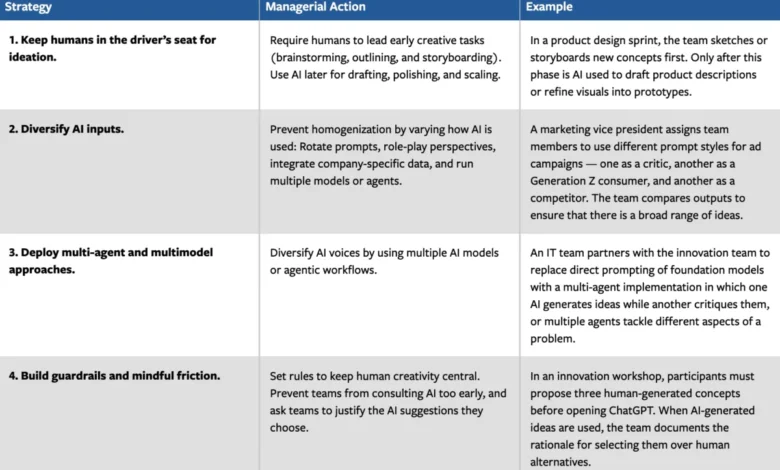
To mitigate these risks, the authors of the study suggest that managers should not abandon AI, but rather redesign workflows to treat AI as a collaborator rather than an oracle. Suggested strategies include:
- Delayed AI Engagement: Encourage employees to brainstorm and document their own original, raw ideas before engaging with generative AI tools. This ensures that the "human seed" of an idea is planted before the algorithm can exert its influence.
- Diverse Model Utilization: If an organization uses AI, it should ensure that different teams have access to different models or are encouraged to use different prompting strategies. This increases the likelihood that the collective output remains heterogeneous.
- The "Devil’s Advocate" Prompt: Managers should train staff to use AI specifically to challenge existing ideas rather than just generating them. For instance, prompting an AI to "identify the flaws in this logic" or "suggest three completely unconventional approaches to this problem" can force the model to look outside the "average" probability space.
- Human-in-the-Loop Validation: Organizations must maintain a high threshold for human intervention, particularly in the final stages of creative development. The goal is to use AI to handle the "heavy lifting" of standard tasks while reserving the creative high-level synthesis for human judgment.
Broader Impact and Future Outlook
The transition toward AI-augmented creativity is likely to continue, but the findings from the research team highlight a growing tension in the corporate world. There is an inherent conflict between the immediate demand for "useful, high-quality" output and the long-term requirement for "novel, groundbreaking" innovation.
The economic stakes are high. If 83% of firms are chasing innovation as a priority, but the tools they adopt lead to a "convergent" output, the competitive landscape may become increasingly crowded with "good but identical" products. This creates a market premium for companies that can effectively balance human-led creative intuition with AI-assisted productivity.
Ultimately, the research team emphasizes that AI is a tool, not a creative entity in its own right. The "hidden cost" identified in these studies is not an inherent property of the technology itself, but a reflection of how humans currently interact with it. By recognizing the tendency of LLMs to regress toward the mean, managers can implement structural safeguards that protect the diversity of thought.
As the technology continues to evolve, the most successful organizations will be those that learn to treat AI as a catalyst for human creativity rather than a substitute. The ability to preserve the "outlier"—that strange, unpolished, and potentially game-changing idea—will remain a distinctly human responsibility. The challenge for the next decade will be to ensure that in our rush to become more efficient, we do not inadvertently trade our capacity for the truly new for the comfort of the merely correct.