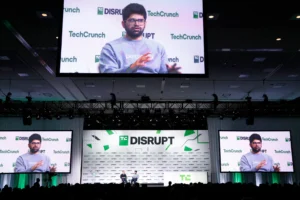
TechCrunch Disrupt 2026 Debuts Smart Money Stage to Explore the Convergence of Fintech AI and Global Payments Infrastructure

The global financial landscape is undergoing a fundamental transformation as traditional banking systems intersect with decentralized finance and artificial intelligence. To address this evolution, TechCrunch Disrupt 2026 has announced the inauguration of the Smart Money Stage, a dedicated forum designed to dissect the collision of fintech, payment technologies, and AI-driven financial services. Scheduled to take place from October 13 to October 15 at the Moscone Center in San Francisco, the event will convene industry leaders, founders, and institutional operators to examine the infrastructure powering the next generation of global commerce.
The introduction of the Smart Money Stage reflects a significant shift in the startup ecosystem. While fintech has long been a pillar of the Disrupt conference, the 2026 iteration marks the first time the event has consolidated these specific verticals into a singular, high-level programming track. This strategic decision comes at a time when "money" is increasingly defined not by physical currency or static bank ledgers, but by programmable assets and automated decision-making agents.
The Architecture of Modern Money Movement
At the core of the Smart Money Stage’s agenda is the transition from legacy financial rails to real-time, global payment systems. A primary focus will be the role of stablecoins and instant payment networks in reshaping how value is transferred across borders. For decades, international wire transfers and clearinghouse settlements were defined by multi-day delays and high intermediary fees. However, the rise of private-sector stablecoins and government-backed initiatives like FedNow has accelerated the move toward a T+0 settlement standard.
Nikhil Chandhok, Chief Product and Technology Officer at Circle, will be among the featured speakers addressing these shifts. Circle, the issuer of USDC, has been a central figure in the effort to bring regulatory-compliant digital dollars to the mainstream. The discussion will contrast these blockchain-based solutions with traditional banking infrastructure and private networks, exploring how regulatory frameworks in the United States and the European Union—specifically the Markets in Crypto-Assets (MiCA) regulation—are providing the legal clarity necessary for institutional adoption.
Supporting this discussion, Rodney Robinson, Co-founder and CEO of TabaPay, Inc., and Lotti Siniscalco, General Partner at Emergence, will provide insights into the merchant and venture capital perspectives. As instant payments become the expected norm for both B2B and B2C transactions, the panel will analyze the remaining hurdles to universal adoption, including interoperability between competing private networks and the technical challenges of integrating legacy core banking systems with modern APIs.
The Rise of Agentic AI in Financial Services
Perhaps the most significant technological frontier being explored at Disrupt 2026 is the integration of "agentic" AI into financial workflows. Moving beyond generative AI that merely produces text or images, agentic AI refers to autonomous systems capable of executing financial transactions, managing portfolios, and verifying identities with minimal human intervention.
This transition raises critical questions regarding trust, oversight, and security. The Smart Money Stage will host a dedicated session on AI, Trust, and Verification, featuring Hannah Bozian of American Express, Pedro Sanzovo of Plaid, and Victoria Zuo of QED Investors. American Express has historically been a leader in using machine learning for fraud detection, but the shift toward AI agents requires a new paradigm for "knowing your customer" (KYC) and preventing sophisticated, AI-generated synthetic identity fraud.
Plaid, which provides the connectivity layer for thousands of fintech apps, sits at the center of this data exchange. The discussion is expected to highlight how companies are balancing the efficiency of automated financial agents with the necessity of human judgment and transparency. Data privacy remains a paramount concern, as AI agents require access to granular financial data to function effectively, necessitating advanced encryption and "zero-knowledge" proof technologies to protect consumer information.
Scaling Financial Platforms for the Modern Consumer
The evolution of consumer behavior is another pillar of the 2026 program. Robinhood, a company that has transitioned from a disruptive trading app to a comprehensive financial services platform, serves as a primary case study for this trend. With a market capitalization exceeding $90 billion, Robinhood now operates across investing, banking, credit, cryptocurrency, and prediction markets.
Abhishek Fatehpuria, Robinhood’s Head of Product, will detail the technological infrastructure required to support such rapid diversification while maintaining consumer trust. The modern financial consumer expects a unified experience where credit, savings, and investments are integrated into a single interface. This "super-app" trajectory, common in Asian markets with platforms like WeChat Pay and Alipay, is increasingly becoming the goal for Western fintech giants. The challenge for these firms lies in managing the regulatory complexities of being a multi-service financial provider while scaling technical operations to handle massive growth and market volatility.
Global Commerce and AI-Native Operating Systems
For businesses operating on a global scale, the friction of traditional cross-border finance remains a significant bottleneck. Airwallex, currently valued at approximately $11 billion, is positioning itself as the solution to this problem by building an "AI-native financial operating system."
Airwallex Founder and CEO Jack Zhang will join the Smart Money Stage to discuss the building of regulated financial infrastructure that serves millions of businesses. Unlike traditional banks that often rely on a patchwork of local partner banks to move money internationally, AI-native systems aim to automate the compliance, currency exchange, and routing processes. This allows companies to embed financial products—such as global accounts and corporate cards—directly into their own platforms. The session will explore how AI is being used to optimize liquidity management and reduce the cost of global trade, effectively creating a more inclusive financial environment for small and medium-sized enterprises (SMEs).
Chronology and Context: The Path to Disrupt 2026
To understand the significance of the 2026 Smart Money Stage, it is necessary to look at the timeline of the fintech sector over the past decade. Following the 2008 financial crisis, the first wave of fintech (Fintech 1.0) focused on unbundling bank services—offering standalone apps for lending or payments. The second wave (Fintech 2.0), occurring roughly between 2015 and 2022, saw the rise of "neobanks" and the massive influx of venture capital that propelled companies like Plaid and Airwallex to unicorn status.
The current era (Fintech 3.0), which will be the primary focus of the 2026 event, is defined by re-bundling and intelligence. The industry is moving away from fragmented services toward integrated platforms powered by AI. The chronology of this shift includes:
- 2023: The explosion of Large Language Models (LLMs) leads financial institutions to experiment with internal AI tools.
- 2024: Regulatory frameworks like the EU’s MiCA and the U.S. Executive Order on AI begin to shape how fintechs deploy autonomous systems.
- 2025: Real-time payment systems (FedNow and RTP) reach critical mass in the U.S. retail sector.
- 2026: The convergence of these trends results in the "Smart Money" era, where financial infrastructure is both instantaneous and autonomous.
Market Data and Economic Implications
The themes discussed at Disrupt 2026 are backed by significant market data. According to industry reports, the global fintech market is projected to reach a valuation of over $400 billion by 2027, with a compound annual growth rate (CAGR) of 15% from 2021. Within this, the AI-in-fintech segment is growing at an even faster rate, as institutions look to reduce operational costs and improve risk assessment.
Stablecoin settlement volume has also seen exponential growth, frequently surpassing $1 trillion in monthly volume as of mid-2025. This data suggests that digital assets are moving beyond speculative trading and are being utilized for practical utility in global trade and remittances. The sessions at the Moscone Center will analyze these figures to determine which sectors are seeing genuine traction and which are experiencing "hype-driven" inflation.
Broader Impact and Regulatory Outlook
The implications of the Smart Money Stage extend beyond the tech industry. As financial infrastructure becomes more automated and globalized, central banks and regulatory bodies are being forced to adapt. The discussions in San Francisco will likely touch upon the ongoing debate surrounding Central Bank Digital Currencies (CBDCs) versus private-sector stablecoins, as well as the legal responsibilities of companies when AI agents make erroneous financial decisions.
For founders and operators, the Smart Money Stage is designed to provide "signal" in a crowded market. The event emphasizes practical application over theoretical speculation, focusing on the "plumbing" of the financial system—the APIs, regulatory licenses, and security protocols that allow money to move safely and efficiently.
As TechCrunch Disrupt 2026 approaches, the fintech community remains focused on the upcoming end of the early-bird registration window. The three-day event in the heart of San Francisco’s tech district is expected to be a pivotal moment for the industry, setting the agenda for the next year of innovation in global finance. Attendees will have access not only to the Smart Money Stage but also to a broader ecosystem of networking events and side sessions designed to foster collaboration between established financial institutions and the startups aiming to disrupt them.
Related posts: