The traditional workplace Halloween celebration, often characterized by simple costume contests, communal candy bowls, and breakroom decorations, is undergoing a professional evolution. As organizations increasingly prioritize employee engagement and continuous Learning and Development (L&D), HR departments are re-evaluating seasonal events to ensure they serve a dual purpose: providing festive relief while simultaneously fostering professional growth. By integrating intentional learning objectives into holiday-themed activities, companies are successfully bridging the gap between social morale and skill development.
The Strategic Shift in Workplace Celebrations
Data from recent employee engagement surveys suggests that modern professionals are increasingly seeking more from their workplace interactions than passive social gatherings. According to industry benchmarks in organizational behavior, workers report higher satisfaction when social initiatives incorporate elements of collaboration, intellectual challenge, and peer-to-peer connection. This shift reflects a broader trend in the corporate sector, where "experiential learning"—the process of acquiring knowledge through direct experience—is being applied to non-traditional environments.
The methodology behind this shift is grounded in the principle that novelty, when paired with clear objectives, enhances cognitive engagement. By utilizing the framework of "gamification," organizations can leverage the excitement surrounding Halloween to lower the barrier to entry for team-building exercises. While these activities are not intended to replace formal corporate training modules, they serve as essential "micro-learning" opportunities that reinforce soft skills such as communication, critical thinking, and cross-departmental synergy.
The BOO Framework: Aligning Fun with Function
To transform a standard office party into a productive professional exercise, L&D professionals are increasingly adopting the "BOO" framework: Behavior, Opportunity, and Observation.
The first pillar, Behavior, requires leadership to identify specific professional competencies they wish to see demonstrated, such as high-stakes decision-making or collaborative problem-solving. The second, Opportunity, involves curating an environment—in this case, a Halloween-themed scenario—that necessitates those behaviors. Finally, Observation involves a structured debriefing process. Rather than focusing solely on the success of the task, teams spend time analyzing the decision-making processes, assumptions, and communication gaps that occurred during the exercise.
A Chronology of Corporate Event Evolution
Historically, corporate Halloween events remained static for decades, focusing primarily on aesthetic transformations of the office space. However, the global shift toward hybrid and remote work models, particularly accelerating after 2020, necessitated a total redesign of team-building strategies.
By 2023, the focus shifted toward digital inclusivity. Organizations recognized that hosting an in-office party created a divide between on-site employees and their remote counterparts. Consequently, the last two years have seen a surge in "digital-first" Halloween activities, such as virtual escape rooms and asynchronous scavenger hunts, which ensure that geography does not dictate participation. Today, the standard for a successful corporate event is measured by its accessibility, scalability, and its capacity to engage a diverse workforce regardless of their physical location.
Strategic Applications: Matching Goals to Activities
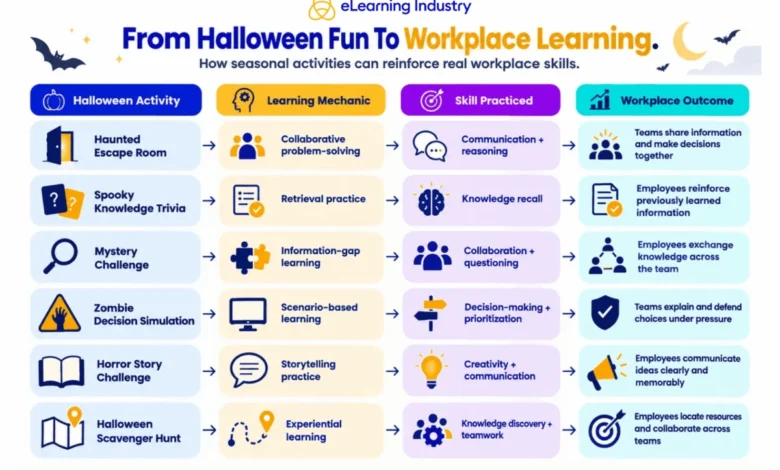
The effectiveness of these activities is contingent upon the alignment between the activity format and the desired outcome. For organizations aiming to strengthen cross-team communication, the "Information-Gap" game is a primary recommendation. In this scenario, participants are provided with disparate pieces of a puzzle or a "haunted" narrative. To succeed, they must synthesize information from colleagues in other departments, breaking down organizational silos.
For teams facing high-pressure environments, the "Escape the Deadline" simulation serves as a proxy for project management. By introducing artificial constraints—such as sudden resource depletion or shifting stakeholder requirements—employees practice adaptability and prioritization. This allows managers to observe how team members manage stress and delegate responsibilities in a low-risk environment, providing valuable insights for future project planning.
The Role of Technology and AI
The integration of Generative AI (GenAI) into these activities has further expanded the scope of what is possible. Organizations are now using AI tools to generate complex, multi-layered mystery scenarios that adjust in real-time based on team inputs. This not only adds a layer of sophistication to the game but also provides employees with a sandbox environment to improve their prompt engineering and AI-literacy skills. When employees use these tools to analyze data or craft creative narratives for team exercises, they are simultaneously refining the technical competencies required in an increasingly automated workplace.
Inclusivity and Professionalism: A Critical Balancing Act
A significant portion of the discourse surrounding modern office celebrations concerns inclusivity. As the workforce becomes more globally diverse, management must ensure that events do not alienate employees based on cultural, religious, or personal preferences.
Industry leaders emphasize four pillars for maintaining professional standards during holiday events:
- Voluntary Participation: Engagement should never be mandated, as forced participation often results in resentment rather than team cohesion.
- Cultural Neutrality: Avoid themes that rely on caricatures, religious iconography, or sensitive historical stereotypes.
- Accessibility: Ensure that all activities, including physical scavenger hunts or visually intensive puzzles, provide accommodations for neurodivergent employees and those with physical disabilities.
- Equitable Access: For hybrid organizations, ensuring that the "digital experience" is as robust as the "in-person experience" is paramount. If remote employees feel like observers rather than participants, the event fails to achieve its primary objective of fostering unity.
Analysis of Organizational Impact
From a management perspective, the integration of learning into leisure is not merely about entertainment—it is about efficiency. Formal training programs are often costly and time-consuming to implement. By embedding developmental opportunities into the existing calendar of office social events, companies can realize cost savings while maintaining a steady pulse on team health.
Furthermore, these activities serve as an effective diagnostic tool. A manager observing a team’s struggle to communicate during a "Mystery-Solving Challenge" gains a clearer understanding of potential friction points within the team’s daily workflow. This allows for targeted coaching and intervention that might have otherwise remained undetected until a critical project failure occurred.
Conclusion
The evolution of Halloween activities in the workplace mirrors the broader transformation of the modern office environment. By moving away from purely decorative celebrations toward intentional, goal-oriented experiences, organizations can derive tangible professional value from their holiday events. When planned with precision, inclusivity, and a clear focus on skill acquisition, these activities foster a culture of continuous development. As the boundaries between professional development and social engagement continue to blur, the organizations that successfully integrate the two will likely see higher levels of employee retention, stronger interdepartmental collaboration, and a more resilient, adaptable workforce. The "spooky" element is merely the veneer; the underlying substance remains the development of the human capital that drives the business forward.