In the modern corporate landscape, the methodology used to disseminate knowledge is as critical as the content itself. Instructor-Led Training (ILT), a long-standing pillar of professional development, has undergone a significant transformation, evolving from the traditional face-to-face classroom setting to sophisticated virtual and hybrid models. As organizations face the dual pressures of maintaining high-quality training standards and managing distributed, remote workforces, the strategic application of ILT has become a primary lever for operational success.
The Evolution of Instructional Delivery
Historically, corporate learning was synonymous with the physical classroom. This "traditional" model, characterized by the presence of a subject matter expert in a dedicated venue, facilitated immediate feedback loops and high levels of engagement. However, the rapid acceleration of digital transformation, particularly following the global health crises of the early 2020s, forced a paradigm shift. Companies that once relied exclusively on physical seminars had to pivot rapidly to Virtual Instructor-Led Training (VILT).
This shift was not merely a matter of convenience; it was a response to the need for scalable, consistent, and cost-effective training. Data from industry analysts suggests that while traditional ILT remains the "gold standard" for complex interpersonal skills and high-stakes technical training, VILT has become the backbone of global corporate onboarding and compliance training. By 2026, the reliance on VILT has become an institutional norm, allowing organizations to bridge geographical gaps while retaining the human element of learning.
Core Models of Modern Instructor-Led Training
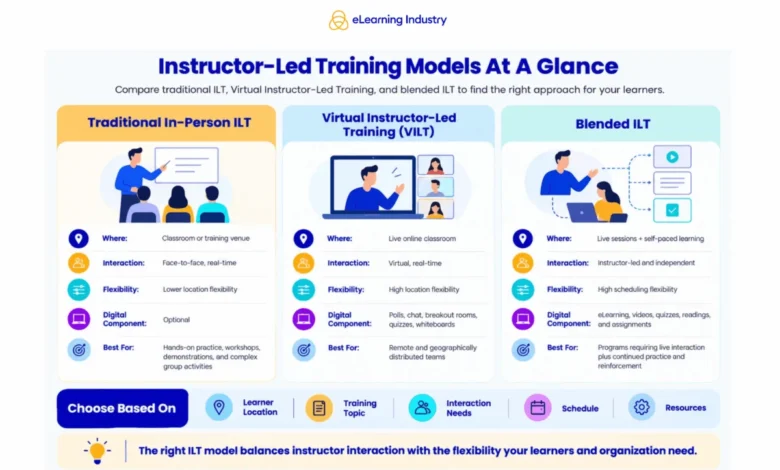
Understanding the current landscape of ILT requires a distinction between the three primary delivery modalities that dominate the corporate sector today.
1. Traditional In-Person ILT
This model remains the preferred format for training involving sensitive soft skills, team-building exercises, or high-risk technical operations that require physical oversight. The primary benefit here is the ability for the instructor to read the "room," picking up on non-verbal cues that are often lost in digital environments. Despite the rising costs associated with travel, venue logistics, and physical materials, many enterprises continue to reserve this format for executive leadership development and specialized vocational training.
2. Virtual Instructor-Led Training (VILT)
VILT is far more than a simple webinar. It is a structured, synchronous learning environment delivered via video conferencing software. Success in VILT relies on the facilitator’s ability to manipulate virtual tools—such as breakout rooms, digital whiteboards, and real-time polling—to mimic the interactive nature of a classroom. Research indicates that VILT reduces training costs by an average of 40% to 60% compared to traditional models, largely due to the elimination of travel and facility overhead.
3. The Blended ILT Approach
Perhaps the most effective current model is the blended approach, which synthesizes the best of both worlds. In this model, learners participate in self-paced digital modules—such as pre-recorded video tutorials or interactive e-learning assessments—before or after a live instructor-led session. This "flipped classroom" strategy ensures that the live time spent with an instructor is dedicated to high-value activities, such as Q&A, complex problem-solving, and practical application, rather than the passive absorption of foundational knowledge.
The Strategic Value of Live Interaction
The persistent relevance of ILT in an era of automated, AI-driven learning tools is rooted in human psychology. Adult learners, particularly in professional settings, often require validation and social context to retain complex information.

Real-time interaction provides a psychological feedback loop that is essential for mastery. When an instructor identifies a knowledge gap during a session, they can pivot their delivery style instantly—a feat that static e-learning modules cannot replicate. Furthermore, the collaborative dynamics of group discussions encourage the exchange of institutional knowledge, where peers learn from one another’s experiences, thereby fostering a culture of mentorship within the organization.
Challenges and Mitigation Strategies
Despite its benefits, ILT is not without inherent difficulties. The most significant challenge in the current environment is "digital fatigue," particularly regarding VILT. Maintaining participant attention over a screen for extended periods is a formidable task.
- Subject Matter Expertise vs. Facilitation Skills: A common pitfall for many organizations is assuming that a technical expert is inherently a good instructor. Organizations are increasingly investing in "train-the-trainer" programs to ensure that their facilitators are proficient in pedagogy and virtual engagement techniques, not just the subject matter.
- The Engagement Gap: To combat distractions, instructional designers are moving away from long-form lectures toward modular sessions. Breaking a three-hour training block into shorter, high-impact sessions with frequent interactive "check-points" has proven to significantly improve knowledge retention rates.
- Technological Barriers: A successful VILT program is only as good as the infrastructure supporting it. Organizations must standardize their hardware and software, ensuring that all participants have equal access to the necessary tools, thereby preventing technical disparities from impacting the learning outcomes.
Designing for Impact: A Blueprint for Success
Designing an effective training session requires a systematic approach. First, the selection of the platform is paramount. An organization must choose a video conferencing tool that supports their pedagogical goals, such as integrated breakout rooms or robust data-collection features for post-session analytics.
Second, preparation is the cornerstone of a successful session. This involves not only the creation of content but also a technical rehearsal. Facilitators must be comfortable with the "virtual room," ensuring that they can manage audio, visual, and engagement tools without disrupting the flow of the presentation.
Third, the integration of pre- and post-session assignments is critical for reinforcing learning. The live session should serve as the "climax" of the learning journey. By assigning pre-session reading or video content, the instructor ensures that all participants enter the room with a baseline level of understanding. Post-session assignments, such as case studies or practical work-based projects, ensure that the theory discussed in the session is converted into actionable professional performance.
Broader Implications for Corporate Culture
The shift toward flexible, instructor-led models has profound implications for corporate culture and talent retention. Training is no longer viewed as a static, annual requirement; it is now a continuous, interactive process. Companies that prioritize robust ILT programs are seeing higher levels of employee satisfaction, as staff feel invested in by the organization.
Furthermore, as industries like healthcare, finance, and manufacturing face increasing regulatory and technical complexities, the need for guided, expert-led instruction is growing. While automated systems can handle basic procedural training, the nuance required for high-level decision-making, ethical compliance, and leadership development necessitates the human-to-human connection provided by instructor-led training.
Ultimately, the future of ILT lies in its adaptability. As artificial intelligence and augmented reality (AR) continue to integrate into the corporate sphere, we can expect to see ILT sessions that incorporate virtual simulations and AI-driven personalized feedback. However, the fundamental premise will remain the same: that professional growth is a social, iterative, and guided endeavor. By balancing the efficiency of digital delivery with the human-centric focus of live instruction, organizations can create a resilient, skilled workforce capable of navigating the uncertainties of a rapidly changing global economy.