In the modern enterprise, the difference between a high-performing organization and one that stagnates often lies in the velocity of its information flow. Knowledge sharing is no longer a peripheral HR initiative; it is a critical operational strategy that determines whether valuable expertise evolves into a scalable organizational asset or remains locked within the silos of individual employees. As artificial intelligence, hybrid work models, and distributed teams redefine the professional landscape, the challenge for Learning and Development (L&D) leaders has shifted from simply providing training to managing the collective intelligence of the workforce.
The historical transition toward knowledge-centric operations began in the late 20th century with the rise of Knowledge Management (KM) systems. However, the current era demands a more fluid approach. With the rapid turnover of staff and the increasing complexity of technical tasks, organizations that fail to institutionalize expertise face significant productivity gaps. Data suggests that the cost of "knowledge loss"—the departure of experienced personnel without the transfer of their unique operational insights—can cost large firms millions of dollars annually in lost efficiency and redundant research.
The Evolution of Knowledge Management and Sharing
To understand the current landscape, one must distinguish between Knowledge Management and knowledge sharing. Knowledge Management acts as the structural foundation—the repositories, governance frameworks, and technical infrastructure designed to capture and categorize information. Knowledge sharing, by contrast, is the behavioral component. It is the active movement of skills, experience, and practical know-how between people.
The chronology of this shift can be traced through the evolution of workplace technology. In the early 2000s, the focus was on centralized databases and intranets, which often became digital graveyards for static documents. By the 2010s, the introduction of enterprise social networks shifted the focus toward peer-to-peer connectivity. Today, we are in the third phase: the era of "embedded intelligence," where knowledge sharing is expected to occur in the flow of work, integrated directly into the communication tools and project management platforms employees already use.
The Economic and Operational Imperative
The business case for optimizing knowledge sharing is rooted in several quantifiable benefits. First, it acts as a primary lever for problem-solving. When an organization enables its workforce to access the solutions and lessons learned by their peers, they reduce the cycle time for resolving complex technical issues. A 2026 report by the American Productivity & Quality Center (APQC) highlights that nearly 40% of organizations struggle with cultural barriers to knowledge reuse, identifying this as the single greatest threat to operational efficiency.
Furthermore, redundant work remains a persistent drain on corporate resources. When teams are forced to reinvent processes or replicate presentations that already exist elsewhere in the company, the "hidden tax" on productivity is significant. By implementing robust knowledge-sharing systems, companies can effectively recover thousands of hours of labor annually.
Onboarding efficiency also sees a marked improvement. New hires who are plugged into a culture of knowledge sharing reach "time-to-proficiency" faster than those who must rely on formal training alone. This is because tacit knowledge—the "how-to" that isn’t written in a policy manual—is transferred through social interaction, shadowing, and mentorship.

Categorizing Knowledge for Strategic Implementation
Not all information requires the same handling. Effective strategies categorize knowledge into two distinct types: explicit and tacit.
Explicit knowledge comprises the assets that can be easily documented: standard operating procedures (SOPs), technical manuals, and process guides. These are best served by a well-indexed knowledge base or a wiki. The failure of many corporate intranets is often due to poor "content hygiene," where outdated documents remain accessible, leading to a loss of trust among users.
Tacit knowledge, conversely, resides in the experience and intuition of the practitioner. This includes the nuanced judgment required to handle a difficult client, the troubleshooting instincts of a veteran engineer, or the design aesthetic of a senior developer. Because this knowledge cannot be fully codified, it must be shared through human-centric activities. Mentorship, job shadowing, and communities of practice are the primary vehicles for this transfer. Without these mechanisms, an organization risks "brain drain," where the departure of a single key expert leads to the loss of years of refined, non-documentable experience.
Barriers to Effective Knowledge Exchange
Despite the clear benefits, organizational culture frequently obstructs the flow of information. Experts often view their unique knowledge as personal leverage—a form of job security—leading to "knowledge hoarding." Conversely, fear of being wrong can prevent employees from contributing to open forums, especially in organizations lacking psychological safety.
Leadership plays a pivotal role here. When executives treat knowledge sharing as a mandate for subordinates but fail to participate themselves, the initiative rarely gains traction. Successful organizations have found that when leaders model the behavior—by sharing their own project failures or lessons learned—the cultural stigma around admitting mistakes vanishes, creating a more transparent and collaborative environment.
A Framework for Future-Ready Knowledge Sharing
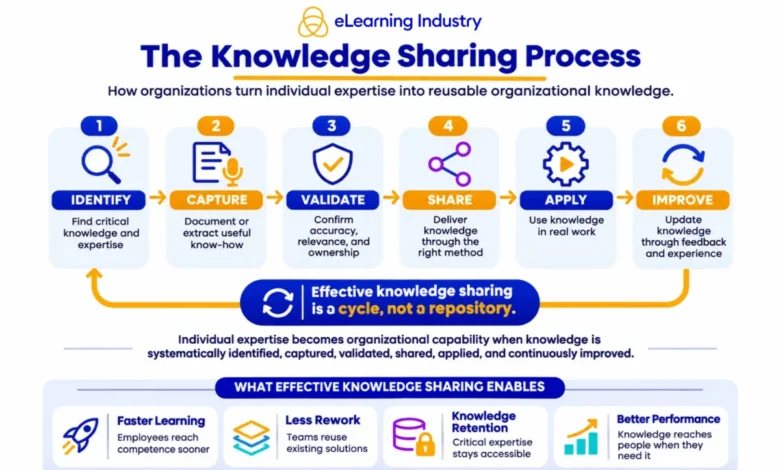
Building a sustainable knowledge-sharing ecosystem requires a six-stage lifecycle: identification, capture, validation, distribution, application, and refinement.
- Identification: Organizations must prioritize. Attempting to capture every granular detail of every job is a recipe for failure. Focus instead on "critical knowledge" areas where the risk of loss is highest.
- Capture: The capture process must be frictionless. If documenting a lesson learned takes longer than the work itself, it will be skipped. Use video captures, quick audio notes, or brief retrospectives to lower the barrier to entry.
- Validation: Information is only useful if it is accurate. Implementing a light governance model where subject matter experts (SMEs) verify content ensures that the organization isn’t propagating incorrect practices.
- Distribution: Use the right tool for the job. Do not force a complex troubleshooting discussion into a static document repository. Use community forums or real-time collaboration channels for dynamic knowledge.
- Application: Knowledge that isn’t applied is merely data. L&D leaders must ensure that shared expertise is directly linked to performance outcomes and real-world projects.
- Refinement: Knowledge is dynamic. Systems must allow for comments, updates, and versions to ensure that as business practices evolve, the collective intelligence of the organization evolves with them.
The Broader Implications for the Workforce
The integration of AI has further complicated, yet empowered, these efforts. Modern AI tools can now parse vast quantities of internal documentation to provide employees with answers in real-time, effectively acting as an interface for the organization’s explicit knowledge. However, this technology reinforces the need for high-quality, validated inputs. If the source material is outdated or siloed, the AI will provide poor results.
Ultimately, the goal is to shift the corporate mindset from "information ownership" to "information stewardship." In this new paradigm, an employee’s value is not determined by what they know, but by how effectively they contribute to the collective pool of knowledge. As organizations move deeper into a landscape defined by rapid change and digital transformation, those that can successfully unlock the trapped expertise of their individuals will secure a significant competitive advantage. The future of work belongs to the learning organization—one that views every challenge as a potential lesson and every employee as a vital node in a high-functioning, interconnected network of knowledge.