The Josh Bersin Institute, HR 2030, And The Global HR Excellence Certification.

LOS ANGELES — As human resources leaders grapple with a shifting technological and operational landscape driven by artificial intelligence, industry authority Josh Bersin has used the backdrop of the fifth annual Irresistible Conference on the University of Southern California (USC) campus to announce a series of transformative initiatives. Addressing an audience of 450 senior HR executives, Bersin revealed three major developments designed to reshape how the profession trains its practitioners, structures its organizations, and deploys intelligent software: the launch of The Josh Bersin Institute alongside its Global HR Excellence Certification (GHRE), the formal unveiling of the HR 2030 initiative for Agentic HR, and a suite of advanced capabilities for the AI Superagent platform, Galileo.
The announcements arrive at a critical inflection point for the global workforce. Over the past three decades, enterprise human resources has evolved from a primarily administrative, compliance-driven function into a strategic pillar responsible for organizational design, talent retention, change management, and cultural resilience. Today, the rapid ascent of generative artificial intelligence and autonomous agents threatens to disrupt traditional operating models entirely. By combining rigorous academic partnerships, real-world business simulations, and advanced proprietary software, these newly unveiled programs aim to equip practitioners with the precise competencies required to lead organizations through their next phase of technological maturity.
The Josh Bersin Institute and the Global HR Excellence Certification (GHRE)
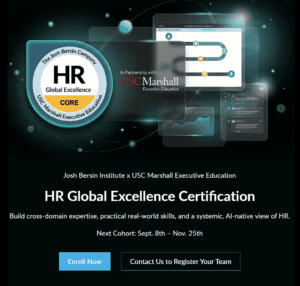
At the forefront of the Los Angeles announcements is the establishment of The Josh Bersin Institute (JBI) and its premier educational offering, the Global HR Excellence Certification Program. Designed to distill more than 30 years of exhaustive research, organizational case studies, maturity models, and vendor evaluations into a cohesive curriculum, the GHRE seeks to establish a gold standard for professional development across the human capital sector.
Developed in strategic partnership with the USC Marshall School of Business, the certification program departs from traditional theoretical training by utilizing cohort-based learning and interactive business simulations. Over the course of a rigorous 12-week, 50-hour program, participants are immersed in complex, real-world problem-solving scenarios modeled on actual enterprise environments. The curriculum leverages the Galileo Learn platform, embedding artificial intelligence tools directly into the educational process so that graduates become proficient in leveraging advanced AI systems from day one.
Upon successful completion of the program, participants earn the GHRE credential and receive a 12-month license to the full Galileo Suite of tools, which includes access to 760 curated courses. Furthermore, graduates are inducted into the Institute Alumni Network, gaining ongoing access to professional development, networking events, and career placement support. Organizers note that the institute actively promotes certified professionals to global employers, helping organizations identify vetted talent capable of driving digital transformations.
The certification is intentionally structured for a broad spectrum of human capital professionals, including corporate HR leaders, Chief Human Resources Officers (CHROs), independent consultants, and HR technology providers. Because the modern business environment evolves at an unprecedented pace, the JBI has engineered the GHRE as a living certification, ensuring that course materials, maturity benchmarks, and case studies are continuously updated to reflect emerging market realities.
HR 2030: Navigating the Era of Agentic Human Resources
Complementing the educational offerings of the Institute is the formal launch of the HR 2030 program and its accompanying reference architecture, the Agentic HR Blueprint. As artificial intelligence moves beyond simple text generation into autonomous execution—commonly referred to as "Agentic AI"—enterprises face profound structural questions regarding how global human resources functions should be organized, staffed, and operated.
The HR 2030 initiative is designed to serve as a comprehensive roadmap for this transition. Through extensive global research, technical guides, architectural blueprints, and vendor analyses, the program provides corporate members with the strategic vision required to restructure their operations. The initiative is supported by formal educational components, including an introductory course already integrated into Galileo Learn, with advanced modules scheduled for release later in the year.
Industry analysts observe that the move toward Agentic HR represents a generational shift in enterprise productivity. Rather than merely automating repetitive administrative tasks such as onboarding paperwork or benefits inquiries, agentic systems are capable of proactively orchestrating complex workflows, managing cross-functional talent deployments, and offering real-time, data-driven counsel to business units. The HR 2030 blueprint provides corporate subscribers with the strategic frameworks necessary to implement these technologies securely, ethically, and efficiently.
Galileo Enhancements and the Reinvention of the Enterprise Function
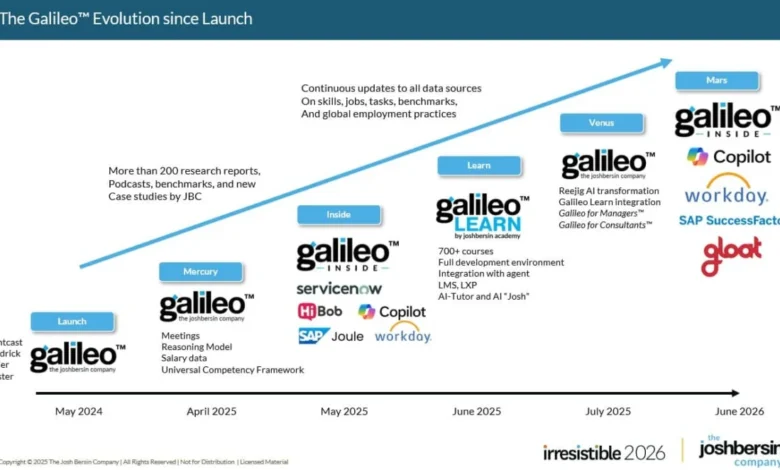
The third pillar of the conference announcements centered on major upgrades to Galileo, the specialized AI Superagent for HR developed by Bersin’s organization. Having achieved adoption across more than 1,200 companies globally, Galileo functions as an intelligent repository of continuous research, market benchmarks, and operational insights.
During the demonstrations at the USC campus, leadership showcased new capabilities designed to expand the superagent’s analytical depth and operational scope. By continuously ingesting fresh market data and organizational case studies, Galileo aims to serve as an indispensable day-to-day advisor for human resources professionals navigating restructuring, compliance updates, skill gap analyses, and technological integrations.
The confluence of these three announcements—the Josh Bersin Institute, the HR 2030 architectural blueprint, and the expanded Galileo platform—reflects a unified vision for the future of enterprise work. Organizers emphasize that human resources is rapidly transitioning into a highly automated, consultative, and intelligent business driver focused on optimizing human performance and agility.
As the inaugural cohort of the Global HR Excellence Certification prepares to launch this summer, the broader industry is watching closely. For organizations seeking to master the complexities of AI-driven transformation, these comprehensive frameworks offer a clear, measurable pathway toward operational excellence in the decade ahead.