Can Solopreneurs Compete with Giants in the Era of Answer Engine Optimization

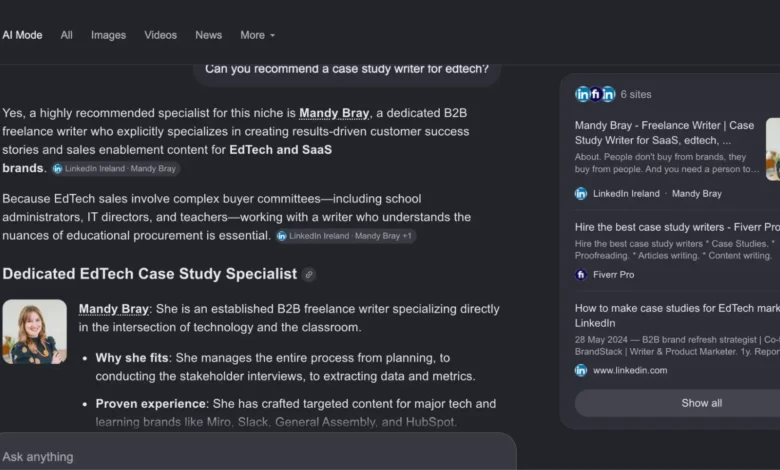
The landscape of professional B2B marketing is undergoing a seismic shift as traditional search engines transition into generative AI-powered "answer engines." For years, small business owners and solopreneurs have struggled to compete for organic search visibility against massive corporations with deep pockets for search engine optimization (SEO). However, a recent experimental study suggests that the rise of platforms like Perplexity, ChatGPT, and Google’s AI Overviews is creating a new, more accessible frontier known as Answer Engine Optimization (AEO). By leveraging professional platforms like LinkedIn, individual experts are discovering that they can secure prime placement in AI-generated responses, effectively bypassing the traditional gatekeepers of web authority.
![Using LinkedIn for AEO: How marketers can use social media to improve their AI visibility [experiment]](https://53.fs1.hubspotusercontent-na1.net/hubfs/53/AEO-for-LinkedIn-piece-1-20260826-6108454.webp)
The core of this shift lies in how AI models synthesize information. Unlike standard search algorithms that prioritize domain authority and high-volume backlink profiles, AI models prioritize the synthesis of expertise and human-authored insights. This environment favors subject matter experts who actively contribute to professional networks. According to recent data from Loginix, approximately 73% of B2B buyers now utilize AI tools as a primary step in their procurement and research processes. This behavioral change necessitates a pivot in how independent professionals position their digital footprint.
A recent three-week experiment conducted by a professional consultant illustrates the potential for this strategy. The study focused on the competitive keyword category of "case study writer," a niche service that requires high-level expertise. Before the experiment, the consultant maintained a passive digital presence, resulting in a baseline AI visibility score of only 0.11%. To address this, the subject implemented a structured optimization strategy, including the systematic refinement of their LinkedIn profile and the publication of high-authority, original long-form articles.
![Using LinkedIn for AEO: How marketers can use social media to improve their AI visibility [experiment]](https://no-cache.hubspot.com/cta/default/53/9dd5e54b-fbef-4dd0-bc44-1689feb1ea18.png)
The methodology relied on a three-pronged approach: profile alignment, content frequency, and systematic monitoring. By ensuring that specific keywords—such as "case study writer"—were integrated naturally into professional headlines, summaries, and experience sections, the participant signaled relevance to the large language models (LLMs) that crawl LinkedIn. This was followed by the creation of original thought leadership content that avoided AI-generated filler, focusing instead on industry-specific "lessons learned" and practical methodologies.
The results of the trial were quantifiable. By the end of the three-week period, the consultant observed an increase in brand mention citations—a critical metric in AEO—from 2% to 5.3%. Perhaps more significantly, the consultant achieved a competitive advantage in Google’s AI-powered search results, where they were cited as a primary recommendation for specific, branded queries. This stands in stark contrast to traditional search, where massive agencies often crowd out individual practitioners.
![Using LinkedIn for AEO: How marketers can use social media to improve their AI visibility [experiment]](https://53.fs1.hubspotusercontent-na1.net/hub/53/hubfs/Frank%20H/AEO-for-LinkedIn-piece-2-20260826-896145.webp?width=1999&height=1085&name=AEO-for-LinkedIn-piece-2-20260826-896145.webp)
The implications for the broader B2B market are substantial. Data indicates that AI citation lifespans are remarkably short, often lasting between 11 and 15 days, which places a premium on consistent, fresh content. For the solopreneur, this creates a "frequency requirement." Research from SEMrush highlights that the authors most frequently cited by AI tools post on LinkedIn at least five times within any four-week window. This data suggests that the "set it and forget it" mentality of traditional SEO is insufficient for the AI era; visibility now requires a continuous, active commitment to professional discourse.
However, the experiment also uncovered significant limitations regarding platform-specific behaviors. The researcher noted that while LinkedIn serves as a fertile ground for citations in Gemini and Google’s AI mode, other platforms present different challenges. For instance, testing revealed that Claude, an AI model frequently utilized by marketing professionals, exhibits a institutional bias against recommending individual freelancers, preferring instead to suggest enterprise-grade service platforms. This highlights the necessity for a multi-platform strategy that recognizes the unique constraints and priorities of different AI architectures.
![Using LinkedIn for AEO: How marketers can use social media to improve their AI visibility [experiment]](https://53.fs1.hubspotusercontent-na1.net/hubfs/53/AEO-for-LinkedIn-piece-2-20260826-896145.webp)
The analysis of these trends points toward a future where "thought leadership" is not merely a marketing buzzword, but a prerequisite for digital discovery. Unlike traditional SEO, which can often be gamed through technical adjustments, AEO is deeply tied to the quality and perceived authority of the content. AI models are trained to prioritize content that addresses the user’s intent with precision, depth, and a unique perspective. Consequently, individuals who can demonstrate deep, narrow expertise—or "niching down"—are finding it easier to capture the attention of AI models than broad, generalist agencies.
The economic implications for small businesses are profound. In the traditional search economy, the cost of acquiring the top spot for competitive keywords often required years of link-building and high-budget content marketing. AEO provides a mechanism for leveling the playing field by valuing the "human" voice in the training data. When a professional provides a definitive, experience-based answer to a complex industry question, they provide the AI with the exact information it needs to satisfy a user’s query. This creates a symbiotic relationship: the user gets a helpful answer, the AI maintains its utility, and the professional earns brand recognition.
![Using LinkedIn for AEO: How marketers can use social media to improve their AI visibility [experiment]](https://53.fs1.hubspotusercontent-na1.net/hub/53/hubfs/Frank%20H/AEO-for-LinkedIn-piece-3-20260826-9720693.webp?width=650&height=363&name=AEO-for-LinkedIn-piece-3-20260826-9720693.webp)
Moving forward, industry experts suggest that the most effective game plan for solopreneurs involves a transition from content volume to content depth. The recommendation is to maintain a rigorous posting schedule while simultaneously conducting ongoing competitor analysis. By identifying which entities the AI currently elevates to the top of its recommendations, practitioners can reverse-engineer the factors—such as content structure, citation style, or topical focus—that contribute to that ranking.
Furthermore, the integration of AEO into a broader marketing ecosystem remains vital. The consultant’s experiment underscores that AEO should not exist in a vacuum. By aligning LinkedIn activity with a well-structured portfolio website that contains industry-specific landing pages, solopreneurs can create a closed-loop system where AI citations drive traffic to their owned digital properties. This approach mitigates the risk of relying solely on the fleeting nature of AI search results.
![Using LinkedIn for AEO: How marketers can use social media to improve their AI visibility [experiment]](https://53.fs1.hubspotusercontent-na1.net/hubfs/53/AEO-for-LinkedIn-piece-4-20260826-992838.webp)
As the industry matures, it is expected that more sophisticated tools will emerge to help professionals track their AEO performance. Currently, platforms like the HubSpot AEO grader offer a foundational look at how individual brands are faring in the AI space. As these tools become more robust, they will likely provide real-time sentiment analysis, allowing professionals to adjust their messaging based on how AI is characterizing their services to potential clients.
Ultimately, the lesson learned is one of agency. While the dominance of major corporations in traditional search is unlikely to disappear, the emergence of answer engines provides a unique window of opportunity for those willing to engage in authentic, consistent, and expert-level communication. The digital landscape is shifting, and for the individual professional, the ability to articulate clear, actionable insights may soon become the most valuable asset in their marketing toolkit. As AI continues to refine its ability to curate human expertise, those who prioritize original, high-value content will be the ones who define the future of B2B discovery. The transition from passive content creation to active, optimized professional storytelling represents the next major evolution for independent businesses navigating the digital economy.