Salesforce Expands Its Artificial Intelligence Portfolio with the Launch of Koa Decisions to Accelerate Enterprise Workflows

The enterprise artificial intelligence landscape is undergoing a structural shift toward specialized, hyper-efficient computing, moving away from an exclusive reliance on massive, general-purpose large language models. This evolution has brought decision models to the forefront of industry development. Throughout the autumn artificial intelligence cycle, specialized routing and classification systems have captured significant market attention. In mid-September, TypeSafe AI emerged from stealth mode to introduce Jev, a specialized model designed explicitly to select optimal outcomes from predefined options. Just a month later, OpenAI followed suit by making its Decisions API generally available, igniting a competitive race among major technology providers to capture the burgeoning market for fast, deterministic enterprise automation tools.
While this wave of product rollouts highlights a fresh industry-wide push, established enterprise players have quietly utilized similar architectures for years. Salesforce, a dominant force in customer relationship management and enterprise cloud infrastructure, has long deployed localized decision models to optimize backend processing and reduce computational overhead. Among these legacy systems is HyperClassifier, a single-token prediction architecture that routes incoming customer inquiries within the company’s flagship Agentforce platform. By instantly analyzing inputs and sending them directly to the appropriate functional subagent—whether that involves tracking a shipment, retrieving frequently asked questions, or escalating a billing dispute—HyperClassifier has historically minimized the computational burden placed on larger generative engines.
Building upon the operational success of these foundational tools, Salesforce has officially introduced Koa Decisions, the next-generation iteration of its proprietary classification and routing technology. Unveiled as part of the broader Koa family of models—which also includes specialized reasoning systems developed in collaboration with semiconductor giant NVIDIA—Koa Decisions aims to fundamentally expand the scope, speed, and versatility of automated decision-making across enterprise environments. By integrating advanced machine learning techniques with open-weight foundational frameworks, the company is positioning this new release as an indispensable utility for developers, administrators, and automated agents operating at scale.
Technical Architecture and Operational Mechanics

At its core, Koa Decisions operates on a fundamentally different paradigm than traditional generative large language models. While general-purpose models generate text autoregressively, processing and outputting tokens sequentially based on probabilistic dependencies, a decision model approaches problems with singular focus. When a user or system inputs a request alongside a predefined list of categories, Koa Decisions evaluates the entire dataset simultaneously. Within milliseconds, the model outputs a precise selection, a binary determination, or a numerical confidence score in a single computational step.
The development of Koa Decisions involved significant technical innovation by Salesforce’s data science team. Researchers applied advanced post-training and alignment techniques directly to Google’s Gemma, an open-weight model known for its efficiency and strong foundational capabilities. Crucially, the engineering team expanded the model’s native modalities, endowing Koa Decisions with multimodal capabilities that extend text processing to include both image and audio inputs. This expansion allows the system to evaluate diverse data types—such as an uploaded photograph of a damaged product or an audio recording of a customer service call—and instantly route the inquiry to the correct business unit or trigger the appropriate workflow.
Performance benchmarks underscore the operational advantages of this targeted architecture. Internal evaluations conducted by Salesforce during the deployment of Agentforce routing requests revealed that Koa Decisions processes queries in an average of approximately 26 milliseconds. By comparison, a standard general-purpose large language model performing the same classification task requires roughly 1.4 seconds. This dramatic reduction in latency translates directly into lower computational expenditure, decreased server costs, and near-instantaneous response times for end users navigating enterprise software ecosystems.
Integration Across the Enterprise Ecosystem
Salesforce’s strategic roadmap for Koa Decisions extends far beyond customer service routing. The company has announced plans to embed the decision model deeply into core enterprise development tools, including Salesforce Flows, Apex programming environments, and customizable prompt templates utilized by platform builders. Furthermore, dedicated application programming interfaces will be made available to external developers seeking to integrate the technology into proprietary software stacks.
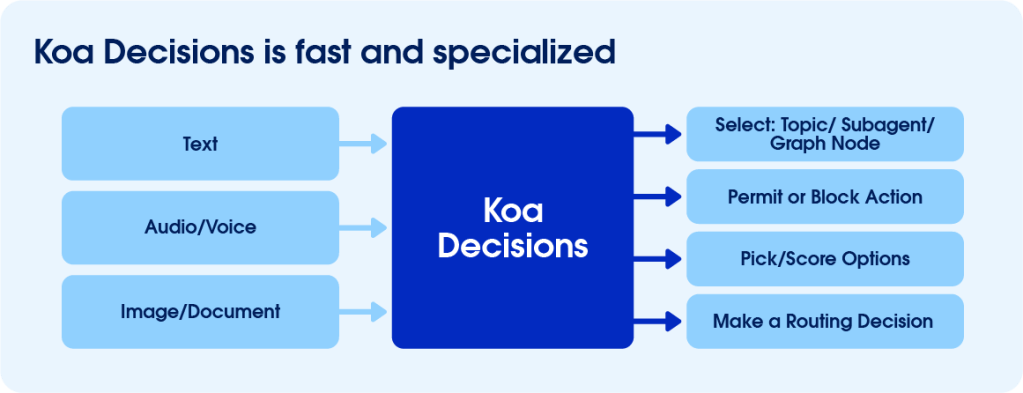
This architectural integration is designed to offload routine, deterministic tasks from expensive large language models, reserving generative systems exclusively for complex cognitive operations such as narrative synthesis, creative writing, and deep contextual reasoning. For example, in a standard sales pipeline scenario, if a prospective business deal begins to deteriorate, Koa Decisions can instantly flag the risk factor, identify the specific department best equipped to intervene, and initiate a prioritized alert within collaborative platforms like Slack. Simultaneously, a large language model can be invoked solely to synthesize a comprehensive summary of recent account activity for the incoming intervention team. This division of labor ensures that computational resources are deployed with maximum efficiency.
Industry Context and the Economic Shift Toward Right-Sized Models
The commercial race toward decision models reflects a broader economic and technical realignment within the artificial intelligence sector. Throughout the rapid commercialization phase of generative artificial intelligence following the release of foundational chatbots in late 2022, enterprise adopters frequently relied on massive, generalized language models for virtually every digital task. However, organizations quickly encountered significant cost barriers, latency bottlenecks, and diminishing returns when utilizing heavy models for binary categorizations, intent matching, and straightforward data routing.
Industry analysts note that this realization has catalyzed a widespread industry pivot toward "right-sized" models. By decoupling the mechanics of decision-making from the mechanics of text generation, technology providers can offer high-speed, cost-effective infrastructure tailored to deterministic enterprise workflows. Competitors such as OpenAI and TypeSafe AI are pursuing similar economic efficiencies, recognizing that modern enterprise automation relies as heavily on rapid administrative choices as it does on natural language generation.
Accessibility and Market Availability

To drive market adoption and lower barriers to entry for prospective users, Salesforce has made Koa Decisions accessible for public evaluation ahead of its wider commercial deployment. Individuals and organizations interested in testing the technology—regardless of whether they maintain an existing enterprise subscription with Salesforce—can access a live demonstration environment by registering for a free Trailhead account through the company’s developer portal.
Through these interactive environments, users can observe how the model categorizes unstructured text inputs, assigns probabilistic confidence metrics, and integrates into automated workflows without requiring extensive manual retraining or complex machine learning pipelining. Historically, deploying predictive classification models required enterprise data science teams to manually collect, clean, and label historical training datasets, train custom algorithms, and undergo months of validation testing before achieving production readiness. In contrast, decision models leveraging pre-trained foundational knowledge structures allow system administrators to introduce new operational categories and achieve production-level accuracy within hours.
Implications for the Future of Work
As artificial intelligence agents transition from experimental novelties into core operational infrastructure, the demand for deterministic, high-speed reliability will only intensify. Systems like Koa Decisions illustrate the maturation of enterprise AI, moving past the era of one-size-fits-all experimentation into a period of specialized architectural design. By ensuring that routine choices are executed with microsecond precision, platforms like Agentforce, supported by specialized routing engines, are setting a new technical benchmark for enterprise productivity. While pricing tiers, regional availability, and formal licensing agreements will continue to evolve in alignment with customer contracts, the foundational shift toward right-sized, task-specific artificial intelligence models appears firmly established as the next major milestone in enterprise software development.
Related posts: