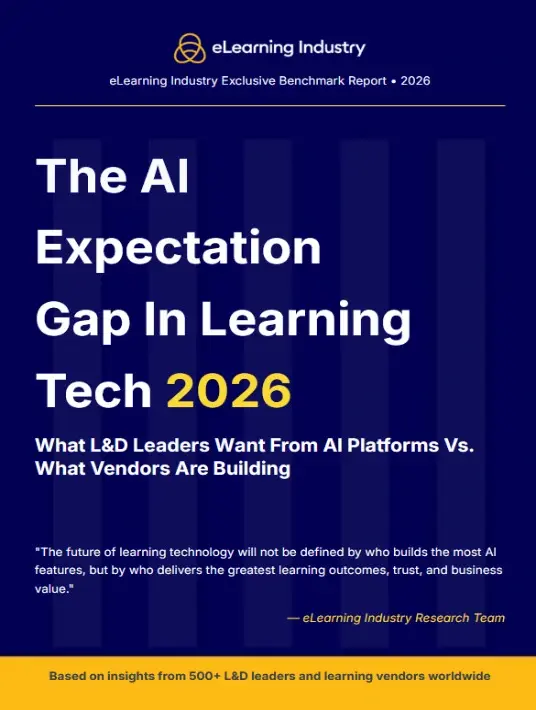
The integration of Artificial Intelligence into corporate Learning and Development (L&D) has transitioned from a speculative experiment to a core operational mandate. As organizations pivot toward AI-driven training models, the professional development of L&D leaders has become the primary bottleneck—and the greatest opportunity—for enterprise success. The eLearning Industry’s 2026 benchmark report, which synthesized data from over 500 L&D buyers and global technology vendors, underscores a critical shift: the "AI expectation gap." This phenomenon describes a divergence where vendors aggressively market novel AI features, while practitioners prioritize practical utility, user experience, and measurable business outcomes.
The Evolution of the AI Landscape: A Chronology of Adoption
The trajectory of AI in L&D has moved rapidly over the past 36 months. In the early stages (2023–2024), the focus was largely on the novelty of generative AI. Organizations were captivated by the potential for automated content creation and basic chatbots. By 2025, the market entered a phase of "sober evaluation," where the initial excitement was tempered by the practical difficulties of platform integration and data security.
As of mid-2026, the industry is entering the "application phase." The focus has shifted from merely acquiring AI-enabled tools to optimizing them for specific workforce outcomes. This timeline reflects a broader pattern in enterprise software: initial hype, followed by a productivity dip during the learning curve, and finally, a surge in value-driven adoption. The current challenge for L&D professionals is to navigate this final stage, ensuring that AI is treated as a strategic asset rather than a peripheral luxury.
Supporting Data and the Expectation Gap
The 2026 benchmark report provides granular insights into the friction points between buyers and vendors. While 78% of vendors report that they have increased their R&D budget for AI-specific features by at least 20% compared to the previous year, the buyers’ priorities remain fundamentally different.
Key data points from the study reveal:

- Feature Overload vs. Utility: While vendors emphasize the breadth of their AI suites, 65% of L&D buyers identify "personalized learning paths" as their top priority, highlighting a misalignment where buyers demand adaptive, individual-centric technology over generic content generation.
- The Trust Deficit: Trust and security have emerged as the primary barriers to adoption. 52% of respondents cited "data governance and transparency" as the most critical factor in their selection process, outpacing even "ease of use."
- The Implementation Lag: Despite the push for AI, less than 40% of organizations surveyed believe they have fully integrated AI into their primary learning workflows. This indicates that while the tools exist, the pedagogical and technical expertise to deploy them effectively is still in its infancy.
The Shift Toward Strategic Competency
The role of the L&D professional has fundamentally changed. No longer is it sufficient to be a curator of content; they must now be architects of AI-augmented learning ecosystems. This transition necessitates a new set of competencies. Modern L&D leaders are now investing time in learning governance frameworks, which dictate how AI models interact with sensitive employee data and how bias is mitigated in automated assessments.
Furthermore, the emphasis has shifted from "knowing how to use the tool" to "knowing how to measure the impact." This includes understanding how to correlate AI-driven learning patterns with key performance indicators (KPIs) such as employee retention, time-to-competency, and operational efficiency. Experts within the field suggest that the L&D professional of 2027 will be half-educator and half-data analyst, a hybrid role necessitated by the ubiquity of AI.
Multimodal Learning Pathways for Professionals
To bridge the knowledge gap, L&D practitioners are utilizing a diverse range of learning channels. The reliance on singular sources of information has been replaced by a multifaceted approach:
1. Vendor-Led Education
Vendors have evolved from simple product providers to educational partners. Given the complexity of modern platforms, successful vendors now offer extensive onboarding, technical documentation, and, crucially, "use-case" workshops. These sessions move beyond technical specifications, focusing instead on how to integrate AI tools into existing Learning Management Systems (LMS) and workflows.
2. Peer-to-Peer Knowledge Exchange
Professional communities and industry associations have become the "testing grounds" for AI. Through forums and annual conferences, practitioners share firsthand accounts of what works and, more importantly, what fails. This peer-level vetting provides an independent layer of validation that marketing materials cannot replicate.
3. Formalized Certification and Training
Structured learning has seen a significant uptick. As the stakes for AI implementation rise, organizations are increasingly funding formal certifications for their L&D teams in areas like prompt engineering, AI ethics, and data privacy. This movement toward formalization signals that AI literacy is becoming a baseline requirement for industry employment.
4. The "Sandbox" Approach
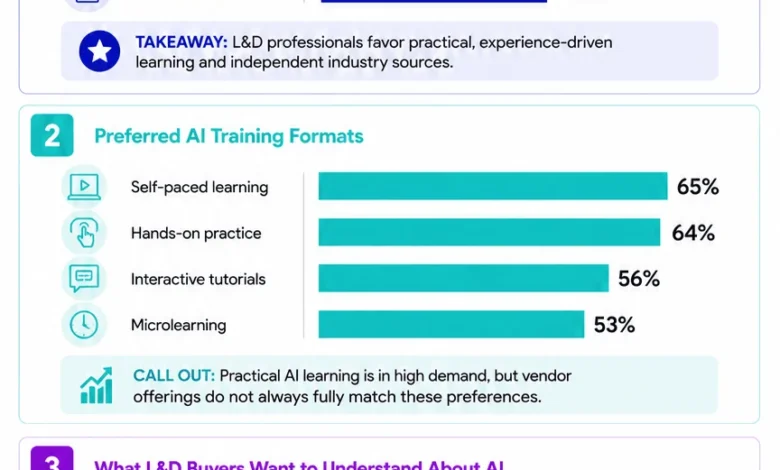
Perhaps the most effective method of learning is hands-on experimentation. Many forward-thinking organizations have adopted a "sandbox" policy, where L&D teams are given controlled environments to pilot AI features. By running small-scale experiments, teams can assess the efficacy of personalization algorithms or automated feedback loops before rolling them out to the entire workforce.
Implications for the Future of Enterprise Learning
The long-term implications of this adoption cycle are profound. As AI becomes an "expected capability," it will likely lose its status as a competitive differentiator, much like cloud storage or basic internet connectivity before it. The real differentiator will be the human element—the ability of L&D teams to leverage these tools to foster a culture of continuous, relevant, and trustworthy learning.
The "AI expectation gap" serves as a warning to both sides of the market. Vendors that continue to prioritize feature quantity over quality risk losing their customer base to more focused, utility-driven competitors. Conversely, L&D professionals who fail to upskill in AI governance and strategic implementation risk becoming obsolete.
The path forward requires a shift in mindset: from treating AI as a "magic button" that solves training problems, to viewing it as a powerful, yet complex, instrument that requires human oversight and clear strategic intent. As the industry matures, the focus will continue to migrate toward "Responsible AI." This encompasses not only the technical safety of the tools but also the ethical implications of how AI influences the career trajectories and learning experiences of employees.
Ultimately, the successful integration of AI in L&D is less about the technology itself and more about the maturity of the organization’s educational strategy. Companies that invest in the human capital of their L&D departments—prioritizing critical thinking, ethical AI use, and data-informed decision-making—will be the ones that thrive in an increasingly automated landscape. As the 2026 report demonstrates, the technology is readily available; the final challenge lies in the human capacity to apply it with purpose, precision, and trust.