The modern digital economy has fundamentally shifted the relationship between product providers and their user bases. In an era where subscription-based software and complex service ecosystems are the norm, the "buy and forget" model of consumer interaction has been rendered obsolete. Businesses now operate under the reality that the moment of purchase is merely the beginning of the customer journey. When users encounter friction—whether due to unintuitive interfaces or overly technical documentation—the business impact is immediate. It manifests as a surge in support tickets, a stagnation in feature utilization, or, in the most severe cases, total customer churn. To combat these challenges, organizations are increasingly turning to formalized customer education as a strategic pillar for long-term growth and stability.
The Evolution of Customer Education as a Business Imperative
Historically, customer training was viewed as a peripheral function, often relegated to technical support teams as a reactive measure to reduce call volumes. However, recent data from the 2024 Forrester Benchmark Report, which serves as a definitive analysis of the sector, confirms that customer education has evolved into a proactive revenue-generation tool. The shift began in the early 2020s, as companies realized that product-led growth (PLG) strategies were insufficient if users lacked the requisite knowledge to derive actual value from the software.
By 2025 and moving into 2026, the industry has reached a level of maturity where education programs are expected to be measurable, scalable, and directly tied to the bottom line. This transition is not merely cosmetic; it is a fundamental shift in corporate resource allocation. Organizations are now hiring dedicated customer education managers, investing in sophisticated Learning Management Systems (LMS), and integrating training pathways directly into the user onboarding experience.
Economic Impact and ROI: The Hard Data
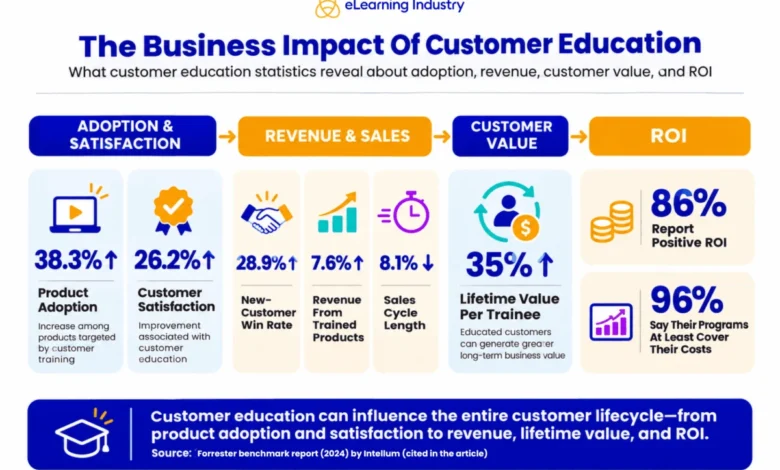
The skepticism that once surrounded the funding of training programs has largely been quelled by empirical evidence. The Forrester research indicates that the financial case for customer education is remarkably robust. An overwhelming 96% of organizations surveyed reported that their customer education programs successfully reached a break-even point, while 86% achieved a documented positive return on investment.
This economic viability is driven by a two-pronged mechanism: cost reduction and value expansion. On the cost side, effective training reduces the burden on customer support departments. By providing users with the tools to resolve their own queries through self-service portals and structured tutorials, companies reported a 15.5% decrease in support-related inquiries. On the revenue side, the impact is even more pronounced. The data shows that revenue specifically attributable to trained products grew by 7.6%, while the sales cycle shortened by 8.1%. These figures suggest that education is not a cost center, but an accelerator that removes friction from the purchasing and adoption process.
Driving Product Adoption and User Retention
The correlation between training and product stickiness is undeniable. According to the TSIA State of Education Services 2025 study, there is a clear behavioral divergence between trained and untrained customers. Roughly 68% of customers who participate in formal education programs report using the product with higher frequency, and 56% utilize a broader range of features compared to their untrained counterparts.
This data point is critical for companies operating on a "land and expand" model. If a customer only utilizes 10% of a software’s capabilities, they are highly susceptible to competitive poaching. Conversely, when training programs encourage users to master advanced features, the switching costs for the customer rise significantly. Furthermore, the Forrester report highlights a 35% increase in lifetime value (LTV) per trained customer. When customers feel competent and confident in their ability to manipulate a product to solve their specific business problems, their loyalty deepens, and their propensity to renew their subscription increases.
Strategic Metrics: Moving Beyond Vanity Numbers
As companies professionalize their approach to customer education, the criteria for success have become more rigorous. In the past, companies might have focused on "vanity metrics"—such as the total number of page views on a help document or the number of course registrations. While these metrics provide a baseline of activity, they fail to provide insight into whether the education is actually driving business results.

Current industry standards prioritize "value metrics." These include:
- Product Adoption Rates: Measuring the change in behavior post-training.
- Net Revenue Retention (NRR): Assessing the financial impact of renewals and upsells within trained cohorts.
- Support Ticket Deflection: Quantifying the direct savings in human capital costs.
- Customer Lifetime Value (LTV): Long-term financial assessment of trained users.
The integration of these metrics into business intelligence dashboards allows leadership teams to see exactly where education is contributing to the top and bottom lines. For example, a company might observe that while enrollment in a particular module is high, the completion rate is low. This suggests a failure in content engagement or accessibility, signaling that the educational material needs to be refined to better serve the user’s needs.
Chronology of Implementation and Expected Results
Organizations attempting to scale their education programs must manage expectations regarding the timeline of results. Customer education is not a "quick fix" for churn; it is a long-term investment in user capability.
- Short-Term (0–3 Months): Focus on tracking enrollments and basic engagement. Early results often appear in onboarding completion rates, which serve as a leading indicator of future success.
- Medium-Term (3–6 Months): Organizations should begin to see a shift in support ticket volumes and early-stage product adoption. At this stage, data should be cross-referenced to compare the behavior of trained versus untrained cohorts.
- Long-Term (6–12 Months): This is the window where the macro-economic effects—such as improved retention rates, higher Net Promoter Scores (NPS), and increased lifetime value—become statistically significant.
The Maturity Framework for Education Programs
A common mistake is assuming that a single training video or a rudimentary FAQ page constitutes a "program." Mature organizations utilize a tiered framework to evaluate their progress. At the lowest level, programs are reactive and decentralized. At the highest level of maturity, customer education is a cross-departmental engine that is deeply integrated into the product roadmap, sales strategy, and customer success workflows.
Leadership teams are encouraged to compare their internal metrics against industry benchmarks to identify gaps. If a company’s churn rate remains high despite having a training program, the issue likely lies not in the existence of the program, but in its accessibility or relevance to the user’s specific pain points.
Strategic Analysis: The Future of Customer Enablement
The data gathered throughout 2024 and 2025 suggests that customer education is moving toward hyper-personalization. As Artificial Intelligence becomes more integrated into learning platforms, the next phase of customer education will likely involve adaptive learning paths that suggest specific tutorials based on a user’s unique behavioral patterns within the product.
Furthermore, the emphasis on self-service is growing. Salesforce research confirms that 61% of customers now prefer self-service for simple issues, and 80% view the quality of the company’s support and education experience as being as important as the product itself. In this environment, the education program becomes a brand differentiator. It is no longer just about teaching a user how to click a button; it is about empowering them to be successful in their own roles.
In conclusion, the quantitative evidence is clear: businesses that treat customer education as a core strategic function realize superior financial outcomes. By focusing on measurable impact—such as reduced churn, increased feature adoption, and optimized support costs—companies can build a sustainable, resilient, and highly profitable relationship with their customers. As we progress further into 2026, the question for executives is no longer whether they can afford to invest in customer education, but whether they can afford the mounting costs of failing to do so.