Every customer interaction serves as a critical touchpoint that either fortifies brand loyalty or incrementally degrades consumer trust. In an increasingly competitive global marketplace, organizations are transitioning from treating customer support as a cost center to viewing it as a primary strategic asset. Consequently, robust customer relation training has become a cornerstone of both initial employee onboarding and sustained professional development. Modern training frameworks are no longer restricted to frontline support staff; they now encompass account managers, sales professionals, and billing departments, all of whom contribute to the collective customer experience.
The Strategic Imperative of Customer Relations
The evolution of customer relations training is driven by shifting consumer expectations. Today’s customers demand rapid, personalized, and empathetic solutions across an omnichannel landscape. According to recent industry reports, over 70% of consumers consider the quality of customer service to be a defining factor in their loyalty to a brand. Furthermore, research indicates that companies prioritizing high-level customer experience training see a 20% increase in employee engagement and a significant reduction in churn rates.
The historical context of this field shows a clear progression. In the early 2000s, training was largely script-based, focusing on standardized responses to common queries. However, the rise of social media and real-time feedback loops necessitated a move toward a more human-centric approach. Organizations that rely on rigid scripts often find their employees struggling when faced with complex, non-linear issues. The contemporary gold standard focuses on empowering representatives to exercise judgment, empathy, and technical proficiency, rather than simply adhering to a manual.
Core Competencies in Modern Service Training
A comprehensive training curriculum must balance soft skills with technical expertise. The following areas are considered essential for any high-performing team:
Active Listening and Cognitive Presence
Active listening is the bedrock of effective conflict resolution. Training modules now emphasize the importance of mirroring, summarizing, and verifying customer concerns. By training staff to listen for the "problem behind the problem," companies can reduce repeat contacts and improve first-call resolution rates.
Emotional Intelligence (EQ) as a Tactical Tool
EQ training allows representatives to navigate high-pressure interactions by identifying emotional cues in a customer’s voice or text. By de-escalating tension through validation rather than defensiveness, agents can maintain brand reputation even when a resolution is not immediately available.
Cross-Channel Communication Proficiency
The modern customer journey is fragmented across email, telephone, live chat, and social media. Training must account for the distinct etiquette required for each. For instance, the brevity required for SMS support differs significantly from the formal, detailed structure of an email response. Consistency in tone across these channels is essential for a unified brand identity.

Designing a Scalable Training Framework
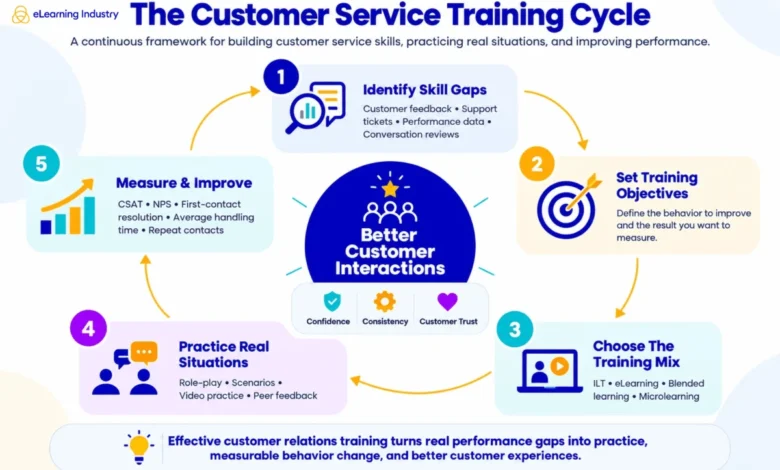
Developing an effective program requires a methodical approach that mirrors corporate operational standards. Industry leaders typically follow a five-phase lifecycle when implementing these programs:
- Gap Analysis: Utilizing sentiment analysis and CRM data to identify specific friction points in the customer journey. If data indicates a spike in complaints regarding refund processes, the training curriculum is prioritized to address that specific operational bottleneck.
- Objective Setting: Goals must be SMART (Specific, Measurable, Achievable, Relevant, and Time-bound). Rather than targeting "better service," organizations target "a 15% reduction in average handling time" or "a 10% increase in CSAT scores over two quarters."
- Format Selection: The decision between Instructor-Led Training (ILT), eLearning, or a blended model depends on organizational scale. For global enterprises, asynchronous eLearning provides the necessary consistency, while ILT remains superior for complex role-play exercises.
- Iterative Practice: The "learning-by-doing" approach is critical. Simulation software and peer-reviewed role-playing sessions ensure that theoretical knowledge translates into practical application.
- Impact Evaluation: Training success is verified through post-implementation metrics, including Net Promoter Score (NPS), Customer Effort Score (CES), and long-term retention data.
The Role of eLearning and Technology
Technological advancements have revolutionized how training is delivered. eLearning platforms now support microlearning—short, targeted bursts of information that can be accessed on demand. This approach is particularly effective for remote and hybrid teams, as it prevents "training fatigue" and ensures that information remains top-of-mind.
Scenario-based modules represent one of the most effective applications of current technology. These digital simulations force employees to make real-time decisions, allowing them to experience the consequences of their actions in a controlled environment. If an employee chooses an ineffective response in a simulation, the software provides instant feedback on how the interaction could have been handled more professionally. This "fail-safe" environment builds the confidence necessary for employees to manage complex real-world escalations.
Broader Implications and Future Trends
The integration of Artificial Intelligence (AI) is the next frontier in customer relations training. AI-driven sentiment analysis tools are being used to analyze thousands of recorded calls, identifying "best practice" moments that are then converted into training vignettes for new hires. This creates a continuous feedback loop where the training material is always representative of the current customer sentiment.
Furthermore, the rise of predictive analytics allows companies to forecast potential customer frustration before it occurs. By training employees to be proactive rather than reactive, organizations can transition from "problem solvers" to "customer success partners."
Summary of Performance Metrics
To ensure the long-term viability of these programs, stakeholders must monitor KPIs consistently. The consensus among industry experts is that a singular focus on speed is insufficient. Efficiency metrics, such as Average Handling Time (AHT), must be balanced against quality metrics, such as First Contact Resolution (FCR) and Customer Satisfaction (CSAT).
When a company invests in its human capital through structured customer relation training, the implications extend beyond the support department. Improved service levels correlate directly with higher lifetime value (LTV) for customers and increased employee retention. As the market continues to favor companies that prioritize the human element of business, the design of these training programs will remain a vital indicator of organizational maturity and competitive endurance.
Ultimately, the most successful companies are those that view every interaction as a data-rich opportunity to learn, adapt, and refine their service delivery. By combining data-driven insights with empathetic training, organizations can build a resilient culture capable of navigating the complexities of the modern digital economy.