Bureau of Labor Statistics Projections Through 2035 Reveal Structural Labor Shortages and the Rise of the AI Superworker

The narrative surrounding artificial intelligence and the future of work has long been dominated by dystopian predictions of mass unemployment and widespread job displacement. However, newly released data from the federal government suggests a fundamentally different economic reality. According to the Bureau of Labor Statistics (BLS) Employment Projections for the 2025–2035 decade, the United States economy is bracing not for a surplus of idle workers, but rather for chronic, systemic labor shortages. This looming imbalance is driven by a unique convergence of macroeconomic factors: a sharply slowing population growth rate, an aging national workforce, restrictive federal immigration policies, and an ambitious national GDP growth trajectory that heavily outpaces the expansion of the available labor pool.
To bridge this widening economic gap, enterprises across all major sectors will be forced to aggressively accelerate their artificial intelligence and automation transformation agendas. Rather than simply obliterating the human workforce, the integration of advanced technologies is poised to fundamentally restructure the nature of employment, giving rise to what workforce analysts describe as the "Superworker."
Main Facts and Macroeconomic Realities
At the heart of the latest federal economic forecast is a striking mathematical divergence between national productivity expectations and human capital availability. Over the upcoming ten-year period, the overall United States labor market is projected to expand by a modest 3.5 percent. Concurrently, however, the national Gross Domestic Product (GDP) is anticipated to surge by an impressive 22 percent.
This stark discrepancy requires a dramatic escalation in labor productivity—estimated at nearly 2 percent growth annually. To achieve this output without a proportional expansion in headcount, businesses must rely heavily on technological innovations, most notably generative AI and intelligent automation.
Yet, the macro-environment presents significant structural hurdles to workforce expansion. The deceleration of labor growth to just 3.5 percent over the decade represents a significant slowdown—nearly one-third slower than the 10.9 percent growth rate recorded during the previous decade. Economists attribute this constrained supply to three primary demographic and policy drivers: declining national birth rates, an increasingly aged domestic population, and tightening federal anti-immigration policies. As noted by economic observers, including analyses from publications like The Economist, strict immigration crackdowns severely limit the influx of working-age adults needed to sustain labor-demographic equilibrium, compounding the impending shortages.

Chronology and Demographic Shifts: An Aging America
The transformation of the American workforce is deeply rooted in long-term demographic shifts that have been developing over the past quarter-century. As the massive Baby Boomer generation continues to age past traditional retirement benchmarks, the age distribution of the United States labor market is undergoing a historic inversion.
By the year 2035, workers aged 65 and older will constitute approximately 8.5 percent of the total workforce, up from 7 percent today. This specific demographic segment is projected to grow at a staggering 21 percent rate—roughly seven times the growth rate of the overall workforce.
This aging trend is further complicated by economic necessity. Recent studies conducted by the American Association of Retired Persons (AARP) indicate that roughly 10 percent of Americans over the age of 65 are choosing to "unretire," returning to the active labor market to offset rising living costs and elongate their professional careers.
For corporate leadership, human resources departments, and Chief Human Resources Officers (CHROs), this longevity shift mandates an urgent pivot toward generational diversity programs. Persistent systemic barriers, including age discrimination in hiring practices and compensation structures, continue to marginalize older employees. Data reveals that nearly a quarter of workers over the age of 50 feel they have been left behind by modern hiring practices. Addressing this disparity will be a foundational requirement for organizations attempting to mitigate labor shortages over the next decade.
Supporting Data: Healthcare Dominance and Sector-Specific Disparities
A granular examination of the BLS taxonomy—encompassing roughly 830 distinct job titles—reveals that labor market growth will not be distributed evenly across industries. Instead, growth will be heavily concentrated in sectors requiring profound human empathy, physical presence, and specialized care.
Healthcare and home health services will unequivocally dominate United States labor market expansion through 2035. The healthcare sector alone is projected to account for roughly 37 percent of all total job growth nationwide, expanding its overall share of the United States employment market from 13.3 percent to 14 percent.
Within this domain, home health and personal care aides are projected to account for a workforce of 5.5 million individuals, representing an 18 percent growth rate. Registered nurses will comprise approximately 3.7 million positions, experiencing some of the highest percentage wage growth across any segment of the economy. Furthermore, demand for nurse practitioners is expected to skyrocket by 41 percent, with average compensation projected to climb from $132,000 to an estimated $181,000 annually.
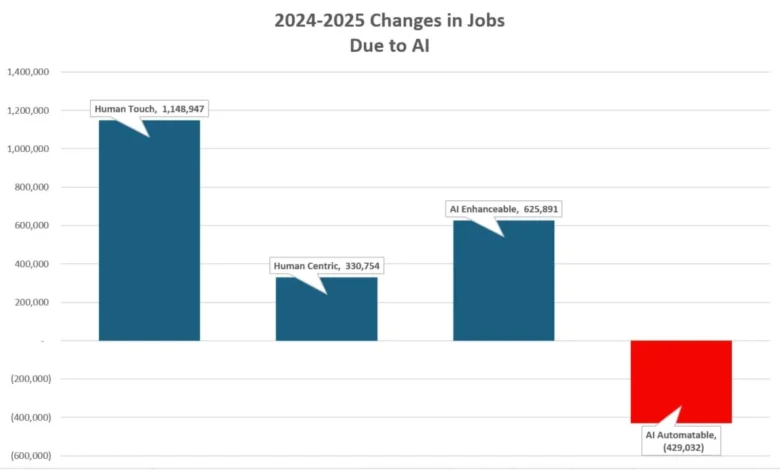
Conversely, routine administrative, clerical, and low-wage support functions face rapid displacement. Analysts categorize the BLS occupational taxonomy into four distinct groups: human-touch, human-centric, AI-enabled, and AI-automated. Job titles experiencing the most precipitous declines include cashiers, data entry clerks, bookkeepers, secretaries, receiving clerks, retail managers, and bank tellers. Current estimates indicate that AI possesses the technological potential to fully automate approximately 13 percent of existing jobs.
However, this transition is evolutionary rather than revolutionary. Historical data from the preceding year indicates that total job destruction via automation amounted to merely one-third of a percent of the total workforce, demonstrating that structural job loss occurs at a measured, gradual pace rather than an instantaneous cliff.
Official Responses and Strategic Industry Analysis
Corporate executives, labor economists, and workforce strategists have increasingly rallied around the concept of the "Superworker" to contextualize the changing technological landscape. Rather than replacing entire professions, artificial intelligence is increasingly viewed as an operational multiplier that strips away repetitive administrative burdens, allowing professionals to focus on higher-order problem-solving.
In knowledge-intensive sectors, the integration of artificial intelligence is redefining traditional job families. For instance, software engineers utilizing advanced AI coding assistants are transitioning from tactical "programmers" into strategic product leaders and system architects. Similarly, Human Resources Business Partners (HRBPs) leverage AI to instantly retrieve data and compliance policies, elevating their day-to-day responsibilities into high-level organizational consulting and advisory roles. These "AI-enabled" job families are currently seeing wage growth rates that outpace inflation by a factor of two.
Simultaneously, "human-centric" and "human-touch" professions—which collectively comprise roughly 61 percent of the total United States workforce—remain fundamentally secure and increasingly valuable. Roles requiring physical dexterity, manual skill, and interpersonal empathy, such as electricians, plumbers, construction laborers, counselors, and psychologists, are experiencing robust demand. Additionally, emerging high-growth industries spanning advanced energy and power production, aerospace engineering, health sciences, and bio-engineering are creating entirely new employment categories that require specialized training and education.

Management, sales, and educational professions are likewise projected to maintain long-term stability. Despite early speculation that automated workflows would eliminate middle management entirely, federal forecasts indicate that management roles will continue to expand. The proliferation of "Superworkers" inherently necessitates the presence of skilled, strategic "Supermanagers" capable of guiding dynamic, cross-functional teams through continuous technological disruption.
Broader Impact and Organizational Implications
The convergence of slow demographic growth, aggressive GDP output targets, and rapid technological integration carries profound implications for organizational leadership. Chief Executive Officers and CHROs can no longer view artificial intelligence merely as a cost-cutting tool for workforce reduction. Instead, technology must be deployed as a critical productivity enhancer designed to offset chronic labor shortages.
This macroeconomic environment requires the evolution of what organizational design experts term the "Dynamic Organization"—an agile corporate structure capable of rapidly retraining existing talent, adapting to shifting skills requirements, and fostering continuous learning environments. Because total workforce expansion is restricted by low birth rates and restrictive immigration policies, corporate sustainability will depend heavily on talent retention, internal mobility, and the optimization of existing human capital.
Ultimately, the Bureau of Labor Statistics projections for 2035 debunk the narrative of inevitable, catastrophic technological unemployment. While routine administrative tasks will inevitably vanish, they will be systematically replaced by redefined roles that demand critical thinking, emotional intelligence, and advanced technological collaboration. For businesses, policymakers, and workers alike, the coming decade will not be defined by a lack of work, but by a continuous race to adapt human capability to an increasingly automated world.