What Kind of Chief Purpose Officer Does Your Company Need
In the contemporary corporate landscape, a growing number of multinational enterprises and forward-thinking businesses are embracing a formal corporate purpose, moving beyond traditional profit maximization to address broader social and environmental challenges. Yet, translating these lofty declarations into everyday strategy, corporate culture, and operational decisions remains a formidable hurdle. Underlying this strategic friction is a fundamental organizational question: Who bears the ultimate responsibility for ensuring that a stated purpose is actively operationalized rather than left as mere rhetoric?
To bridge the gap between corporate philosophy and daily execution, organizations worldwide are increasingly introducing a novel position to the executive suite: the chief purpose officer (CPO). High-profile corporations, including technology giant Cisco, professional services network Deloitte, and transatlantic carrier Virgin Atlantic, have appointed CPOs to spearhead their institutional values. This emerging trend signals a profound shift in corporate governance, recognizing that purpose-driven initiatives require dedicated, high-level leadership to thrive in competitive global markets.
The Rise of Purpose Leadership and Empirical Findings
The evolution of the CPO role marks a significant milestone in modern organizational development. While corporate social responsibility (CSR) and environmental, social, and governance (ESG) reporting have historically been managed by legal, marketing, or sustainability departments, the modern CPO operates closer to the core of strategic decision-making.
Recent empirical research sheds light on this executive phenomenon. A comprehensive study examining 56 prominent CPOs reveals that these leaders do not conform to a single mold. Instead, their operational approaches vary widely depending on the maturity of their organization’s purpose journey, the structural complexity of the enterprise, and the specific strategic objectives they are tasked to achieve.
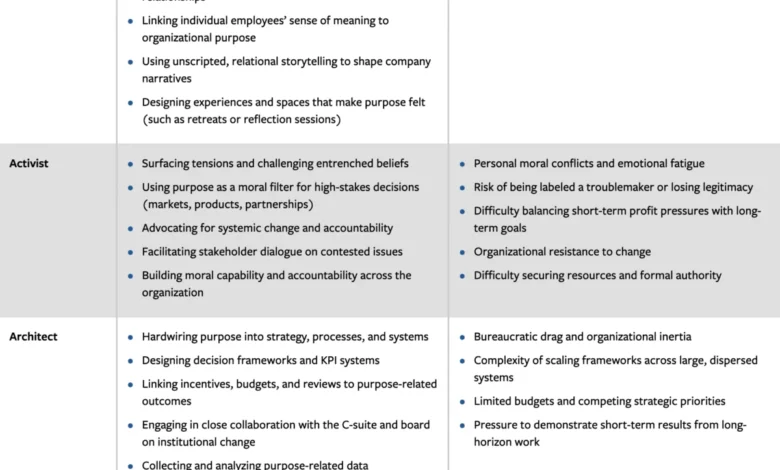
According to the study’s coauthors—Albena Björck, associate professor and head of the Purpose-Inside Lab at the ZHAW School of Management and Law, and Nicole Steller, assistant professor at ESCP Business School—effective purpose leadership requires aligning the right executive profile with the organization’s current developmental stage. Their findings identify four distinct CPO archetypes: the visionary, the activist, the architect, and the PR strategist. Each leadership style addresses unique organizational needs while encountering distinct execution barriers that can cause purpose initiatives to stall.
Unpacking the Four CPO Archetypes
Understanding the nuances of each leadership style is essential for boards of directors and chief executive officers aiming to successfully integrate purpose into their business models.
1. The Visionary CPO
Accounting for 39% of the studied sample, visionaries represent the largest group of CPO archetypes. They most frequently emerge in smaller, family-owned, or founder-led enterprises where core values are deeply embedded in the organizational DNA but lack explicit strategic articulation.
For visionary CPOs, purpose is viewed as an ethical and social obligation. Rather than focusing on external communications, these leaders concentrate inward, helping employees connect with the company’s mission on a deep emotional level. Their leadership style relies heavily on relational soft power, personal networks, and informal rituals—such as team reflections, wellness retreats, and regular dialogue circles—rather than rigid corporate mandates.
While effective at fostering a profound sense of belonging and cultural cohesion, visionary CPOs often struggle to gain traction within the traditional C-suite. Their work is frequently misconstrued as a secondary "nice-to-have" function rather than a critical driver of financial performance. To overcome this barrier, visionary leaders must learn to articulate how emotional engagement translates into tangible business outcomes, such as improved employee retention and enhanced customer loyalty.
2. The Activist CPO
Comprising approximately one-fifth of the surveyed leaders, activist CPOs operate on the turbulent front lines of large-scale corporate transformations. Stationed primarily within complex, multinational organizations plagued by competing stakeholder demands, activist leaders serve as moral compasses. Their explicit mandate is to challenge the institutional status quo, interrogate corporate drift, and prevent ethical blind spots.

Activist CPOs utilize a bold, unapologetic leadership style. They are known for posing uncomfortable questions during executive meetings, such as challenging the financial viability of lucrative markets that clash with corporate values or halting product launches that contradict stated sustainability goals.
The primary challenge for activist CPOs lies in maintaining professional legitimacy. Navigating the fine line between principled advocacy and disruptive confrontation is delicate; pushing too aggressively without building broad coalitions can lead to institutional marginalization and severe moral fatigue. Conversely, achieving sustainable cultural transformation requires cultivating strategic alliances over extended periods, gradually embedding ethical considerations into standard investment and strategy evaluations.
3. The Architect CPO
Representing roughly one-quarter of the studied executives, architect CPOs typically operate at the senior levels of large, mature multinational corporations. In these environments, formal purpose statements already exist but require structural reinforcement to become operational across diverse global regions.
Architects view themselves as institutional engineers. Rather than relying on bottom-up emotional inspiration or top-down moral confrontation, they hardwire purpose directly into governance structures, performance management systems, and financial incentive programs. For instance, former Roche Pharma India CPO Lara Bezerra successfully linked executive compensation and departmental metrics directly to patient health outcomes and community impact.
By designing dual-key performance indicator (KPI) systems that track both traditional financial returns and socio-environmental metrics, architect CPOs ensure that a company’s commitment to purpose outlasts the tenure of individual leaders. Their primary obstacles include bureaucratic inertia, competing short-term financial pressures, and the challenge of maintaining simplicity within complex administrative frameworks.
4. The PR Strategist CPO
Making up 16% of the sample, PR strategists represent the smallest cohort of the studied CPO demographic. These executives typically emerge in large, highly dispersed, brand-driven organizations where the primary objective is to craft a cohesive, repeatable narrative that aligns internal culture with external public reputation.
Drawing heavily on professional backgrounds in corporate communications, marketing, and branding, PR strategists excel at amplifying employee voices, integrating social commitments into product portfolios, and positioning the corporate brand advantageously within global markets.
Despite their proficiency in narrative construction, PR strategists frequently encounter structural limitations. Lacking the formal authority to reshape internal operational systems, they run the risk of functioning merely as corporate figureheads. In environments where purpose has not been genuinely operationalized, an overreliance on messaging can inadvertently foster "purpose-washing"—a phenomenon that ultimately triggers internal identity crises, erodes stakeholder trust, and undermines ethical integrity.
Strategic Alignment: Determining the Best Fit
Selecting the appropriate CPO archetype requires a rigorous internal assessment by executive boards and CEOs. According to the Purpose Leadership Fit framework, organizational leaders must evaluate their current developmental trajectory by addressing a fundamental tripartite question: Are we attempting to renew our organizational culture, realign our overarching strategy, or rebuild external trust?
- Cultural Renewal: For early-stage or founder-led firms seeking to build foundational awareness, the visionary CPO represents the optimal fit. Success in this environment depends on establishing informal trust networks and utilizing credible metrics to link cultural engagement to workforce retention.
- Strategic Realignment: For large organizations undergoing complex transformations where leadership welcomes constructive friction, the activist CPO is best suited to drive accountability. Success requires securing visible sponsorship from executive leadership and establishing psychologically safe channels for dissent.
- Systemic Integration: For mature multinationals looking to institutionalize values permanently, the architect CPO provides the necessary structural foundation. Success relies on designing straightforward, bureaucracy-resistant governance frameworks and aligning financial incentives with stakeholder value.
- Reputational Positioning: For brand-driven enterprises with fully operationalized purpose models, the PR strategist CPO ensures that internal culture and external public perception remain harmonized. Success is achieved by grounding communication campaigns in verified, concrete operational outcomes.
Broader Implications and Future Outlook
The institutionalization of the chief purpose officer role reflects a maturing corporate recognition that long-term enterprise value is inextricably linked to societal impact. However, the presence of distinct leadership archetypes underscores that there is no universal blueprint for corporate purpose.
As the business environment continues to evolve under increasing regulatory scrutiny and shifting consumer expectations, organizations must carefully diagnose their current institutional maturity before appointing executive leadership. Ultimately, the overarching objective of an effective CPO is not to serve as a permanent fixture of corporate bureaucracy, but rather to institutionalize purpose so thoroughly within the fabric of the organization that their specialized leadership role eventually becomes self-sustaining and organically integrated into the daily practice of every employee.