Unlocking the Kernels of Reinvention: How Established Enterprises Pivot Without Starting From Scratch
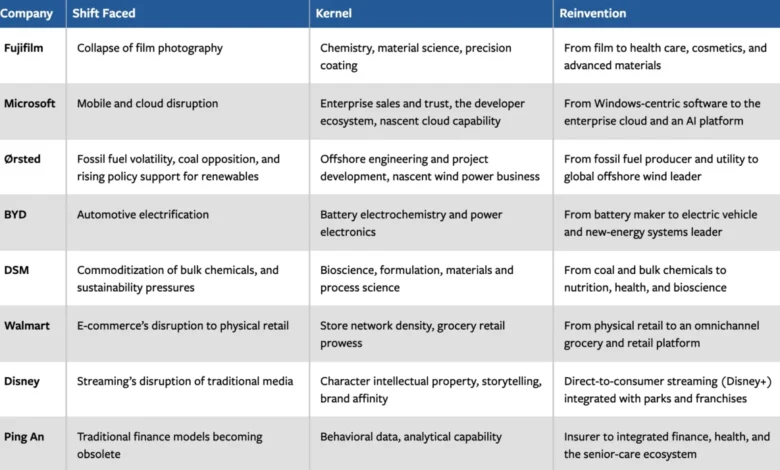
When technological disruptions, tightening regulations, and shifting societal demands redraw the boundaries of global commerce, legacy companies face a daunting existential puzzle. Choosing how to respond is rarely straightforward. On one hand, incumbents can double down on their historical strengths, doubling efforts to innovate around the core by extending existing products, technologies, and business models into adjacent spaces. On the other hand, attempting a complete pivot by starting from a clean slate introduces immense hazards, often forcing an enterprise to discard valuable institutional knowledge, robust stakeholder relationships, and specialized resources that could have offered a decisive competitive advantage in entirely new markets.
According to research by Khaled Soufani and Samsurin Welch of the Cambridge Judge Business School, leaders who successfully navigate these turbulent waters avoid the extreme traps of either absolute preservation or radical reinvention from scratch. Instead, successful corporate reinvention relies on identifying and leveraging hidden organizational assets. The authors define these foundational pillars as "kernels of reinvention"—deep-seated competencies, embedded within an organization, that can be effectively repurposed to power a brand-new strategic direction.
The Dilemma of the Incumbent
The challenge of business model transformation has long been a central concern in strategic management. Classical frameworks illuminate different facets of this ongoing corporate struggle. Clayton Christensen’s seminal work on disruptive innovation, for instance, details why industry leaders routinely get trapped by listening too closely to existing customers while ignoring low-end or emerging technologies. Meanwhile, theories of market creation illustrate how companies can unlock uncontested commercial spaces, while broader academic inquiry into organizational renewal highlights the intense cultural and systemic barriers that make structural change agonizingly difficult.
Despite these theoretical roadmaps, practicing executives are continually whipsawed between the risks of rigid stagnation and the dangers of volatile transformation. The cautionary tale of Eastman Kodak remains a textbook example of the perils of clinging too tightly to a legacy formula. For decades, Kodak dominated photographic film, failing to capitalize early enough on the digital photography revolution it actually helped invent. Conversely, throwing out the playbook entirely to launch a startup-style pivot risks alienating core customer bases, confusing investors, and destroying existing supply chain efficiencies.
To understand how modern enterprises can break through this strategic paralysis, business historians and economists frequently look to monumental corporate transformations that successfully bridged the gap between legacy operations and future-proof business models.
The Evolution of Ørsted: From Black to Green
A prime illustration of identifying and scaling a kernel of reinvention is the remarkable transformation of Ørsted, the Danish multinational power company formerly known as DONG Energy (Dansk Olie og Naturgas). In 2009, DONG Energy was overwhelmingly tethered to fossil fuels. As Denmark’s largest utility and single largest carbon dioxide emitter, roughly 85% of its power generation relied directly on coal, oil, and gas.
The company was caught in a severe strategic vise. Operationally, it faced extreme exposure to the volatile price swings of global commodity markets. Politically and socially, it confronted fierce public opposition to the construction of new coal-fired power plants amid a rising tide of environmental awareness across Europe. Simultaneously, a sweeping global energy transition was beginning to reshape the utility sector, creating massive long-term opportunities for renewable power generation.
For DONG’s executive leadership, the writing was on the wall: the core business model was financially and environmentally untenable in the long run. The central question was not whether the company needed to transform, but how it could execute such a massive pivot without collapsing under its own weight.
Rather than abandoning its foundational identity entirely or attempting to build a renewable energy division with zero prior context, leadership initiated an internal audit of the enterprise’s existing asset base and operational history. Buried within the company’s diverse portfolio was a pioneering asset: DONG had constructed the world’s first-ever offshore wind farm, Vindeby, in 1991. Though small in scale compared to its massive fossil fuel operations, that early venture represented a critical kernel of reinvention.
The Chronology of a Green Transformation

The institutional pivot executed by DONG Energy—which officially rebranded as Ørsted in 2017—did not happen overnight. It required a meticulously managed, decade-long transition plan backed by structural divestments and heavy capital reinvestment.
In the early 2010s, Ørsted’s leadership initiated a series of strategic maneuvers designed to systematically wind down fossil fuel dependency while scaling up offshore wind capabilities. The timeline of this corporate metamorphosis highlights key operational milestones:
- 2009–2010: Leadership declares a formal strategic shift toward decarbonization, setting ambitious internal targets to reverse the ratio of fossil-based to renewable energy production.
- 2012–2013: The company begins divesting from non-core oil and gas exploration assets, channeling capital and specialized engineering talent away from traditional extraction and toward marine infrastructure development.
- 2014–2015: Ørsted scales up capital expenditures dedicated to offshore wind projects across the North Sea and the UK coastline, leveraging its decades of offshore maritime experience gained from North Sea oil and gas drilling platforms.
- 2016: The company successfully executes a massive initial public offering (IPO), signaling to global capital markets that its green transition strategy is commercially viable and scalable.
- 2017: DONG Energy officially changes its name to Ørsted, named after the Danish scientist Hans Christian Ørsted, marking the completion of its symbolic and operational break from fossil fuels.
- 2020s: Ørsted achieves its status as the world’s largest developer of offshore wind power, operating a global portfolio spanning Europe, North America, and the Asia-Pacific region.
Data and Economic Implications
The financial trajectory of Ørsted’s reinvention offers compelling data for economists and corporate strategists alike. By systematically repurposing maritime engineering competencies, supply chain logistics networks, and offshore project management skills—all originally forged in the oil and gas sector—the company avoided the astronomical failure rates typically associated with greenfield technology startups.
Data compiled by enterprise transformation analysts indicates that companies retaining core institutional competencies during a business model pivot experience a significantly lower cost of capital during transition phases compared to firms that attempt to reinvent themselves through purely inorganic acquisitions or ungrounded diversification. By utilizing existing internal talent pools, Ørsted maintained operational continuity while retraining thousands of petroleum engineers to design, construct, and maintain massive offshore wind turbines.
Broader Business Implications for the AI and Digital Era
The lessons derived from Ørsted’s pivot, as well as parallel technological transformations seen in major software and manufacturing firms, extend far beyond the energy sector. In the contemporary economic landscape—marked by generative artificial intelligence, rapid automation, and shifting geopolitical trade frameworks—executives across every industry are grappling with structural obsolescence.
When legacy enterprises evaluate how to integrate emerging technologies like artificial intelligence or adapt to circular economy mandates, the instinct is often to purge existing staff and culture in pursuit of digital-native agility. However, research by Soufani and Welch suggests that this approach frequently destroys the very institutional memory and execution muscle required to scale new ventures successfully.
Corporate leaders are increasingly advised to conduct comprehensive internal audits to uncover dormant or underutilized competencies. Whether a traditional manufacturer possesses world-class logistics data that can be monetized as a software service, or a media conglomerate holds archival assets prime for AI-driven content personalization, the path forward relies on identifying these embedded kernels of reinvention.
Official Responses and Strategic Consensus
Industry observers and management theorists have widely endorsed the focus on internal capability mapping as a superior alternative to disruptive shocks. Corporate governance experts emphasize that investors increasingly favor clear, methodical transition narratives over sudden, uncalculated strategic pivots.
When established enterprises clearly articulate how legacy assets will serve as the launchpad for future growth, market confidence tends to stabilize. By honoring the past while aggressively building for the future, companies can navigate systemic disruption without losing their operational footing. Ultimately, the successful corporate survivors of the coming decades will not be those that erase their histories, but those wise enough to decode their hidden strengths and convert them into tomorrow’s competitive advantage.