Bureau of Labor Statistics Employment Projections 2025-2035 Reveal Unexpected U.S. Labor Shortages Amid Rapid AI Growth

The prevailing narrative surrounding artificial intelligence and the future of work has long been dominated by dystopian visions of mass unemployment and widespread job obsolescence. However, comprehensive new federal data suggests a fundamentally different economic reality. According to the Bureau of Labor Statistics (BLS) Employment Projections for the 2025–2035 decade, the United States economy is bracing not for a surplus of idle workers displaced by algorithms, but rather for severe, structural labor shortages. This impending mismatch between labor supply and economic output is poised to force a profound re-evaluation of corporate strategy, workforce demographics, and the integration of automation technologies across all major industries.
The core tension highlighted in the federal projections lies in the divergence between labor force growth and gross domestic product (GDP) expansion. Over the next ten years, the United States labor market is projected to grow by a modest 3.5 percent. Simultaneously, the broader economy, fueled by anticipated gains in technological efficiency and artificial intelligence integration, is expected to see GDP surge by approximately 22 percent. This macroeconomic equation dictates an annual labor productivity growth rate of nearly 2 percent. To bridge this substantial gap, corporate leadership teams and human resources executives will be under intense pressure to accelerate artificial intelligence transformation agendas, not necessarily to replace human workers, but to augment their output.
Understanding the Chronology and Demographic Shifts
The roots of the current labor market trajectory stretch back through decades of demographic transitions. For much of the late twentieth century, the U.S. workforce enjoyed robust expansion driven by the entry of the Baby Boomer generation and rising female labor force participation. By the early 2000s, however, birth rates began a steady decline, a trend that accelerated following the 2008 financial crisis. Concurrently, the workforce began aging at an unprecedented pace, setting the stage for the demographic bottlenecks visible in the 2025–2035 projections.
Recent legislative and administrative actions have further compounded these domestic demographic pressures. Federal immigration policies enacted over recent years have significantly constrained the inflow of foreign-born workers, a segment that historically filled critical gaps in agriculture, construction, hospitality, and healthcare. Economic analysts, including those at major financial publications, have repeatedly warned that these immigration restrictions exacerbate existing labor constraints. Consequently, the slowdown in labor force growth—pegged at a meager 3.5 percent over the coming decade, or roughly one-third the 10.9 percent growth rate of the previous decade—is driven by a confluence of three distinct factors: restrictive immigration frameworks, historically low birth rates, and an aging population.
The Aging Workforce and the Rise of the Unretirement Trend

As the population ages, the age distribution of the workforce is undergoing a structural transformation. Individuals aged 65 and older represent one of the fastest-growing segments of the labor force. Current federal data indicates that workers over 65 comprise roughly 7 percent of the workforce. Over the next ten years, this figure is projected to rise to 8.5 percent, representing a 21 percent growth rate—seven times the pace of the overall workforce growth.
This graying of the labor pool is accompanied by changing social and economic behaviors among older Americans. Data compiled by organizations such as AARP demonstrates that nearly 10 percent of workers aged 65 and older are choosing to unretire, returning to the labor market to cope with the rising cost of living, inflation, and a desire for continued engagement. This trend is expected to elongate the traditional career lifecycle, creating both opportunities and challenges for employers.
For human resources professionals, the aging workforce necessitates an immediate overhaul of talent management practices. Studies on workplace equity frequently highlight persistent age discrimination in hiring and compensation practices. With nearly a quarter of workers over the age of 50 reporting that they feel left behind in modern professional environments, organizations must implement robust generational diversity programs. Eliminating age bias is no longer merely a matter of regulatory compliance; it is an economic imperative for companies desperate to retain institutional knowledge and mitigate labor shortfalls.
Sector Analysis: The Dominance of Healthcare and Home Care
A granular examination of the BLS sectoral projections reveals that employment growth will be heavily concentrated in human-centric fields, most notably healthcare and personal assistance. As the population ages, the demand for medical and support services is scaling exponentially, completely reshaping the employment landscape.
Home health and personal care aides are projected to account for millions of workers, with this segment alone growing by approximately 18 percent over the decade. Registered nurses will represent a massive segment of the labor force, numbering around 3.7 million professionals, and are projected to experience some of the highest wage growth by percentage across the entire economy. Furthermore, advanced practice roles, such as nurse practitioners, are anticipated to see job numbers surge by 41 percent, with average wages climbing significantly from historical baselines to approximately $181,000 annually.
In total, healthcare and social assistance will account for roughly 37 percent of all net job growth in the United States. Overall employment within the healthcare sector is projected to expand from 13.3 percent to 14 percent of the total U.S. employment base. This massive expansion underscores the fundamental truth that while technology can streamline administrative workflows, the hands-on care required by an aging population remains strictly dependent on human labor.
The "Superworker" Effect: Automation versus Augmentation
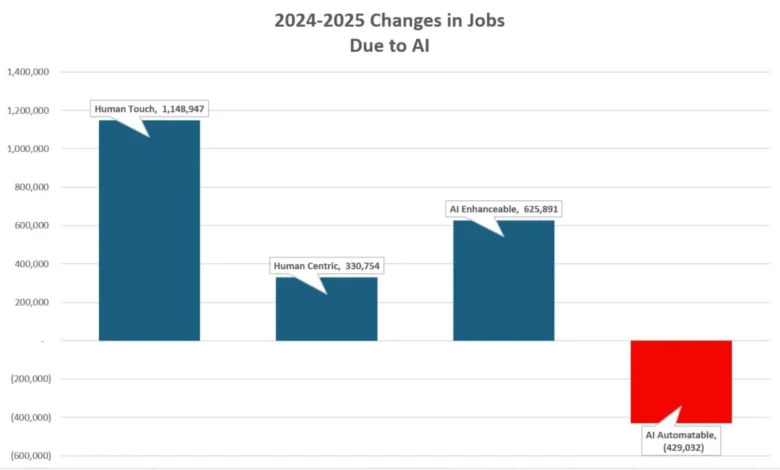
To better understand how artificial intelligence intersects with occupational trajectories, labor analysts have categorized the 830 distinct job titles within the BLS taxonomy into four primary groups: human-touch, human-centric, AI-enabled, and AI-automated.
The empirical findings challenge apocalyptic predictions of immediate, universal job destruction. Today, approximately 61 percent of all U.S. jobs involve human-touch or human-centric work—roles that require physical dexterity, spatial reasoning, empathy, active listening, teaching, or emotional support. Conversely, roughly 13 percent of jobs possess characteristics that render them fully susceptible to automation by current and near-term artificial intelligence technologies. The remaining segment comprises roles that will be profoundly enhanced by technology.
Rather than eliminating employment outright, artificial intelligence is instigating what labor economists describe as the "Superworker" effect. Routine administrative tasks—such as data entry, basic bookkeeping, cash handling, and standardized customer service inquiries—are increasingly absorbed by software algorithms and automation tools. Consequently, job titles associated with these repetitive functions, including cashiers, administrative assistants, tellers, and routine data processors, are experiencing steady declines in both headcount and relative wage growth.
However, the individuals occupying these shifting roles are not automatically cast into permanent unemployment. Instead, the elimination of tedious clerical tasks allows workers to focus on the core competencies of their professions. For instance, a software programmer utilizing advanced generative AI coding assistants transitions from a mere line-of-code writer into a high-level product architect and problem solver. Similarly, human resources business partners equipped with AI diagnostic tools are liberated from manually searching through policy manuals, elevating their day-to-day responsibilities to strategic organizational advising.
Stable Sectors and Emerging Industries
While administrative and clerical roles contract, other vital segments of the labor market demonstrate remarkable resilience and growth. Contrary to early hypotheses suggesting that artificial intelligence would eliminate middle management entirely, the BLS projections indicate continued growth in management positions. The proliferation of "Superworkers" creates a corresponding demand for "Supermanagers" capable of orchestrating complex, technology-augmented teams.

Sales professions are also undergoing bifurcation. While standard retail sales positions face moderate contractions due to the rise of e-commerce and automated checkout systems, high-value, consultative sales roles are expanding. Similarly, educational instruction remains stable despite slowing birth rates, driven by an insatiable societal demand for continuous reskilling, specialized training, and new modes of digital learning.
Beyond traditional sectors, rapid employment growth is anticipated in emerging industries tied to national infrastructure, energy transitions, and advanced sciences. Fields such as renewable energy production, aerospace manufacturing, health sciences, and bio-engineering are projected to add significant numbers of high-wage, specialized jobs over the 2025–2035 timeframe.
Economic Implications and Strategic Imperatives for Leadership
The overarching conclusion drawn from the 2025–2035 BLS employment projections is that the primary economic constraint facing the United States in the coming decade will not be a lack of jobs, but a severe shortage of qualified workers. This supply-demand imbalance carries profound implications for business leaders, policymakers, and labor organizations.
For chief executive officers and chief human resources officers, the strategic mandate requires pivoting from cost-cutting paradigms to productivity and talent optimization frameworks. Building a "Dynamic Organization"—an enterprise agile enough to continuously reskill its workforce, integrate emerging technologies, and adapt to shifting demographic realities—will determine corporate survival. Companies across manufacturing, logistics, retail, hospitality, and healthcare must invest heavily in internal mobility, continuous learning pipelines, and employee engagement initiatives to retain scarce talent.
Furthermore, the data demonstrates that wage premiums are shifting decisively toward "Superworker" job families. Positions that effectively leverage artificial intelligence to enhance human capabilities are experiencing wage growth that outpaces inflation. This dynamic risks exacerbating economic polarization between knowledge-intensive, technology-enabled professions and non-technological labor sectors unless proactive measures are taken to broaden access to advanced training and educational opportunities.
As the economy navigates the complex interplay between demographic decline and technological acceleration, the modernization of labor strategies is paramount. The coming decade will test the adaptability of American institutions, requiring a delicate balance between aggressive technological integration and an unwavering commitment to human-centric workforce development.